


Walumbe : The Ganda Spirit of Death and Disease
Listen
At a glance
| Description | |
|---|---|
| Origin | Baganda Mythology |
| Classification | Spirits |
| Family Members | Ggulu (Father), Nambi (Sister), Kayikuzi (Brother) |
| Region | Uganda |
| Associated With | Death, Disease, Mortality, Underground realms, Earthquakes |
The Mythlok Perspective
In Mythlok’s perspective, Walumbe represents death not as punishment but as proximity. His myth suggests that mortality enters the world not through human failure alone, but through a breakdown in cosmic boundaries. Death arrives because it is allowed to walk alongside life, not because life deserves it. This places responsibility not on individual sin, but on balance and vigilance. Across cultures, Walumbe mirrors figures such as Yama in Indian traditions and Mot in ancient Levantine lore, both of whom govern death as an ordered force rather than chaotic destruction. What distinguishes Walumbe is his unfinished pursuit. Unlike underworld judges who rule from fixed domains, he remains hidden within the living world itself, reminding humanity that death is never elsewhere. It is always beneath our feet.
Walumbe
Introduction
Walumbe occupies a central and unsettling place in the Ganda creation narrative that explains why death exists in the human world. Within the legend of Kintu, the first man, Walumbe is not an abstract idea but a conscious presence whose arrival on earth permanently alters the fate of humanity. He is introduced as the son of the sky god Ggulu and the brother of Nambi, who chooses to descend from heaven to live with her husband Kintu. Against his father’s explicit command, Walumbe follows them, carrying with him the seeds of disease and mortality. What begins as a family dispute becomes a cosmic rupture, marking the moment when death enters a world that had previously known only continuity and life.
The story does not frame Walumbe as evil in a simplistic sense. Instead, he embodies an unavoidable principle that must coexist with life. His insistence on claiming Kintu and Nambi’s children establishes death not as punishment for a single moral failure, but as a permanent condition of being human. For the Baganda, Walumbe’s myth answers one of humanity’s oldest questions with brutal clarity: death exists because it was brought deliberately into the world, and once present, it could never be fully banished.
Physical Traits
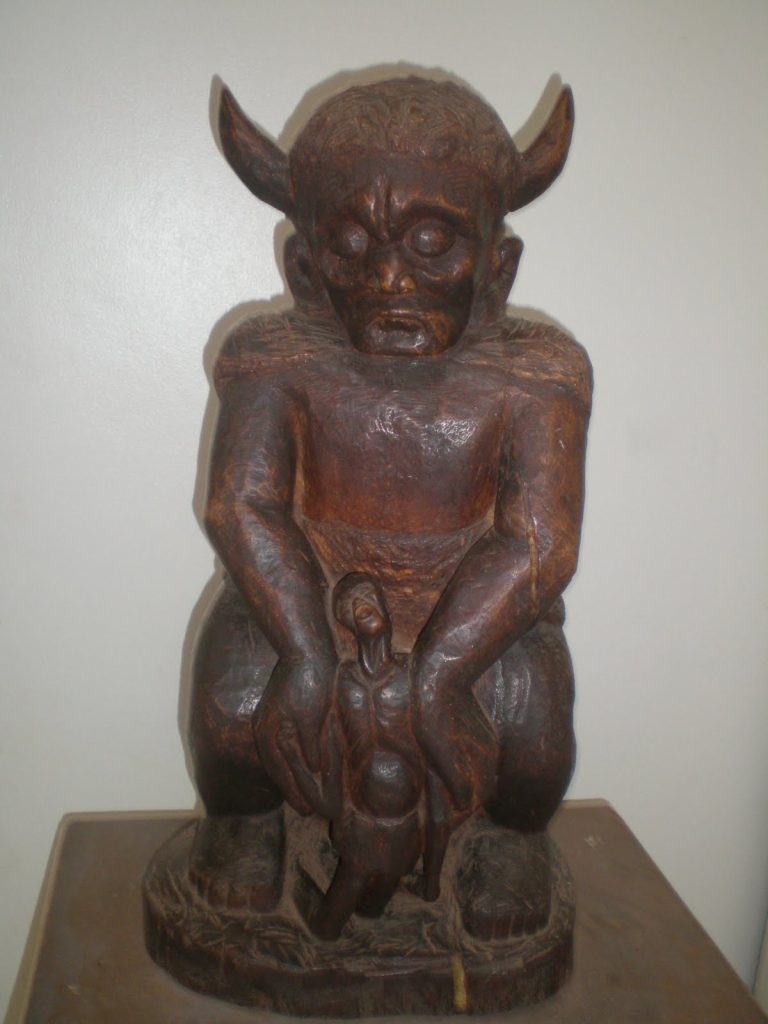
Traditional Ganda sources are notably restrained when it comes to Walumbe’s physical appearance. Unlike many mythic beings who are described in vivid, symbolic detail, Walumbe is defined more by his actions and his effects on the world than by a fixed form. He is consistently associated with the ground opening beneath human feet, with pits, tunnels, and underground spaces that swallow life without warning. This absence of physical description is not accidental. Walumbe represents death as an experience rather than a spectacle, something felt rather than seen.
Some later retellings and secondary interpretations describe him loosely as a serpentine or shadowy presence, but these images are not supported by early oral traditions. What remains consistent is his connection to the earth itself. Walumbe hides beneath the soil, digs his own refuges, and vanishes into the ground when pursued. His physicality is therefore environmental rather than anatomical. He is present wherever the earth breaks, trembles, or claims the living, reinforcing his identity as a force that cannot be easily confronted or contained.
Family
Walumbe’s role becomes more complex when viewed through his family relationships. He is the son of Ggulu, the sky god who governs heaven and order, and the brother of Nambi, whose marriage to Kintu initiates human society. This divine lineage places Walumbe firmly within the cosmic family rather than outside it. Death, in this worldview, is not an external enemy but a relative who refuses to obey boundaries.
His brother Kayikuzi is dispatched by Ggulu to retrieve him from earth and restore the separation between heaven and humanity. The pursuit that follows is relentless and ultimately unresolved. Kayikuzi nearly succeeds but is distracted when humans break his silence, allowing Walumbe to escape permanently into the earth. Their unfinished struggle explains not only the permanence of death but also the instability of the land itself. The family conflict remains frozen in time, continuing beneath the surface of the world and shaping human experience long after its origin.
Other names
The name Walumbe is inseparable from its meaning. In Luganda, it directly translates to death or fatal disease, leaving no ambiguity about his function. Closely related terms such as olumbe refer to incurable illnesses often understood as spiritually caused, while kulumba implies an aggressive affliction that overwhelms its victim. These linguistic connections reveal how deeply Walumbe is embedded in everyday understandings of sickness and mortality.
The variant spelling Warumbe appears in some historical and regional records, reflecting the oral transmission of the myth rather than a separate identity. In specific ritual contexts, particularly around the Tanda pits, Walumbe is sometimes addressed as Jaaja Bulamu, meaning “Grandfather of Life.” This paradoxical title does not deny his association with death but reframes him as a necessary counterpart to life itself, a being whose presence gives existence its urgency and meaning.
Powers and Abilities
Walumbe’s power is absolute but not theatrical. He does not rely on weapons, spells, or visible transformations. His defining ability is the introduction of death as a daily reality. After being denied the right to claim one of Kintu and Nambi’s children, he begins taking them one by one, establishing a rhythm of loss that humanity can never escape. Death, once begun, becomes self-sustaining.
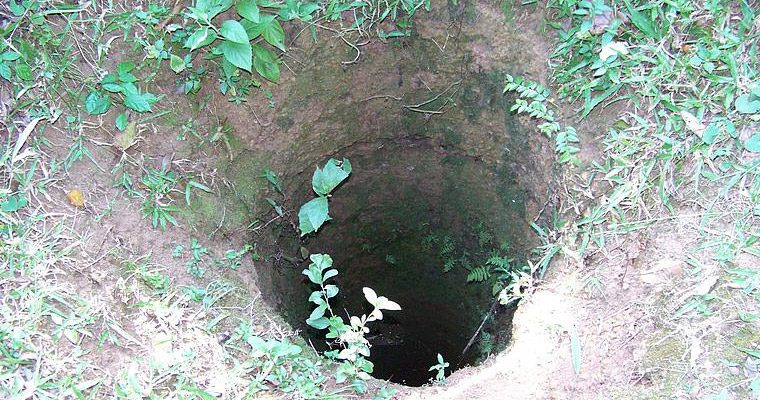
He is also capable of reshaping the land to protect himself. During his flight from Kayikuzi, Walumbe creates deep pits that allow him to disappear underground, forming a network of hiding places that cannot be sealed. These spaces are not merely physical shelters but symbolic thresholds between the living world and the realm of death. The Baganda belief that earthquakes result from his ongoing struggle with Kayikuzi reflects an understanding of death as active and restless, always pressing against the surface of life.
Modern Day Influence
Walumbe’s presence remains tangible in contemporary Uganda through the Tanda pits of Mityana District. Numbering over two hundred, these circular shafts are widely believed to mark the places where Walumbe hid during his escape. The site functions simultaneously as an archaeological landmark, a spiritual shrine, and a cultural memory. Offerings, bark cloth coverings, and ritual objects maintain its sacred character, and the area is treated with caution and respect.
Beyond the physical site, Walumbe’s myth continues to shape attitudes toward illness, burial practices, and the interpretation of natural disasters. Death is not viewed solely as biological failure but as participation in a much older cosmic story. The legend is preserved through oral storytelling, education, and artistic reinterpretations, ensuring that Walumbe remains a living concept rather than a forgotten relic. His story continues to explain not just why people die, but why death still feels personal, intrusive, and unresolved.
Related Images



Source
Atkinson, R. R. (1975). The traditions of the early kings of Buganda: Myth, history. JSTOR.
https://www.jstor.org/stable/3171464
Daily Monitor. (2021, January 4). Tanda pits: Holding the legend of death in Buganda. https://www.monitor.co.ug/uganda/lifestyle/reviews-profiles/tanda-pits-holding-the-legend-of-death-in-buganda-1560846
Daily Monitor. (n.d.). Tanda pits: The legend of Walumbe. https://www.monitor.co.ug/uganda/news/national/tanda-pits-the-legend-of-walumbe-3299274
Mulindwa, G. (2000). The legend of Kintu, Nambi, and Walumbe still lives west of Kampala. Uganda Journal. https://www.semanticscholar.org/paper/The-Legend-of-Kintu%2C-Nambi%2C-and-Walumbe-Still-Lives-Mulindwa/ed7e316bf1ae790f2796ba2a9945b
Roscoe, J. (1911). The Baganda: An account of their customs and beliefs. Macmillan.
Wikipedia. (2024). Kintu. https://en.wikipedia.org/wiki/Kintu
Wikipedia. (2025). Warumbe. https://en.wikipedia.org/wiki/Warumbe
Frequently Asked Questions
Who is Walumbe in Ganda belief?
Walumbe is the spirit associated with death and disease who enters the human world in the legend of Kintu, explaining why all humans are mortal.
Is Walumbe considered evil?
Walumbe is not portrayed as purely evil but as an unavoidable cosmic force whose presence makes life finite.
What are the Tanda pits linked to Walumbe?
The Tanda pits in Mityana District are believed to be the places where Walumbe hid underground while escaping capture.
Why are earthquakes associated with Walumbe?
Earthquakes are traditionally explained as signs of Walumbe still struggling beneath the earth against his brother Kayikuzi.
Does Walumbe have a physical form?
Traditional sources do not describe a fixed physical appearance, emphasizing his role as a spiritual and environmental force rather than a visible being.
