
Umkulomqango : The Supreme Sky Spirit of the Ngoni People
Listen
At a glance
| Description | |
|---|---|
| Origin | Ngoni Mythology |
| Classification | Gods |
| Family Members | N/A |
| Region | Malawi, Zambia |
| Associated With | Creation, Rain, Cattle |
The Mythlok Perspective
Umkulomqango represents authority without presence, power that governs by distance rather than intervention. Within the Mythlok framework, he is not a ruler who acts but a structure that must be acknowledged. Unlike creator figures who shape the world through narrative action, Umkulomqango exists as cosmic legitimacy itself. Comparable to high gods such as Nyame or Olodumare, his role is elemental rather than personal, reinforcing hierarchy, continuity, and restraint as sacred principles.
Umkulomqango
Introduction
Umkulomqango occupies a singular and elevated position within Ngoni spiritual thought, functioning as the ultimate source of existence and authority in Maseko Ngoni tradition. Often referred to as the Great Spirit, Umkulomqango is understood as the owner of all things and the wellspring from which power, order, and legitimacy flow. Unlike more accessible spirits or ancestors, this presence is distant, restrained by sacred protocol, and situated firmly in the sky. The Ngoni conception does not encourage intimacy or direct appeal; reverence is maintained through distance.
Creation narratives describe Umkulomqango lowering the first man to earth by a cattle intestine cord, later sending a woman in the same manner, establishing humanity as Amazulu, people who descended from the sky. This myth does more than explain origins. It affirms patrilineal descent, kingship, and cattle as sacred wealth, reinforcing the idea that political authority and social order are not human inventions but inheritances sanctioned from above. Through this framework, Umkulomqango is not merely a creator but the cosmic guarantor of Ngoni identity itself.
Physical Traits
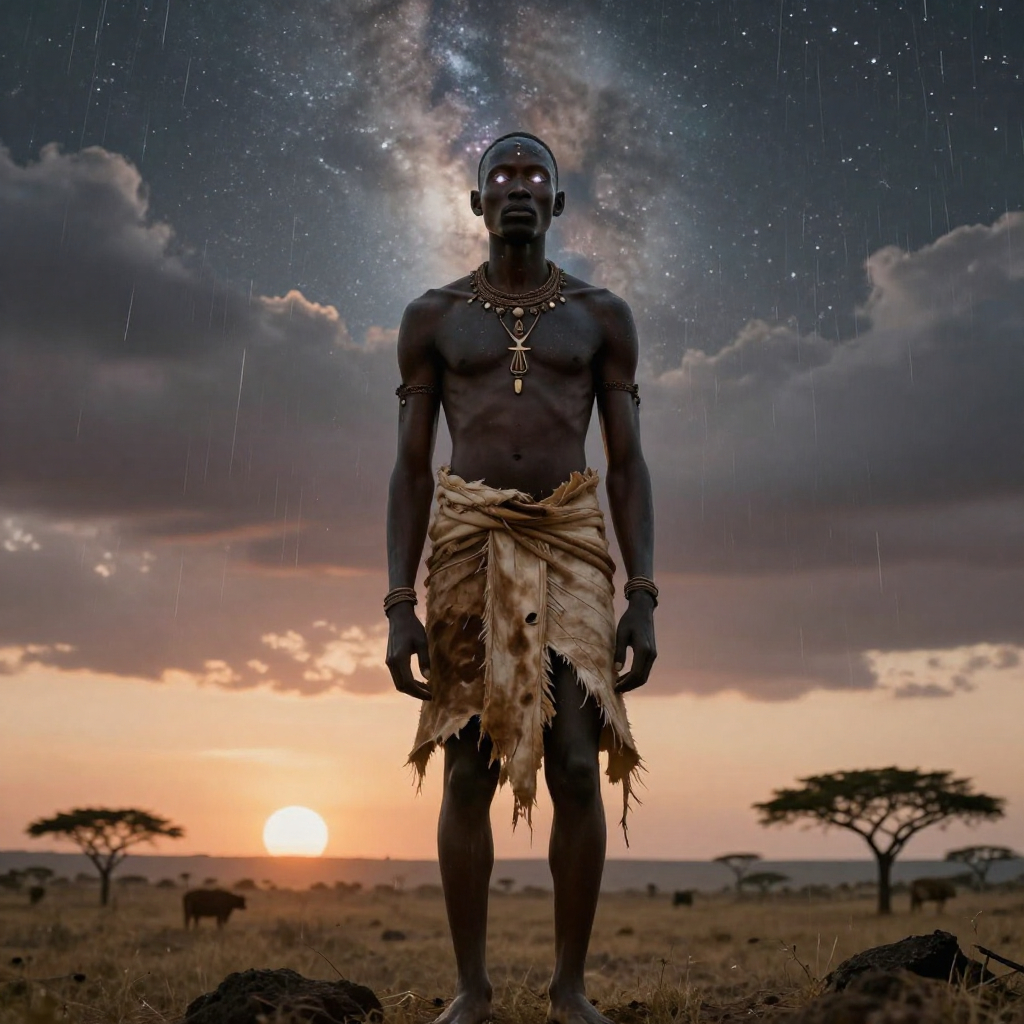
Ngoni tradition does not assign Umkulomqango a physical body or anthropomorphic form. The deity is defined precisely by the absence of visible shape, reinforcing supreme status through invisibility. Masculine identification emerges symbolically rather than visually, linked to the sky, authority, and generative power rather than bodily features. Cosmological imagery replaces physical description. The sky is imagined as a vast blue rock resting upon four immense bulls, whose movements cause earthquakes, while stars appear as punctures in this firmament and the Milky Way becomes a celestial cattle path. Rain, thunder, and falling stars are interpreted as signs of divine movement rather than manifestations of a visible being. In this way, Umkulomqango is experienced through environment and event, not image. The refusal to depict form preserves sanctity and prevents familiarity, maintaining a clear boundary between the divine realm and human perception.
Family
Umkulomqango stands outside conventional genealogies. There are no parents, siblings, or spouses recorded in Ngoni oral tradition. Instead, the deity functions as the primordial father of humanity itself. The creation narrative establishes a direct paternal link between Umkulomqango and the first humans, symbolised by the umbilical cord descending from the sky. This metaphor reinforces patrilineal descent and the divine legitimacy of male authority within Ngoni society. Communication with Umkulomqango does not occur directly but flows upward through ancestral spirits, known as amadlozi. These ancestors, particularly those of royal lineages and founding figures, act as intermediaries who carry human concerns skyward. Paramount chiefs inherit a form of divine kingship by virtue of this ancestral proximity, embodying the idea that rulership is not elected or seized but transmitted along sacred lines established at creation.
Other names
Across Ngoni communities, Umkulomqango is known by several titles that emphasise different aspects of supreme authority. Umkulu Ikakulu translates as the Great or Elder Spirit, underscoring seniority beyond all other beings. Umnikazi we zinto zonke identifies the deity as the owner of everything that exists, while Uluhlanga refers to the source of power itself. These names are descriptive rather than personal, reflecting a tendency to define the deity by function rather than character. In broader Nguni cosmology, related supreme beings such as Mvelamqangi or Umvelinqangi share overlapping attributes and are sometimes conceptually merged. Such variations reflect migration, oral transmission, and regional adaptation rather than theological contradiction, reinforcing the idea of a single, distant source perceived through different cultural lenses.
Powers and Abilities
The powers attributed to Umkulomqango are absolute but indirect. Creation of the heavens and earth establishes foundational authority, while ongoing influence manifests through rain, fertility, health, and victory in war. Drought, disease, or military defeat are understood as disruptions in cosmic balance rather than punishments delivered personally. Natural phenomena such as earthquakes or celestial events are interpreted as movements within the divine order upheld by Umkulomqango. The deity’s power extends to social structure, legitimising kingship and validating ritual practices centred on cattle sacrifice and first-fruit ceremonies. Importantly, Umkulomqango does not intervene spontaneously. Action occurs through ancestral mediation, reinforcing communal responsibility and continuity. This distance ensures that power remains awe-inspiring rather than negotiable, binding society to ritual discipline rather than individual devotion.
Modern Day Influence
Although colonial rule and Christian conversion disrupted many traditional practices, belief in Umkulomqango continues to shape Ngoni cultural identity in Malawi, Zambia, and neighbouring regions. Ceremonies such as Ncwala or Incwala, which celebrate kingship, harvest cycles, and communal renewal, still invoke ancestral mediation linked ultimately to the sky deity. Paramount chiefs retain symbolic authority rooted in divine descent narratives, even when operating within modern political systems. Contemporary Ngoni music, dance, and public festivals frequently reference these cosmological themes as expressions of cultural resilience rather than overt worship. In academic discourse, Umkulomqango provides valuable insight into African concepts of transcendence, authority, and non-anthropomorphic divinity. Rather than disappearing, the deity’s role has shifted into a cultural foundation that continues to inform ethics, leadership, and collective memory.
Related Images
Source
Callaway, H. (1870). The religious system of the Amazulu. J.A. Blair.
Green, R. (2017). Introduction to the Ngoni spiritual world. https://greenankhworks.files.wordpress.com/2017/06/ngoni.pdf
Krige, E. J. (1936). The social system of the Zulus. Longmans, Green and Co.
Nkwazi Magazine. (2025). Ngoni pride and power at Ncwala 2025. https://nkwazimagazine.com/ngoni-pride-and-power/
Read, J. (1936). Maseko Ngoni record. Livingstonia Press.
Wikipedia. (2025). Umvelinqangi. https://en.wikipedia.org/wiki/Umvelinqangi
Kuper, A. (1982). The Invention of Primitive Society: Transformations of an Illusion. London: Routledge.
Junod, H. A. (1927). The Life of a South African Tribe. London: Macmillan.
Hodgson, D. L. (2001). Once Intrepid Warriors: Gender, Ethnicity, and the Cultural Politics of Maasai Development. Bloomington: Indiana University Press.
Frequently Asked Questions
Who is Umkulomqango in Ngoni belief?
Umkulomqango is the supreme sky deity and ultimate source of power, creation, and authority in Ngoni tradition.
Is Umkulomqango the same as Mvelamqangi?
They share similar attributes as creator figures, though Umkulomqango functions as a distinct expression within specific Ngoni traditions.
Why is Umkulomqango considered distant?
Distance preserves sacred authority and ensures that divine power is mediated through ancestors rather than accessed directly.
What role do ancestors play in relation to Umkulomqango?
Ancestors act as intermediaries, carrying prayers and concerns from the living to the supreme deity.
Is Umkulomqango still worshipped today?
Direct worship is rare, but his presence continues through cultural ceremonies, kingship symbolism, and ancestral traditions.
