

Tarisso : The Mortal Mother of Micronesia’s Trickster Demigod
Listen
At a glance
| Description | |
|---|---|
| Origin | Chuukese Mythology |
| Classification | Mortals |
| Family Members | Hit (Mother), Lugeleng (Husband), Olifat (Son) |
| Region | Caroline Islands |
| Associated With | Mother |
Tarisso
Introduction
Tarisso occupies a fascinating place in the mythology of the Caroline Islands of Micronesia, a region whose cultures have preserved rich oral traditions shaped by voyaging, kinship, and deep reverence for the natural world. Unlike the pantheons of consolidated mythologies, the Caroline Islands nurture distinct yet interwoven narratives across Chuuk, Yap, Pohnpei, and Kosrae. Within this mosaic, Tarisso emerges as a compelling figure whose story bridges mortal experience and divine agency. Most prominently known as the mother of the renowned trickster demigod Olifat (or Olofat), Tarisso’s tale reflects the values of her people: resilience, ancestral loyalty, the interplay between gods and mortals, and the symbolic role of women in creation and lineage. Her mythology embodies both the vulnerability and influence of a mortal whose life becomes intertwined with supernatural forces, offering insight into how Micronesian communities interpret destiny, family conflict, and the shaping of the world.
Physical Traits
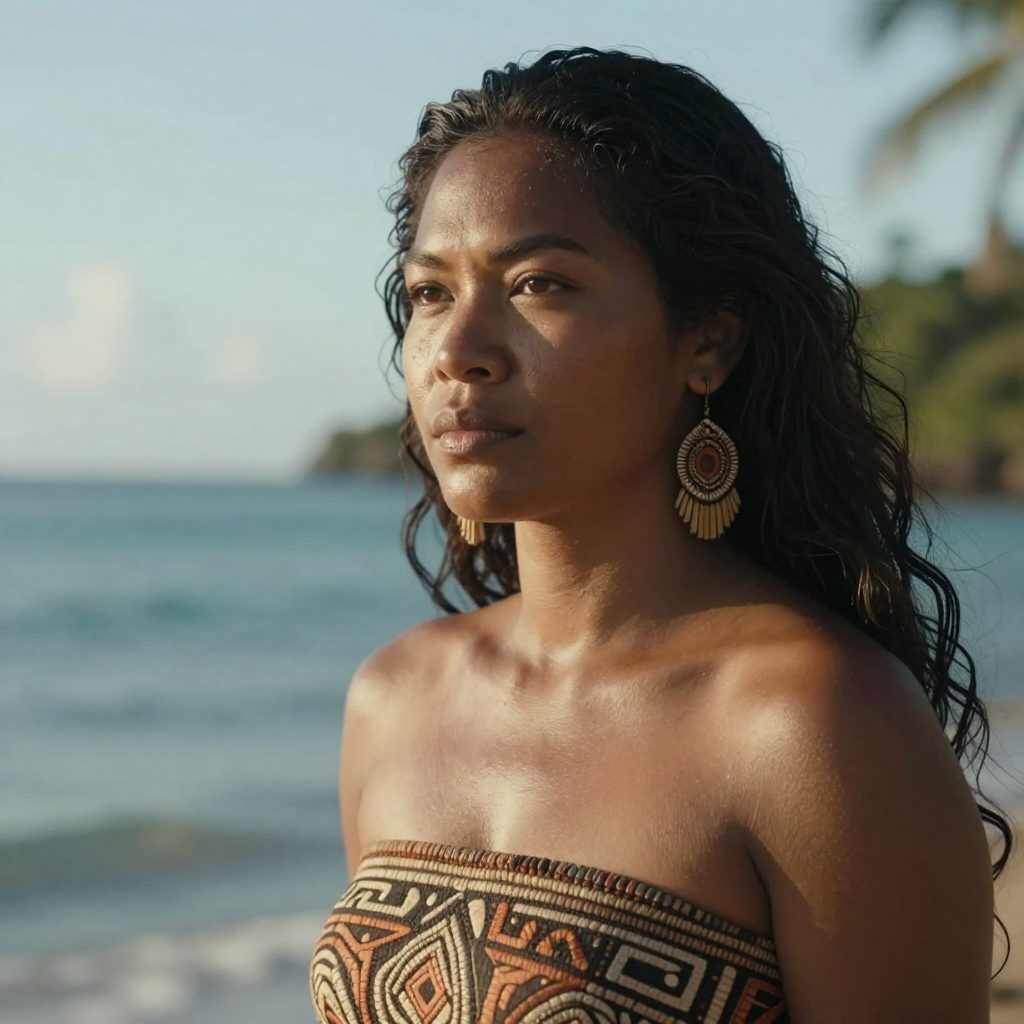
Micronesian storytelling focuses on action, lineage, and relationships rather than physical detail, so descriptions of Tarisso highlight her presence rather than specific features. She is remembered as a woman whose beauty and vitality attract the attention of the god Lugeleng, suggesting qualities that reflect cultural ideals of health, grace, and strength. Oral traditions emphasize her symbolic role more than her outward form, positioning her as an archetype of mortal femininity capable of drawing divine interest and producing a child whose exploits become central to Caroline Islands mythology. Her physical depiction remains intentionally open to interpretation, allowing storytellers to adapt her presence to different communities and contexts across generations.
Family
Tarisso’s lineage is one of the richest aspects of her myth. She is described as the daughter of Hit, the octopus goddess whose transformative abilities and oceanic associations represent the fluidity of life in Micronesian cosmology. This divine origin explains much of Tarisso’s narrative importance, for her connection to Hit grants her access to supernatural protection and influence. Her union with the god Lugeleng—sometimes paralleled with Anulap in related Micronesian traditions—results in the birth of Olifat, one of the most prominent demigods in regional mythology.
Family conflict shapes much of Tarisso’s story. Lugeleng’s wife attempts to prevent Tarisso from conceiving, creating tension that highlights the complex dynamics between divine and mortal relationships. Hit intervenes with her iconic dance, overpowering the rival’s resistance and enabling the conception of Olifat. Through this episode, Tarisso becomes a vessel through which divine will manifests, and her role as Olifat’s mother positions her at the heart of countless myths about creation, mischief, and moral order.
Other names
Unlike many deities of Micronesian mythology, Tarisso does not appear widely under alternate names. Her identity remains consistent across the main recorded traditions, and linguistic variations are minimal. While dialectal shifts across the Caroline Islands may cause subtle pronunciation differences, “Tarisso” is the recognized and culturally anchored form. In some oral stories she is referred to indirectly through lineage—such as “daughter of Hit”—but these are descriptive rather than alternate names. Her stability of name signals the clarity of her role in the mythic framework and the cultural importance of her maternal identity.
Powers and Abilities
Tarisso herself is depicted as mortal, and thus she does not wield independent supernatural powers. However, her significance lies in the influence she exerts through her relationships and lineage. As the daughter of Hit, she occupies a privileged position between human and divine realms, which allows her to benefit from divine intervention when needed. Her mother’s dramatic dance to secure the conception of Olifat demonstrates the strength of her familial network and the reverence surrounding her role in a mythic event of great importance.
Her greatest legacy is the birth of Olifat, whose magical abilities, trickster nature, and cosmic interventions shape much of Micronesian mythology. Through him, Tarisso becomes tied to stories of creation, mischief, transformation, and moral teaching. Her story is a reminder that in Micronesian cosmology, mortals can become essential to divine narratives through the power of lineage, destiny, and connection to ancestral spirits.
Modern Day Influence
Tarisso’s presence endures in the cultural memory of the Caroline Islands, where communities continue to preserve oral traditions despite the impacts of colonization, Christianity, and modernization. Her story appears in contemporary re-tellings, educational materials, and cultural preservation projects that seek to document Micronesian mythology for future generations. As the mother of Olifat, she maintains symbolic importance in discussions of ancestry, maternal strength, and the transmission of cultural knowledge.
In modern artistic expressions—whether storytelling festivals, visual art, or online folklore communities—Tarisso represents the enduring relevance of mythic women in Pacific heritage. Her character is also increasingly referenced in discourses surrounding identity and belonging, especially in efforts to revitalize indigenous narratives within the Federated States of Micronesia. Through these contemporary lenses, Tarisso transcends her mythological origins, becoming a figure of cultural resilience and continuity.
Related Images
Source
Goodenough, W. H. (Ed.). (2023). Tales from Ulithi Atoll: A comparative study in Oceanic folklore. University of Hawaii Press.
Craig, R. D. (2004). Dictionary of Polynesian mythology. Greenwood Press.
Encyclopedia.com. (2025). Micronesian mythology. https://www.encyclopedia.com/humanities/news-wires-white-papers-and-books/micronesian-mythology
Wikipedia. (2025). Micronesian mythology. https://en.wikipedia.org/wiki/Micronesian_mythology
Guam Museum. (2019). Legends of the Mariana Islands: Chamorro and Micronesian tales. Pacific Island Publications.
LeBarth, J. (2022). Caroline Islands mythology overview. Lebarty Press. https://lebarty.com/caroline-islands-mythology/
Barnett, H. G. (1949). Culture and society in the Caroline Islands. Eugene: University of Oregon Press.
Lessa, W. A. (1980). Micronesian mythology and oral traditions. Honolulu: University of Hawai‘i Press.
Alkire, W. H. (1977). An introduction to the people and cultures of Micronesia. Menlo Park, CA: Cummings Publishing.
Petersen, G. (2009). Traditional Micronesian narratives and identity. Pacific Studies, 32(2), 45–67.
Rainbird, P. (2004). The archaeology of Micronesia. Cambridge: Cambridge University Press.
Frequently Asked Questions
Who is Tarisso in Micronesian mythology?
Tarisso is a mortal woman from Caroline Islands mythology known primarily as the mother of the demigod trickster Olifat.
Is Tarisso considered a goddess?
No, Tarisso is not a goddess; she is mortal, though born to the octopus goddess Hit, giving her divine lineage.
What is Tarisso best known for?
She is best known for her role in the conception and birth of Olifat, whose adventures are central to Micronesian myth.
Does Tarisso have supernatural powers?
She does not possess powers herself, but she benefits from the intervention of her divine family.
How is Tarisso viewed today?
Tarisso remains a symbol of maternal strength, cultural identity, and mythological heritage in Micronesian communities.
