


Ravgga : The Sámi Fish Deity of Prophecy
Listen
At a glance
| Description | |
|---|---|
| Origin | Sami Mythology |
| Classification | Spirits |
| Family Members | N/A |
| Region | Norway, Sweden, Finland, Russia |
| Associated With | Prophecy, Foresight |
The Mythlok Perspective
Ravgga represents a form of divinity that listens rather than commands. Unlike thunder gods such as Thor or Horagalles, who impose order through force, Ravgga belongs to the same quiet lineage as river spirits like Nyami Nyami or the Celtic salmon of wisdom. These water-bound beings reveal truth through patterns, not punishment. In Sámi cosmology, survival comes from attention and timing, where nature speaks softly before it turns unforgiving.
Ravgga
Introduction
Ravgga is a lesser-known yet deeply significant figure within Sámi belief systems, representing the intimate relationship between water, survival, and foresight. Rooted in the spiritual traditions of the indigenous Sámi people of northern Scandinavia and parts of Russia, Ravgga is understood as a prophetic fish spirit invoked for divination and guidance. Sámi cosmology does not separate the sacred from the natural world; instead, animals, rivers, and landscapes act as living conduits of knowledge. Within this worldview, Ravgga emerges not as a distant ruler but as an oracular presence encountered through water, fishing practices, and shamanic trance.
Unlike thunder or fertility deities who govern broad cosmic forces, Ravgga’s importance lies in specificity. Rivers and lakes were lifelines for Sámi communities, especially in subarctic regions where resources were unpredictable. Knowing when fish would appear, when waters were dangerous, or when fortune would turn could mean survival. Ravgga embodied that uncertainty and insight, allowing noaidi, Sámi shamans, to read the future through aquatic signs. The deity’s role was practical, spiritual, and existential, reflecting a culture where prophecy was not spectacle but necessity.
Physical Traits
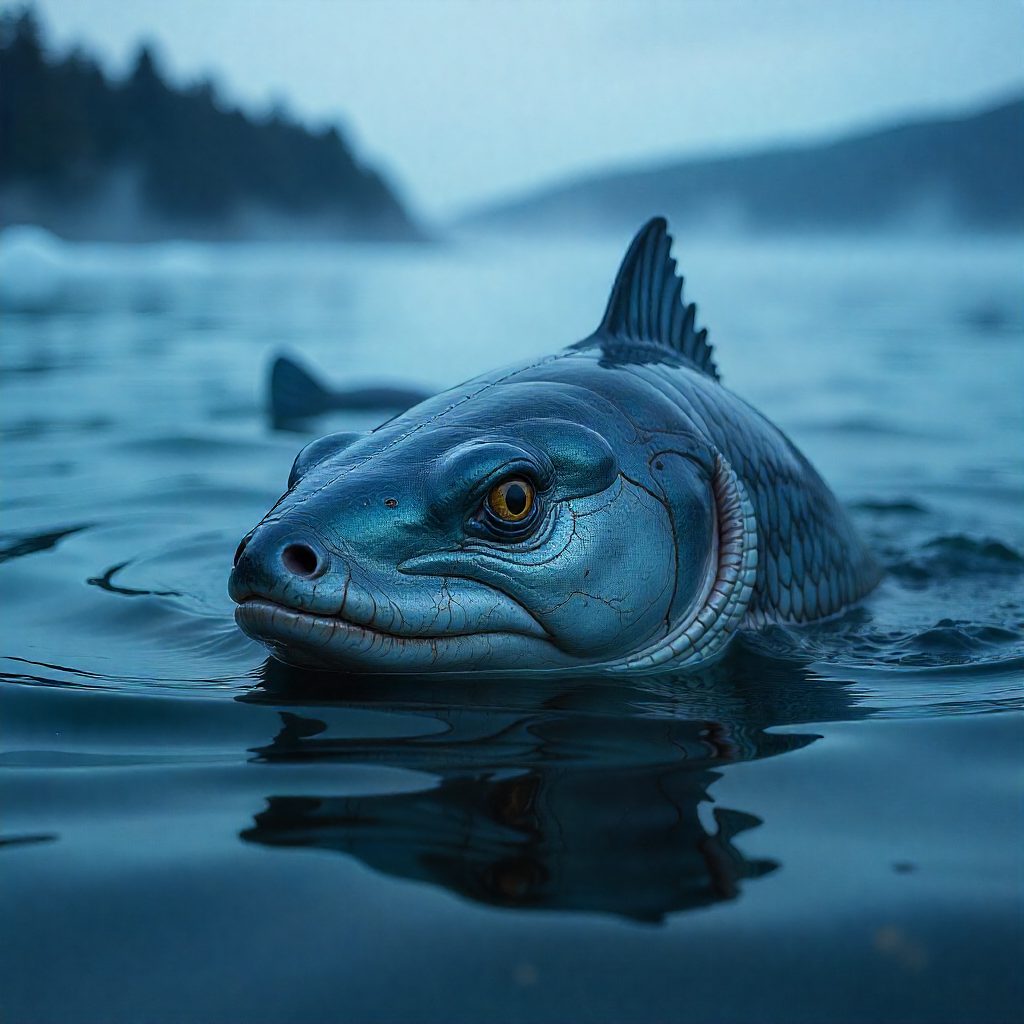
Ravgga is consistently described in zoomorphic terms, appearing as a fish rather than a human-like god. Folkloric reconstructions suggest a form resembling large northern species such as salmon or trout, animals deeply embedded in Sámi subsistence and seasonal rhythms. This piscine form is not decorative symbolism but theological intent. Fish move between visible and hidden depths, mirroring the nature of prophecy itself, partially revealed yet never fully grasped.
In shamanic visions, Ravgga is sometimes imagined as shimmering or iridescent, with scales reflecting light in dark waters. The eyes are often emphasized in oral descriptions, conveying perception beyond linear time. There is no tradition of elaborate ornamentation or humanoid features, which distinguishes Ravgga from sky or hearth deities. The god’s appearance reinforces the idea that divine knowledge does not always speak in human language but flows through animal movement, water currents, and silence beneath ice.
Family
Unlike many Sámi deities who appear within familial groupings, Ravgga stands alone in preserved sources. Sámi belief systems include clear divine lineages, such as the Radien family or the maternal triads associated with childbirth and domestic life. Ravgga, however, is not assigned parents, siblings, or offspring. This absence is not an oversight but reflects the deity’s function. Ravgga operates outside household, sky, or ancestral hierarchies and belongs instead to the liminal space of water.
Some scholars have proposed loose conceptual associations with other nature spirits, particularly those linked to underworld or transitional realms, but no direct kinship is recorded. This solitude mirrors the way fish spirits were approached: individually, situationally, and without ritual dependency on pantheonic order. Ravgga is encountered, not inherited, reinforcing the Sámi understanding that knowledge arises from engagement with place rather than lineage.
Other names
The name Ravgga appears with remarkable consistency across recorded sources, suggesting a stable identity despite regional linguistic variation. The term is believed to derive from Proto-Sámi roots connected to fish or prophetic insight, though precise etymology remains debated. Unlike major deities whose names shift across dialects and Christian-era reinterpretations, Ravgga retains its original form, possibly because its worship was localized and shamanic rather than communal.
Occasional transliterations such as “Ravka” appear in ethnographic notes, reflecting phonetic differences among Northern, Inari, or Skolt Sámi speakers. These variations do not represent distinct identities but rather oral transmission across regions. The absence of elaborate titles or honorifics reinforces Ravgga’s understated role. The name itself functions as both identity and description, aligning with Sámi traditions where naming often carries functional meaning.
Powers and Abilities
Ravgga’s primary ability is divination. Through the god, noaidi sought insight into future events, environmental changes, and personal fate. This divination was not abstract prophecy but grounded in observation. Fish behavior, water patterns, and the success or failure of catches served as omens interpreted through ritual knowledge. Ravgga was believed to guide these signs, shaping what was revealed and what remained hidden.
Beyond foresight, Ravgga influenced abundance. A successful fishing season was not merely economic fortune but confirmation of spiritual balance. Conversely, empty waters warned of moral, social, or environmental imbalance. Offerings were sometimes made before fishing or divinatory rituals, acknowledging that knowledge could not be taken without respect. Ravgga’s power was subtle, never coercive, and always conditional, reinforcing the Sámi belief that nature responds rather than obeys.
Modern Day Influence
Ravgga does not occupy a central place in modern popular culture, yet the deity has quietly resurfaced through Sámi cultural revitalization. As indigenous communities reclaim spiritual narratives suppressed during centuries of Christianization, lesser-known figures like Ravgga gain renewed attention. Educational initiatives, museums, and cultural festivals increasingly include references to shamanic divination and aquatic spirits as part of a broader effort to preserve intangible heritage.
In contemporary art and literature, Ravgga often appears symbolically rather than explicitly, representing ecological awareness, foresight, and the ethics of resource use. The figure resonates with modern concerns about water stewardship and sustainability, particularly in Arctic regions facing climate disruption. Digital archives and academic platforms now document Ravgga alongside better-known deities, ensuring that this quiet prophetic presence remains part of the living Sámi narrative.
Related Images

Source
Harva, U. (1964). The mythology of all races: Finno-Ugric, Siberian (Vol. 4). Marshall Jones Company.
Justapedia. (n.d.). Ravgga. https://justapedia.org/wiki/Ravgga.
Milwaukee Public Museum. (2026). Religion: Sami. https://www.mpm.edu/research-collections/anthropology/online-collections-research/sami/religion.
Saami Blog. (2009). The ancient gods of the Sami. http://saamiblog.blogspot.com/2009/07/ancient-gods-of-sami-de-gamle-samiske.html.
Wikipedia. (n.d.). Ravgga. https://en.wikipedia.org/wiki/Ravgga
Wikipedia. (n.d.). Sámi shamanism. https://en.wikipedia.org/wiki/Sami_shamanism.
Wiktionary. (2025). Reconstruction:Proto-Samic/rāvkë. https://en.wiktionary.org/wiki/Reconstruction:Proto-Samic/r%C4%81vk%C3%AB.
Pentikäinen, J. (1995). Saami Shamanism: Studies on the Shamanic Tradition of the Saami. Helsinki: Finnish Academy of Science and Letters.
Hultkrantz, Å. (1981). Belief and Worship in Native Scandinavia. Stockholm: Almqvist & Wiksell.
Lehtola, V.-P. (2004). The Sámi People: Traditions in Transition. Fairbanks: University of Alaska Press.
Frequently Asked Questions
Who is Ravgga in Sámi belief?
Ravgga is a prophetic fish spirit associated with divination, fishing omens, and foresight in Sámi spiritual traditions.
Is Ravgga a god or a spirit?
Ravgga is best classified as a spirit deity, operating within shamanic and animistic belief systems rather than a structured pantheon.
What is Ravgga associated with?
Ravgga is linked to fish, rivers, lakes, prophecy, and the interpretation of future events through natural signs.
How was Ravgga worshipped or invoked?
Ravgga was approached through shamanic rituals, water scrying, and fishing-related divination rather than temples or communal rites.
Does Ravgga appear in modern Sámi culture?
Yes, Ravgga appears in cultural preservation efforts, academic studies, and symbolic representations tied to ecological awareness.
