
Nuckelavee : The Skinless Sea Demon of Orkney
Listen
At a glance
| Description | |
|---|---|
| Origin | Scottish Mythology |
| Classification | Hybrids |
| Family Members | N/A |
| Region | Scotland |
| Associated With | Seas, Evil |
Nuckelavee
Introduction
The Nuckelavee stands as one of the most terrifying figures in Scottish folklore, a creature so feared in the Orkney Islands that its name was avoided in everyday speech. Emerging from a harsh landscape shaped by unpredictable seas, disease, and scarce resources, the Nuckelavee came to embody the darkest aspects of nature. More than a simple monster tale, its legend captured the anxieties of a community living on the edge of the North Sea, where storms, famine, and illness could strike without warning. Unlike many mythic beings who oscillate between benevolence and wrath, the Nuckelavee is a creature of unrestrained malice. In folklore accounts recorded by Walter Traill Dennison, islanders described it not as a trickster, guardian, or misunderstood spirit, but as an embodiment of evil whose arrival signified disaster. The Nuckelavee is often viewed as a fusion of Celtic and Norse influences, shaped by centuries of cultural overlap in the Orkneys. Its story remains one of the most vivid examples of how myth can arise from profound environmental fear.
Physical Traits
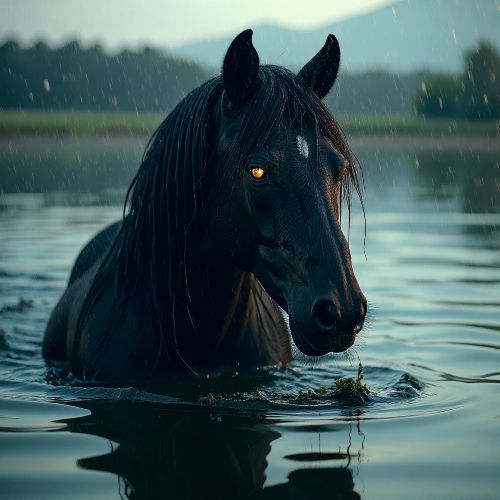
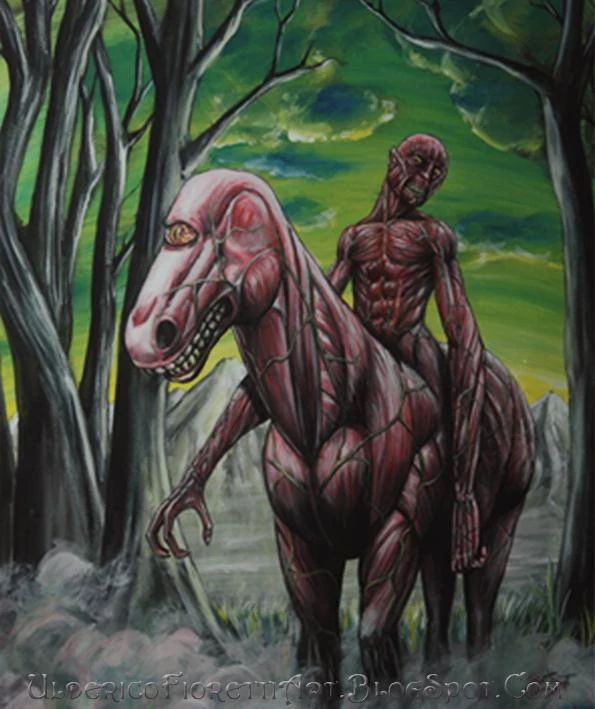
Descriptions of the Nuckelavee consistently emphasize its revolting skinless body, a detail that makes it one of the most visually disturbing entities in European folklore. The creature merges human and horse into one seamless, unnatural form. Its equine body is completely exposed, revealing veins swollen with dark, tar-like blood and muscles that move visibly beneath sinew. Where legs might have hooves, they instead end in fin-like appendages, underscoring its connection to the sea. Rising from the horse’s back is a distorted human torso, fused directly into the animal’s spine. Its arms hang so low that the fingers nearly drag across the ground as it moves. The head is disproportionately large, with a single red eye that burns intensely and a mouth described as stretching almost to its chest. Eyewitness stories, such as the famous account of the islander Tammas, paint a consistent picture: a creature that appears neither alive nor dead, neither human nor animal, but a raw, pulsating abomination that chills all who see it. This grotesque design reinforces its symbolic role as nature’s fury stripped bare.
Family
Unlike many figures in Scottish or Norse mythology, the Nuckelavee has no lineage, consort, or offspring. Its existence is solitary, further amplifying its aura of otherworldly dread. However, folklore does link it to one important force: the Mither o’ the Sea, an ancient Orcadian spirit who controls the seas and restrains the Nuckelavee during the summer months. When her power weakens in winter, the creature is free to roam the land. This relationship is not familial in any traditional sense, but it establishes a cosmological framework in which the Nuckelavee represents unchecked destruction, and the Mither symbolizes seasonal order. Some scholars suggest that the creature may share distant roots with Scandinavian water spirits brought to the islands during Norse settlement, yet even in this wider context, the Nuckelavee remains unique. Its isolation reflects the idea of a disaster born from the sea itself—without origin, alliances, or attachments.
Other names
The Nuckelavee appears in oral tradition under several spellings and dialectal variations. “Nuckalavee” is the most common alternative, while earlier antiquarian texts refer to forms like “knoggelvi” or “mukkelevi,” each rooted in Orcadian and Shetland linguistic traditions. Some interpretations connect the name to Old Norse “nökk,” referring to water spirits, while others link it to the Scottish “nuggle,” a type of water horse. Regardless of linguistic path, all forms emphasize its identity as a sea demon. Island communities often avoided speaking the name directly, believing that doing so invited the creature’s attention. These naming taboos reflect its deep cultural impact and the fear it inspired.
Powers and Abilities
The Nuckelavee’s powers mirror the environmental terrors of the islands. Its breath is described as toxic, capable of withering crops, blighting grasslands, and infecting livestock with diseases such as the dreaded “mortasheen.” Islanders blamed it for droughts, epidemics, and unexplained livestock deaths, viewing its presence as the embodiment of agricultural and ecological collapse. The creature possesses immense physical strength and relentless speed, enabling it to chase victims across open landscapes. Unlike many supernatural beings that can be repelled by charms or bargains, the Nuckelavee offers no negotiation and no mercy. Its one limitation is its inability to cross fresh water. Streams, lochs, and rainfall form natural barriers, a detail prominently featured in Dennison’s tale of Tammas, who escaped by splashing into a freshwater channel. This vulnerability reflects a common motif in Scottish folklore, where pure water symbolizes protection against dark forces.
Modern Day Influence
The Nuckelavee continues to fascinate modern audiences, appearing in television, literature, tabletop RPG manuals, and digital media. Its grotesque design lends itself naturally to horror and fantasy genres, where it is often reimagined as a boss creature or apocalyptic entity. In the television series Grimm, a monstrous wesen inspired by the Nuckelavee appears as a skinless, horse-like humanoid with brutal strength. Fantasy role-playing games such as Pathfinder reinterpret it as a nature-avenging fey monster linked to polluted waters, using its traditional symbolism to explore environmental themes. In online folklore communities and modern mythological fiction, the Nuckelavee is increasingly invoked in discussions of climate anxiety, ecological collapse, and the destructive consequences of disrupting natural balance. Orkney-based cultural tourism also references the creature during storytelling festivals and folklore tours, preserving its legacy as one of Scotland’s most fearsome mythic beings. Its enduring presence demonstrates how deeply the Nuckelavee resonates—as both an ancient fear and a modern metaphor for the fragility of the world.
Related Images

Source
Bane, T. (2014). Encyclopedia of fairies in world folklore and mythology. McFarland & Company.
Briggs, K. M. (1976). An encyclopedia of fairies: Hobgoblins, brownies, bogies, and other supernatural creatures. Pantheon Books.
Douglas, G. (1901). Scottish fairy and folk tales. Walter Scott Publishing Co.
Marwick, E. W. (1975). The folklore of Orkney and Shetland. Batsford.
Matthews, J., & Matthews, C. (2006). The element encyclopedia of magical creatures. HarperElement.
Monaghan, P. (2004). The encyclopedia of Celtic mythology and folklore. Facts on File.
Ravenheart, O. Z., & DeKirk, A. L. D. (2007). A wizard’s bestiary: A menagerie of myth, magic, and mystery. New Page Books.
Wikipedia. (2025). Nuckelavee. https://en.wikipedia.org/wiki/Nuckelavee
The Archaeologist. (2025, July 24). The myth of the Nuckelavee, the Scottish sea demon. Retrieved December 10, 2025, from https://www.thearchaeologist.org/blog/the-myth-of-the-nuckelavee-the-scottish-sea-demon
Revlox. (2025, April 14). The Nuckelavee: Scotland’s most terrifying folklore monster. Retrieved December 10, 2025, from https://www.revlox.com/myths/the-nuckelavee-scotlands-most-terrifying-folklore-monster/
Frequently Asked Questions
What is the Nuckelavee in Scottish folklore?
The Nuckelavee is a skinless horse-human sea demon from Orkney folklore known for spreading disease, drought, and devastation.
Why is the Nuckelavee considered so terrifying?
Its skinless body, toxic breath, and relentless malevolence make it one of the most horrifying mythological creatures in Scotland.
What weakness does the Nuckelavee have?
The Nuckelavee cannot cross fresh water, making rivers and streams natural barriers against it.
Is the Nuckelavee related to kelpies or other water spirits?
While it shares some similarities with Scottish water horses, it is considered a distinct and far more malevolent being.
Does the Nuckelavee appear in modern media?
Yes, it appears in TV shows, novels, role-playing games, and digital folklore adaptations, often as a horror creature.