


Kumuhonua : The First Man in Hawaiian Sacred Tradition
Listen
At a glance
| Description | |
|---|---|
| Origin | Hawaiian Mythology |
| Classification | Mortals |
| Family Members | Lalo-honua (Wife) |
| Region | Hawaii |
| Associated With | First Man |
The Mythlok Perspective
From the Mythlok perspective, Kumuhonua is not merely a first man but an elemental threshold where earth becomes human. His story reflects a worldview in which creation is not about dominance but balance. Unlike traditions that elevate humanity above nature, this narrative binds human fate to soil and law. Across cultures, first humans often fall, yet in Hawaii the fall does not erase belonging. Kumuhonua reminds us that to exist is to be accountable to the land that formed us.
Kumuhonua
Introduction
Kumuhonua holds a foundational place in Hawaiian sacred tradition as the first man shaped by the gods and placed upon the earth. His name, often translated as “foundation of the land” or “origin of the earth,” reveals his role not merely as an individual but as a living symbol of humanity’s beginning. In many chants and genealogies, Kumuhonua appears at the point where divine creation gives way to human lineage, marking the transition from cosmic order to lived history. His story explains how humans emerged from the same substance as the land itself and why people remain bound to it through responsibility and restraint. Unlike later heroic figures, Kumuhonua is remembered less for dramatic deeds and more for what he represents: the moment humanity was entrusted with the world.
Physical Traits
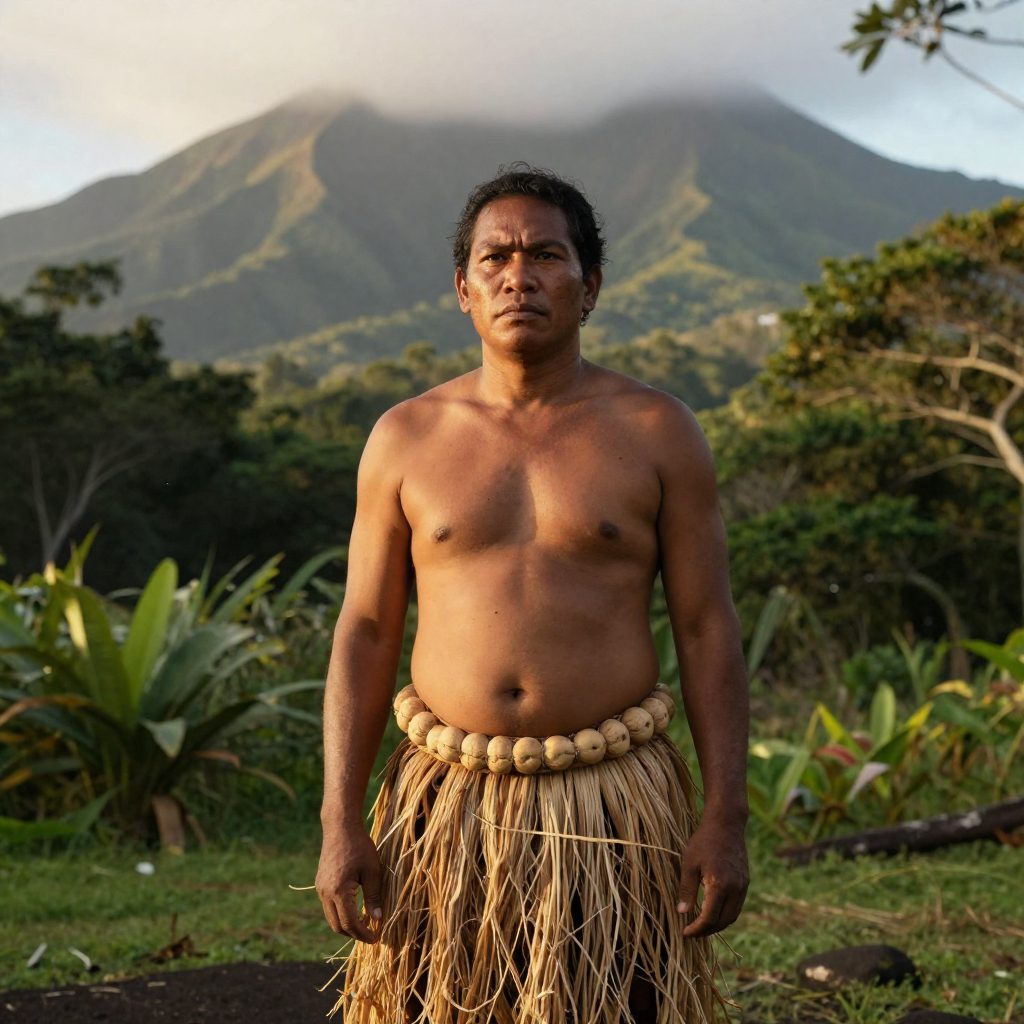
Descriptions of Kumuhonua’s appearance are sparse and deliberately symbolic. He is said to have been formed from red earth and sacred clay, animated by divine breath, making his body an extension of the land rather than a separate creation. Hawaiian oral tradition emphasizes completeness and balance rather than individual features, portraying him as strong, whole, and unmarred at the moment of creation. His physical perfection reflects harmony between gods, earth, and human life before any breach of divine law. Over time, this idealized form becomes a reminder that the human body itself is part of nature, not something placed above it. Kumuhonua’s physicality therefore serves as metaphor, reinforcing the belief that humans carry the land within themselves.
Family
Kumuhonua’s family connections reveal how Hawaiian tradition blends myth and genealogy into a single narrative. He is paired with Lalo-honua, the first woman, who complements him as the “earth below,” forming a balanced union of male and female, surface and depth. Together they stand as the ancestors of humanity, from whom later generations emerge. In some traditions, Kumuhonua is also remembered as a high chief of Oʻahu, linking him to historical lineages that trace descent through named ancestors. This dual identity allows him to function both as a mythic first man and as a genealogical root for aliʻi families. Through this blending, Hawaiian culture grounds divine origins in human ancestry, ensuring that sacred stories remain relevant to lived social structures.
Other names
Kumuhonua is known by several names and titles that emphasize different aspects of his role. The form Kumu-honua highlights his status as the source or foundation of humanity. In genealogical chants, he may be identified simply as the first man or as an early aliʻi, reinforcing his authority and antiquity. Some traditions refer to him by epithets that reflect his fall from divine favor after breaking sacred law, marking a shift from ideal being to mortal ancestor. These variations do not contradict one another but instead reflect how Hawaiian storytelling adapts figures to different contexts, whether cosmological, moral, or genealogical.
Powers and Abilities
Kumuhonua does not possess supernatural powers in the way gods or demigods do. His significance lies in the condition in which he was created rather than in extraordinary abilities. Endowed with life, awareness, and the capacity to procreate, he represents humanity’s original potential. He was placed in a fertile, abundant world and entrusted with its care under divine instruction. His greatest defining moment comes through limitation rather than power, as he and his companion break a sacred rule tied to a forbidden tree. This act results in exile from their place of abundance, introducing hardship and mortality into human experience. Through this narrative, Kumuhonua becomes a moral figure whose story explains why humans must live with consequences and responsibility.
Modern Day Influence
In modern times, Kumuhonua remains a vital figure within cultural, educational, and scholarly contexts. His story is studied in Hawaiian language programs and appears in discussions of Polynesian creation narratives, often compared with similar stories from other cultures while retaining its distinct worldview. For many Hawaiians, Kumuhonua symbolizes the inseparable bond between people and ʻāina, reinforcing values of respect, stewardship, and balance. His narrative is also invoked in conversations about environmental care, reminding communities that humanity’s role is not dominion without limits but guardianship shaped by law and consequence. Though he does not feature prominently in global popular culture, Kumuhonua’s presence endures as a quiet but profound reminder of origins.
Related Images


Source
Beckwith, M. (1970). Hawaiian mythology. University of Hawaii Press. (Originally published 1915)
Fornander, A. (1880). An account of the Polynesian race: Its origins and migrations (Vol. 2). Trübner & Co.
Kam akau, S. M. (1991). Ka mo’olelo o ka hale ali’i (Tales about the kings). Bishop Museum Press.
Kepelino. (1976). Traditions of Hawaii. Bishop Museum Press.
Pukui, M. K., & Elbert, E. M. (1986). Hawaiian dictionary. University of Hawaii Press.
Beckwith, M. (1932). Kumuhonua legend. Journal of the Polynesian Society. https://imagesofoldhawaii.com/kumuhonua/
Fornander, A. (1996). Hawaiian antiquities and folk-lore beyond Hawaii. Mutual Publishing.
https://en.wikipedia.org/wiki/Kumuhonua
Kalakaua, D. (1888). The legends and myths of Hawaii. Charles E. Tuttle Co.
Frequently Asked Questions
Who was Kumuhonua in Hawaiian belief?
Kumuhonua is regarded as the first man created by the gods in Hawaiian sacred tradition, placed on the earth as the origin point of humanity. He represents the moment when divine creation transitioned into human existence and ancestral lineage.
What does the name Kumuhonua mean?
The name Kumuhonua translates to “foundation of the land” or “origin of the earth,” emphasizing humanity’s emergence from the soil itself. It reflects the Hawaiian belief that humans and the land are inseparable in origin and responsibility.
Who was Kumuhonua’s partner?
Kumuhonua was paired with Lalo-honua, the first woman, whose name signifies the earth below or inner earth. Together, they form the ancestral pair from whom human generations are said to descend.
Is Kumuhonua similar to Adam?
Kumuhonua’s story parallels the Adam narrative in that he is a first man placed in a paradisiacal environment under divine law. However, the Hawaiian version emphasizes balance, land stewardship, and consequence rather than sin alone.
Why is Kumuhonua important today?
Kumuhonua remains important as a symbol of humanity’s deep bond with the land and the responsibilities that come with it. His story is often referenced in cultural education, genealogy, and modern discussions about environmental respect and ancestral identity.
