


Kembu : The Ancestral Spirit of the Dani People
Listen
At a glance
| Description | |
|---|---|
| Origin | Dani Mythology |
| Classification | Spirits |
| Family Members | N/A |
| Region | Papua New Guinea |
| Associated With | Protection, Agriculture |
Kembu
Introduction
Kembu stands as one of the most significant ancestral guardian figures in Dani mythology, deeply rooted in the spiritual traditions of the Baliem Valley in Papua, Indonesia. For the Dani people, the world is shaped by an intimate relationship between humans, the land, and unseen forces that maintain balance in daily life. Kembu embodies this worldview, representing both the protective presence of forefathers and the supernatural authority that governs natural taboos, communal well-being, and the fertility of the valley’s crucial sweet potato gardens.
As an extension of the Dani concept of Atou—the inherited patrilineal spiritual power passed down through generations—Kembu functions as a mediator between the living and ancestral realms. His presence is invoked during healing rituals, pig feasts, and rites that ensure harmony with nature. Oral narratives describe how Kembu intervenes when taboos are broken, rewarding respect for sacred places while punishing actions that threaten spiritual order. His influence appears in both ancient lore and more recent prophetic traditions such as Nabelan-Kabelan, where the Dani interpreted cultural and technological changes through an ancestral lens, reflecting their adaptive yet deeply spiritual culture.
Physical Traits
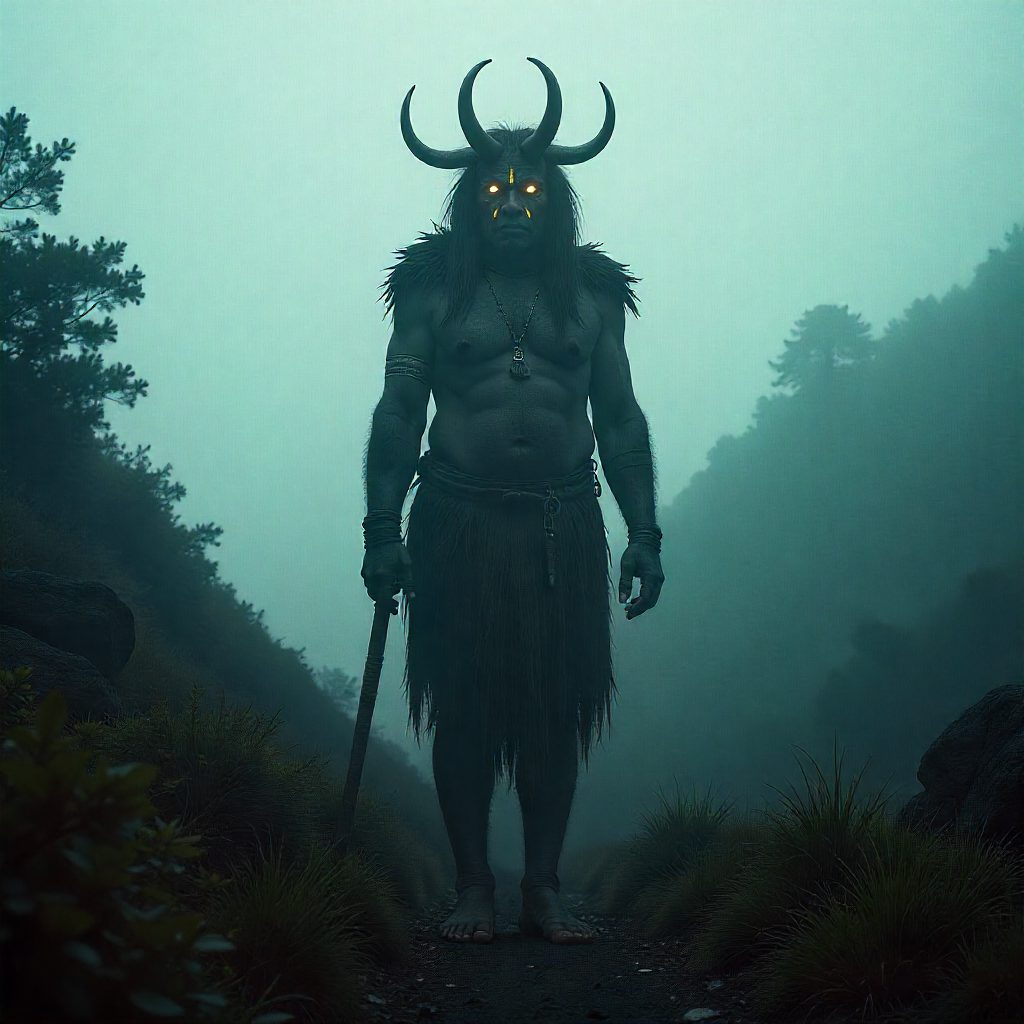
The physical portrayal of Kembu is symbolic, shaped by the dramatic landscape and customs of the Dani highlands. He is often envisioned as a spirit emerging from the fog that blankets the Baliem Valley at dawn, his form shifting between mist and shadow. This ethereal quality mirrors the valley’s environment and reinforces his role as a guardian who moves between natural and spiritual spaces.
Folklore describes Kembu with elongated features that echo ancient mummified ancestors preserved in villages like Jiwika. His skin is imagined as darkened and textured like the preserved bodies smoked over generations, and his eyes glow with ember-like intensity, a nod to ritual fires. Storytellers frequently depict him adorned with pig tusks, feathers, and body paint—elements taken from Dani ceremonial attire—emphasising his connection to both warriors and ancestral spirits. Whether towering like mountain cliffs or dissolving into vapour among garden fields, Kembu’s appearance reflects his ability to adapt to the rugged terrain and shifting needs of the people.
Family
Kembu’s place within the Dani spiritual lineage is not defined through biological ties but through patrilineal ancestry and communal identity. Dani cosmology traces ancestral energy back to Walhowak, also known as Nyopase Kain, a high god who rarely interferes in human affairs. Kembu emerges from this ancestral continuum as a concentrated form of inherited Atou power, passed through generations of men and expressed during crucial rites such as initiations and pig feasts.
Kembu’s “family” is therefore both symbolic and collective. He is linked to the living through the honai—the traditional circular houses where men gather and perform ancestral rituals. He is equally associated with preserved warrior ancestors, whose mummified bodies serve as vessels of protection and communal memory. His kinship extends further to nature spirits believed to inhabit rivers, caves, and sacred groves, creating a network of supernatural relations that parallels the Dani clan system. Through these connections, Kembu reinforces social bonds, territorial identity, and cultural continuity.
Other names
The diverse landscape and oral traditions of the central highlands have given Kembu several alternative names and epithets, each reflecting a different aspect of his role. Some storytellers refer to him as a mountain ancestor, underscoring his presence in highland peaks revered for spiritual potency. Others call him a spirit guardian, capturing his protective oversight of gardens, homes, and hunting paths.
In prophecies linked to the Nabelan-Kabelan tradition, Kembu appears under names associated with change, ritual purity, or the protection of women’s roles in marriage customs. Among neighbouring groups like the Lani, related spirits are sometimes connected to Kembu through regional interpretations, revealing how fluid and adaptable Dani mythology is. These naming variations reflect a living oral tradition that evolves across clans while maintaining core spiritual themes.
Powers and Abilities
Kembu’s powers arise from his embodiment of Atou, the ancestral energy that sustains health, agriculture, social order, and spiritual balance. One of his most vital roles is restoring the edai-egen, the life essence believed to retreat from a person during illness. Through rituals that include chants, pig sacrifices, and ancestral invocations, Kembu is called upon to draw this essence back to the body, enabling healing.
Agricultural fertility is another domain of his influence. The Dani rely heavily on sweet potato cultivation, and Kembu is believed to bless the soil, regulate rainfall, and ensure balanced growth. When taboos concerning sacred sites or natural boundaries are violated, Kembu may withdraw his favour, leading to poor harvests or sickness within the community.
Kembu also serves as a spiritual protector, warding off malevolent forces such as the ghosts of slain warriors. In a society once shaped by ritualised warfare, this protective function was crucial, preventing cycles of haunting and misfortune. His powers extend to guiding elders through visions, forewarning of threats or major cultural shifts—an ability highlighted during the emergence of the Nabelan-Kabelan prophecies in the 20th century.
Modern Day Influence
Although the Dani have undergone significant cultural changes due to missionary influence, tourism, and integration into wider Indonesian society, Kembu remains a powerful symbol of identity. Rituals originating from Kembu traditions continue during pig feasts performed for visitors, preserving the spiritual meaning behind the spectacle. Sacred sites connected to ancestral spirits are protected even as economic activities expand, reflecting enduring environmental reverence.
In villages like Jiwika, festivals and cultural showcases honour ancestral guardians, including Kembu, helping younger generations reconnect with traditional stories. Artistic interpretations—seen in carvings, dances, and tattoo motifs—carry Kembu’s imagery into contemporary life, often blending ancient symbolism with modern expression.
Beyond local culture, Kembu appears in academic discussions on Melanesian belief systems, especially in studies of animism, ecological harmony, and the social role of spirits. While not globally mainstream, Kembu’s growing visibility through cultural tourism and online mythology platforms is introducing Dani spiritual heritage to wider audiences.
Related Images

Source
Giay, B. (1990). Cargoism in Irian Jaya today. In Across the boundaries of belief. Taylor & Francis. https://www.taylorfrancis.com/chapters/edit/10.4324/9780429502569-23/cargoism-irian-jaya-today-benny-giay-jan-godschalk
Heider, K. G. (1991). Dani. In Encyclopedia of world cultures, Oceania. G.K. Hall & Company. https://factsanddetails.com/indonesia/Minorities_and_Regions/sub6_3j/entry-4037.html
Mawikere, M. C. S. (2025). A study of the worldview in the mythology of the Dani ethnic. Padamara Jurnal Ilmiah. https://konselorgkn.com/index.php/padamara-jurnal-ilmiah/article/download/51/41
Teeuwen, J. H. (n.d.). The secret of Nabelan-Kabelan: Stone age people face to face with Jesus Christ. Bible in My Language. https://www.bibleinmylanguage.com/the-secret-of-nabelan-kabelan-jacques-h-teeuwen/
West Papua Voice. (2024). The unique and interesting culture of the Dani tribe of Papua. https://westpapuavoice.ac/social-culture/the-unique-and-interesting-culture-of-the-dani-tribe-of-papua/
Wikipedia contributors. (2025). Dani people. Wikipedia. https://en.wikipedia.org/wiki/Dani_people
Wood, M. (1982). Huli culture and society [Adapted for Dani parallels]. Papua New Guinea National Research Institute.
Zelenietz, M. (1979). The Huli of Papua New Guinea: A study in cultural change [Highlands mythology context]. McMaster University Anthropology Publications
Frequently Asked Questions
Who is Kembu in Dani mythology?
Kembu is a guardian ancestral spirit believed to protect the Dani people, enforce taboos, and ensure harmony between humans and nature.
What powers does Kembu have?
Kembu influences healing, agricultural fertility, protection from malevolent spirits, and guidance through visions and rituals.
How is Kembu connected to Dani ancestors?
He embodies Atou, the patrilineal spiritual energy inherited from forefathers, linking living clans with ancestral realms.
What does Kembu look like?
Folklore portrays him as a mist-like humanoid spirit with features inspired by mummified ancestors and Dani ceremonial adornments.
Does Kembu still influence modern Dani culture?
Yes. His symbolism appears in rituals, festivals, tourism performances, traditional art, and cultural preservation efforts.
