
Jengu : The Water Spirits of Sawa Tradition
Listen
At a glance
| Description | |
|---|---|
| Origin | Sawa Mythology |
| Classification | Spirits |
| Family Members | N/A |
| Region | Cameroon |
| Associated With | Healing, Water, Prosperity, Protection |
The Mythlok Perspective
Within the Mythlok framework, the Jengu are not rulers of water but expressions of it. They represent water as memory, morality, and consequence rather than territory to be controlled. Unlike classical sea deities who command storms or oceans through authority, the Jengu operate through reciprocity, granting balance only where respect is maintained. Comparable to river spirits across Central Africa, they remind us that nature responds not to dominance, but to relationship.
Jengu
Introduction
The Jengu occupy a central place in the spiritual worldview of the Sawa peoples of Cameroon, whose lives have long been shaped by rivers, estuaries, and the Atlantic coastline. Revered as powerful water spirits, the Jengu are understood not merely as supernatural beings but as intermediaries who mediate between human communities, ancestral forces, and the unseen dimensions of existence. Their presence permeates healing rituals, initiation ceremonies, and communal rites that have defined coastal Sawa identity for generations.
Within traditional belief systems of groups such as the Duala, Bakweri, Malimba, Bakoko, Subu, and Oroko, the Jengu are closely associated with purity, moral order, and balance. Water, in this cosmology, is not a passive element but a living force that remembers, judges, and restores. The mythology surrounding the Jengu reflects this understanding, portraying them as beings who reward respect and ritual observance while withdrawing their protection when waterways and traditions are neglected. Through them, the Sawa articulate a worldview rooted in reciprocity with nature rather than dominance over it.
Physical Traits
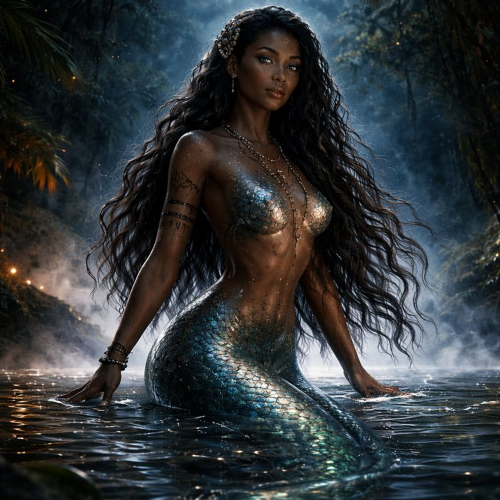
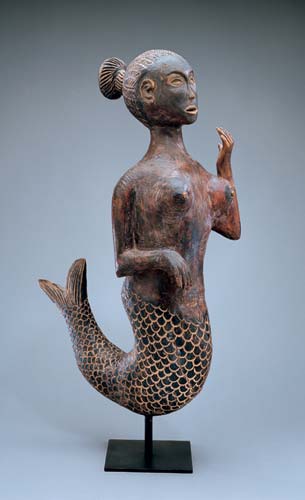
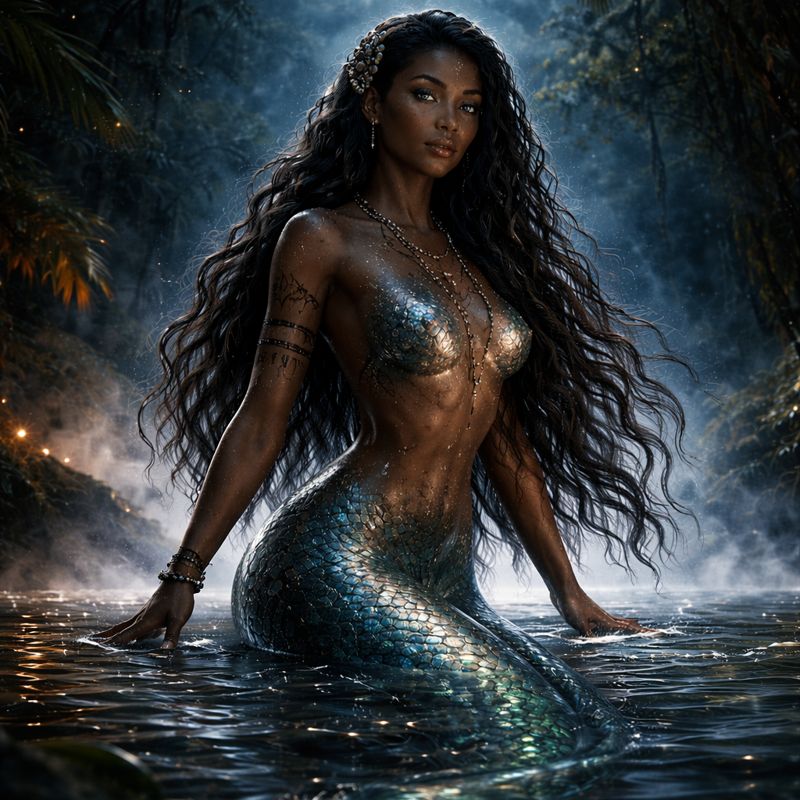
Descriptions of the Jengu emphasize their liminal nature, existing between the human world and the aquatic realm. They are most often portrayed as mermaid-like beings, with a human upper body and a fish-like lower form, reinforcing their identity as spirits who move freely between visible and invisible spaces. Their beauty is a defining characteristic, but it is not ornamental alone; it signals spiritual vitality and otherworldly presence rather than seduction in the human sense.
Oral traditions frequently highlight specific features such as long flowing or woolly hair, radiant skin that reflects light like water at dusk, and eyes that shimmer with an uncanny clarity. Some accounts mention a distinctive gap-toothed smile, a trait locally associated with attractiveness and spiritual favor. These physical traits are not fixed descriptions but symbolic markers, communicating the Jengu’s role as guardians of aquatic thresholds and embodiments of water’s life-giving and unpredictable power.
Family
The Jengu are never conceived as solitary spirits. They exist collectively as miengu, forming underwater communities that mirror human social structures while remaining fundamentally nonhuman. Within Sawa cosmology, they are often connected to ancestral forces, acting as extensions of lineage memory rather than detached supernatural entities. This relationship allows them to function as mediators, carrying human concerns into the spiritual realm and returning guidance, healing, or correction.
Ritual specialists and initiates may be described as having enduring relationships with particular Jengu, sometimes framed symbolically as spiritual marriages or guardianship bonds. These connections are not familial in a biological sense but are relational, emphasizing responsibility, continuity, and obligation. Through such bonds, the Jengu become woven into the moral and social fabric of the community, reinforcing the idea that spiritual kinship extends beyond bloodlines.
Other names
The name Jengu varies across linguistic and cultural contexts within coastal Cameroon, reflecting regional dialects rather than distinct entities. Among the Bakweri, the spirits are often referred to as Liengu, with the plural form Maengu. In Duala and related groups, Miengu is the commonly used plural, emphasizing their collective nature rather than individuality.
Some traditions also record the term Bisima, particularly in older sources or localized usages. These variations highlight the adaptability of Jengu belief across communities while preserving a shared understanding of their identity and function. Scholars have noted parallels between the Jengu and other Central African water spirits, especially the Simbi traditions of the Kongo region, though within Sawa belief the Jengu retain a distinct cultural grounding tied specifically to coastal and riverine life.
Powers and Abilities
The powers attributed to the Jengu reflect the central importance of water in sustaining both physical and spiritual well-being. Healing remains one of their most significant roles, with illnesses often interpreted as signs of spiritual imbalance or neglected obligations. Through ritual offerings, songs, and ceremonial immersion, the Jengu are believed to restore harmony to the body and community alike.
Beyond healing, the Jengu are invoked for prosperity, particularly in fishing, trade, and safe travel across water. Their favor is associated with calm seas, abundant catches, and protection from misfortune. They also function as intermediaries, conveying prayers and intentions between humans and higher spiritual forces. However, their benevolence is conditional. Pollution of waterways, broken ritual commitments, or moral transgressions may result in illness, failed ventures, or spiritual withdrawal, reinforcing their role as enforcers of balance rather than indulgent benefactors.
Modern Day Influence
Despite centuries of religious change and colonial disruption, belief in the Jengu has not disappeared. Instead, it has adapted, surviving alongside Christianity and Islam as a marker of cultural identity rather than open opposition. Ritual societies continue to perform songs, dances, and river ceremonies, often reframed as heritage practices while retaining their spiritual resonance within the community.
In contemporary discourse, the Jengu increasingly appear as symbols of environmental guardianship, embodying indigenous perspectives on ecological responsibility. Artists, writers, and scholars draw upon their imagery to explore themes of water conservation, cultural resilience, and the enduring relevance of African cosmologies. As global interest in non-Western mythic systems grows, the Jengu have emerged as powerful representatives of Central African aquatic spirituality, offering a counterpoint to more commercialized mermaid traditions.
Related Images
Source
Anna Muir Blog. (2016, September 8). Jengu, a brief look at mythology from Cameroon. Retrieved January 6, 2026, from https://annamuirblog.wordpress.com/
Beasts of Legend. (2025, December 27). Jengu: Cameroonian water spirit healers. Retrieved January 6, 2026, from https://beastsoflegend.com/bestiary/africa/central/jengu-water-spirit-healers/
Drewal, H. J. (2008). Sacred waters: Arts for Mami Wata and other divinities in Africa and the diaspora. Indiana University Press.
Geschiere, P. (1997). The modernity of witchcraft: Politics and the occult in postcolonial Africa. University of Virginia Press.
Monstropedia. (n.d.). Jengu. In Monstropedia: The online encyclopedia of monsters. Retrieved January 6, 2026, from https://www.monstropedia.org/index.php?title=Jengu
Peuple Sawa. (2005, November 14). The JENGU cult. Retrieved January 6, 2026, from
https://www.peuplesawa.com/fr/bnnews.php?nid=130
Thornton, J. K. (1998). Africa and Africans in the making of the Atlantic world, 1400–1800 (2nd ed.). Cambridge University Press.
Wikipedia contributors. (n.d.). Jengu. In Wikipedia, The Free Encyclopedia. Retrieved January 6, 2026, from https://en.wikipedia.org/wiki/Jengu
Mbiti, J. S. (1990). African religions and philosophy (2nd ed.). Oxford: Heinemann.
Warnier, J.-P. (1980). Elements for a sociology of Cameroon. Paris: Editions Karthala.
Neba, A. S. (1999). Modern geography of Cameroon. Bamenda: Neba Publishers.
Kopytoff, I. (1987). The African frontier: The reproduction of traditional African societies. Bloomington: Indiana University Press.
Frequently Asked Questions
Who are the Jengu in African belief systems?
The Jengu are water spirits revered by the Sawa peoples of Cameroon, believed to inhabit rivers, estuaries, and coastal waters.
Are Jengu considered gods or spirits?
They are classified as spirits rather than gods, acting as intermediaries between humans, ancestors, and the spiritual realm.
Do people still worship the Jengu today?
While formal worship has declined, ritual traditions and cultural practices honoring the Jengu continue in adapted forms.
What powers do the Jengu possess?
They are associated with healing, prosperity, protection, divination, and the maintenance of moral and ecological balance.
Are Jengu related to mermaids?
They share visual similarities but belong to a distinct Central African spiritual tradition rooted in ecological and ancestral cosmology.
