


Imana : The Supreme Creator in Rwandan Belief
Listen
At a glance
| Description | |
|---|---|
| Origin | Rwandan Mythology |
| Classification | Gods |
| Family Members | N/A |
| Region | Rwanda, Burundi |
| Associated With | Creation, Fertility, Rain, Justice |
Imana
Introduction
Imana occupies the highest position in the traditional cosmology of the Banyarwanda of Rwanda and the Barundi of Burundi, revered as the supreme creator and moral authority governing the universe. Unlike many creator figures who actively intervene in human affairs, Imana is understood as a transcendent presence whose influence permeates existence through order, balance, and natural law rather than constant divine intervention. In oral traditions passed down through generations, Imana is described as the origin of the earth, sky, water, animals, and humanity itself, establishing the ethical framework that binds society together.
At the heart of Imana’s mythology lies the idea of harmony. Creation is not accidental or chaotic but purposeful, structured, and sustained through moral conduct. Fertility of land, abundance of rain, and communal well-being are believed to flow from alignment with Imana’s will, while disorder and suffering arise when humans break this cosmic balance. This worldview reflects the agrarian foundations of Rwandan society, where survival depends on respect for nature, cooperation, and accountability. Through Imana, spirituality, ethics, and daily life become inseparable.
Physical Traits
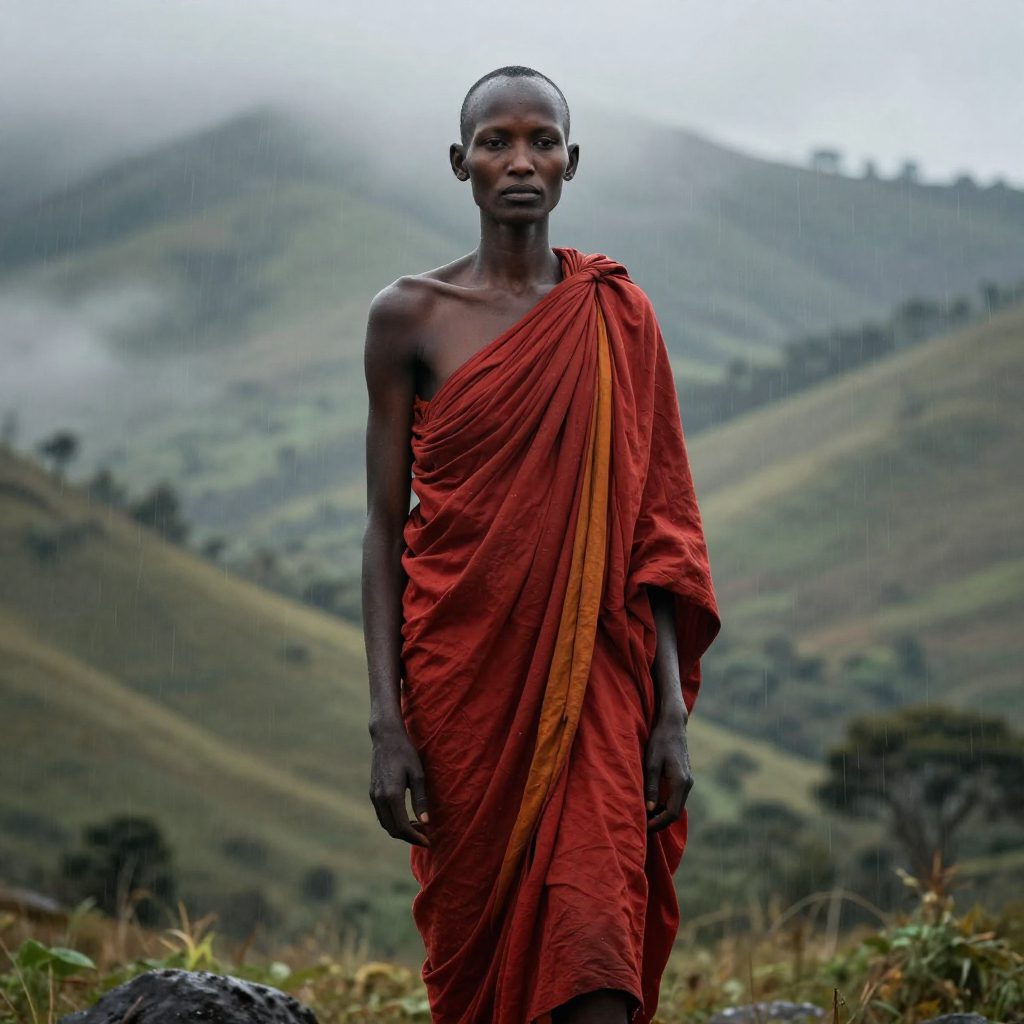
Imana is primarily conceived as a formless and invisible being, existing beyond the limitations of the physical world. Unlike anthropomorphic gods found in many myth traditions, Imana does not possess a fixed appearance, gender, or bodily form. This absence of physical definition reinforces the belief that Imana transcends human categories and cannot be confined to imagery or idols.
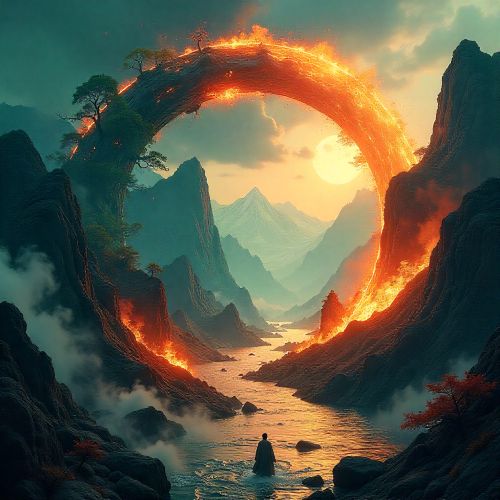
Some oral narratives employ symbolic descriptions to communicate divine distance rather than literal form. In these stories, Imana is said to dwell high above the world, separated from humanity after the loss of immortality, emphasizing the irreversible boundary between the divine and the mortal. Occasional references to radiance, vast reach, or extraordinary limbs function metaphorically, illustrating omnipresence and authority rather than suggesting a concrete body. By resisting visual representation, Rwandan cosmology preserves Imana as an all-encompassing force rather than a localized deity.
Family
Imana stands alone in the spiritual hierarchy and is not part of a divine family in the conventional sense. There are no myths describing spouses, parents, or offspring. This singular status distinguishes Imana from polytheistic systems and highlights the strongly monotheistic structure of traditional Rwandan belief.
Rather than familial gods, Imana presides over a network of spirits who act as intermediaries between the divine and human worlds. These include ancestral spirits known as bazimu and powerful spiritual figures associated with healing, protection, and justice. While these beings may influence daily life, their authority is always subordinate to Imana. This structure reinforces the idea of Imana as the ultimate source of existence and moral law, with all spiritual power ultimately flowing from a single origin.
Other names
While “Imana” remains the most widely used name, several epithets appear in oral traditions to describe specific attributes of the supreme being. One of the most significant is Rurema, meaning “the Creator,” emphasizing Imana’s role as the origin of all existence. Another common title is Rugira, often interpreted as “the Giver” or “Sustainer,” reflecting the belief that life, fertility, and prosperity come directly from divine provision.
In modern usage, Imana has also become synonymous with the Christian concept of God, especially after the spread of Christianity in the Great Lakes region. Rather than replacing the traditional deity, missionary religion absorbed the existing name, allowing spiritual continuity across belief systems. This linguistic and theological overlap demonstrates how deeply embedded Imana is in regional identity, extending across Rwanda, Burundi, eastern Congo, and parts of Tanzania.
Powers and Abilities
Imana’s powers are absolute but exercised through restraint rather than spectacle. As creator, Imana brought the universe into being and established the natural laws governing life and death. One well-known myth recounts Imana’s attempt to eliminate death entirely, pursuing it as a destructive force that threatened humanity. Although death ultimately escaped due to human interference, the story explains mortality as a consequence of broken divine intention rather than cruelty.
Imana is also the source of rain and fertility, vital forces in an agricultural society. Good harvests and healthy livestock are interpreted as signs of divine favor, while drought and famine signal moral imbalance rather than random misfortune. Justice is another core aspect of Imana’s authority. Rather than immediate punishment, justice unfolds through long-term consequences, reinforcing personal responsibility and ethical living. Omnipresence and omniscience define Imana’s awareness, ensuring that no action escapes cosmic accountability.
Modern Day Influence
Imana remains deeply woven into contemporary Rwandan life despite centuries of religious change. In everyday language, expressions invoking Imana are common, used to offer blessings, express gratitude, or acknowledge fate. These phrases reflect continuity rather than nostalgia, demonstrating that traditional cosmology still informs social interaction and moral reasoning.
The name Imana is now widely used to refer to the Christian God, creating a unique fusion of indigenous belief and global religion. This syncretism has allowed traditional spirituality to survive within new theological frameworks rather than being erased. In the aftermath of the 1994 genocide, many Rwandans framed survival, reconciliation, and healing through spiritual reflection, often invoking Imana as a source of endurance and moral renewal.
In academic discourse, literature, and cultural preservation efforts, Imana symbolizes Rwanda’s intangible heritage. Storytelling initiatives, digital platforms, and educational projects continue to document and reinterpret ancient narratives, ensuring that Imana remains a living presence rather than a forgotten relic. Through these evolving expressions, the supreme creator continues to shape identity, resilience, and collective memory.
Related Images

Source
Hiernaux, J. (1975). The people of Africa: Roots of African civilization. Scribner.
Linden, I. (1977). Church and revolution in Rwanda. Manchester University Press.
Newitt, M. (1995). A history of Mozambique. Indiana University Press.
Perraudin, M. (2015). Unsettling the world: Surveying the aftermaths of conflict and revolution in Imana, 1789-1830. Cambridge University Press. (Note: Contextual publication on African spiritual histories.)
Wikipedia contributors. (2025). Imana. https://en.wikipedia.org/wiki/Imana
Wikipedia contributors. (2025). Folklore in Rwanda. https://en.wikipedia.org/wiki/Folklore_in_Rwanda
Zguta, R. (1978). Russian miners and adventurers in Madagascar and East Africa. Cahiers d’Histoire Mondiale, 18(2), 234-256.
Vansina, J. (1990). Paths in the Rainforests: Toward a History of Political Tradition in Equatorial Africa. Madison: University of Wisconsin Press.
Taylor, C. (1999). Sacrifice as Terror: The Rwandan Genocide of 1994. Oxford: Berg Publishers.
Chrétien, J.-P. (2003). The Great Lakes of Africa: Two Thousand Years of History. New York: Zone Books.
Ndagijimana, F. (2016). Spirituality and Identity in Rwanda: The Role of Imana in Cultural Memory. Kigali: Rwanda Cultural Press.
Frequently Asked Questions
Who is Imana in Rwandan belief?
Imana is the supreme creator deity of traditional Rwandan and Burundian cosmology, responsible for creation, moral order, and natural balance.
Is Imana a monotheistic god?
Yes. Traditional belief systems centered on Imana are strongly monotheistic, with all spiritual authority deriving from a single supreme being.
Does Imana have a physical form?
No. Imana is considered formless and transcendent, beyond human appearance or gender.
Is Imana the same as the Christian God?
In modern usage, Imana is commonly used to refer to the Christian God, reflecting religious syncretism rather than replacement.
Why is Imana important today?
Imana remains central to language, ethics, cultural identity, and spiritual reflection in Rwanda and neighboring regions.
