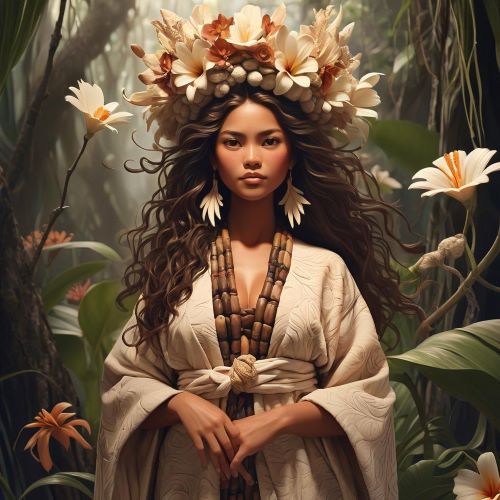

Haumea : The Hawaiian Goddess of Fertility and Creation
Listen
At a glance
| Description | |
|---|---|
| Origin | Hawaiian Mythology |
| Classification | Gods |
| Family Members | Pele, Hiʻiaka, Nāmaka, Kapo (Children) |
| Region | Hawaii |
| Associated With | Fertility, Childbirth, Creation, Regeneration, Abundance |
Haumea
Introduction
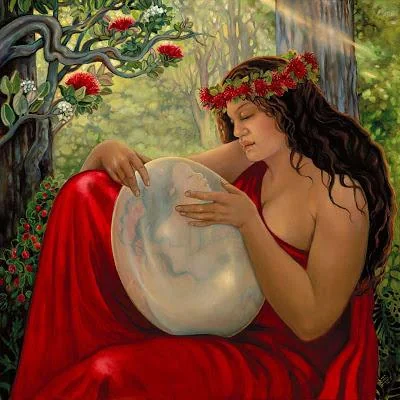
Haumea occupies a foundational place in Hawaiian sacred tradition as a goddess of fertility, childbirth, and generative abundance. She represents the life-giving forces that sustain both land and lineage, embodying the belief that creation is cyclical rather than linear. Unlike deities confined to distant realms, Haumea actively moves between divine and human worlds, shaping genealogies, nourishing communities, and renewing life wherever it falters.
Ancient chants and oral histories situate her among the earliest divine beings, often descending from Nuʻumealani, a celestial homeland, to dwell among humans. Her presence is strongly associated with Oʻahu, especially the Kalihi Valley, where she appears repeatedly in moʻolelo as a quiet traveler, a gatherer of food, or a mysterious woman whose generosity reveals divine origins only after her disappearance. Through these narratives, Haumea emerges not merely as a goddess of birth, but as the living principle of continuity itself—ensuring that people, food, and land remain eternally interconnected.
Physical Traits
Haumea is not defined by a single physical form, and this absence is deliberate rather than incidental. Her power lies in transformation, reflecting the Hawaiian understanding that life is constantly changing while remaining fundamentally whole. She can appear as a frail elderly woman, a radiant young maiden, or an unassuming traveler moving unnoticed through villages and forests.
Central to this ability is the sacred staff known as Mākālei, which allows her to renew her youth and vitality whenever age overtakes her. In some traditions, she becomes inseparable from the landscape itself, entering a breadfruit tree and emerging as its living essence, offering sustenance and protection to those who honor her. Rather than beauty defined by appearance, Haumea’s form expresses function—fertility, survival, and renewal—mirroring the land that feeds without demanding recognition.
Family
Haumea’s importance within Hawaiian tradition is inseparable from her vast and complex lineage. She is consistently remembered as the mother of major deities whose domains define the natural world. Among her most renowned children are Pele, the embodiment of volcanic fire; Hiʻiaka, associated with healing, hula, and growth; Nāmaka, connected to the ocean; and Kapo, linked to fertility and spiritual power.
Her familial relationships extend beyond conventional boundaries. Some genealogies describe her as sister or consort to major male gods such as Kāne or Kanaloa, while others emphasize her role as the ultimate ancestress of chiefs and human lineages. Birth itself becomes symbolic in these stories, as Haumea produces offspring from different parts of her body, reinforcing the idea that creation does not rely on a single form or method. Through her descendants, the elemental forces of fire, sea, forest, and ritual remain bound to a single maternal source.
Other names
Haumea is known by numerous names, each reflecting a particular role, location, or manifestation. These names are not alternative identities but contextual expressions of the same divine presence. In some traditions, she is closely aligned with Papahānaumoku, the earth-birthing mother, reinforcing her identity as the living ground from which life emerges.
Other names emerge from specific episodes—those tied to childbirth, nourishment, or concealment within nature. Certain epithets emphasize her role in painless birth, others her connection to food abundance or transformation. This multiplicity reflects the oral nature of Hawaiian tradition, where a deity’s name evolves alongside the land and people who remember her. Rather than fragmentation, these names reveal Haumea’s adaptability across regions and generations.
Powers and Abilities
Haumea’s powers center on creation, regeneration, and sustenance, extending far beyond biological fertility. She governs childbirth not only as a physical event but as a sacred process tied to balance and continuity. Legends credit her with discovering methods of painless birth, transforming human reproduction into an act aligned with divine harmony rather than suffering.
Her control over abundance is equally significant. Through Mākālei, she summons fish from the sea and ensures a constant supply of staple foods such as breadfruit and taro. When famine or conflict threatens survival, Haumea responds not through destruction but renewal, teaching communities how to endure through adaptation.
Transformation remains her defining power. Whether shifting age, form, or location, she demonstrates that survival depends on flexibility. Even warfare narratives depict her reclaiming youth to continue fighting, reinforcing that renewal is not passive but active resistance against decay and extinction.
Modern Day Influence
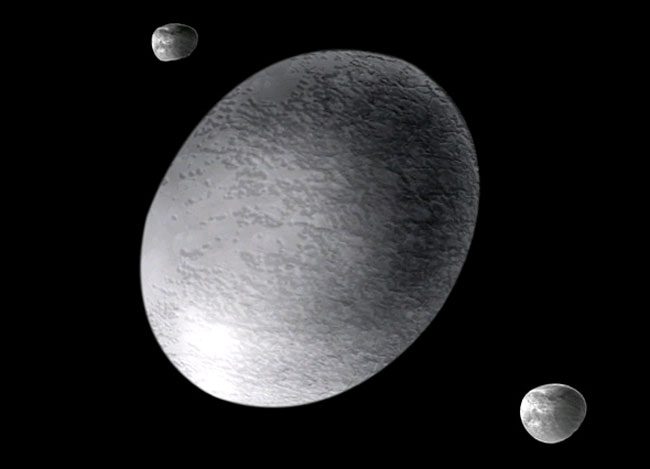
Haumea’s presence extends firmly into the modern world, where she continues to symbolize creativity, resilience, and reverence for the land. Her name gained international recognition when a distant celestial body was officially named after her, with its moons honoring her children. This association between cosmic creation and ancient belief reflects how indigenous knowledge continues to shape contemporary science.
Within Hawaiian cultural revival movements, Haumea is invoked in ceremonies honoring women, birth, and sacred space. Artists, scholars, and storytellers return to her narratives to explore themes of environmental stewardship, feminine power, and ancestral continuity. Far from being confined to the past, Haumea remains a living symbol of balance between humanity and nature—an enduring reminder that creation is sustained only through respect, renewal, and responsibility.
Related Images

Source
Beckwith, M. (1970). Hawaiian mythology. University of Hawaii Press. (Originally published 1915; accessed via sacred-texts.com)
Malo, D. (1951). Hawaiian antiquities (N. B. Emerson, Trans.). Bernice P. Bishop Museum. (Special Publication 2)
Pukui, M. K., Elbert, E. M., & Mookini, E. T. (1974). Place names of Hawaii. University of Hawaii Press.
Westervelt, W. D. (1916). Hawaiian legends of volcanoes. G. H. Ellis Press.
Wikipedia. (2023). Haumea (mythology). https://en.wikipedia.org/wiki/Haumea_(mythology)[1]
NASA. (2025). Haumea. https://science.nasa.gov/dwarf-planets/haumea/
Kumulipo Chant. (1889). In Kumulipo: Hawaiian creation chant (Queen Liliuokalani, Trans.).
Beckwith, M. (1932). Arts and crafts of Hawaii. Bernice P. Bishop Museum. (Section on myths)
Frequently Asked Questions
Who is Haumea in Hawaiian belief?
Haumea is a creation goddess associated with fertility, childbirth, and renewal, regarded as a maternal source of both gods and humans.
Is Haumea the mother of Pele?
Yes, most traditions identify Haumea as the mother of Pele, along with several other major Hawaiian deities.
What powers does Haumea possess?
Her powers include regeneration, transformation, painless childbirth, food abundance, and lineage continuation.
Why is a planet named Haumea?
The dwarf planet Haumea was named after her to reflect themes of creation and fertility, with its moons named after her daughters.
Is Haumea still important in modern Hawaiian culture?
Yes, she remains a powerful symbol in cultural revival, women’s rituals, environmental thought, and artistic expression.