

Gbayi : The Primordial Force in Banda Belief
Listen
At a glance
| Description | |
|---|---|
| Origin | Banda Mythology |
| Classification | Gods |
| Family Members | N/A |
| Region | Central African Republic, Chad, Democratic Republic of the Congo |
| Associated With | Creation |
Gbayi
Introduction
Gbayi occupies the highest position in Banda cosmology, revered as the supreme creator whose existence precedes all things. Among the Banda communities of the Central African Republic, southern Chad, and parts of the Democratic Republic of the Congo, Gbayi represents the origin point from which the heavens, the earth, and all spiritual forces emerged. The mythology surrounding Gbayi reflects a worldview grounded in harmony, where human life, the natural environment, and the realm of spirits operate as interdependent systems requiring continuous balance.
Rather than depicting Gbayi as an active overseer of daily events, Banda traditions describe a creator who established the framework of existence before withdrawing from direct involvement. This distance is not absence but a deliberate cosmic design: Gbayi’s essence remains within the world, while responsibility for maintaining order falls to spiritual intermediaries such as the mbanza nature spirits and revered ancestors. Rituals, dances, and oral storytelling preserve these beliefs, allowing Banda culture to transmit ethical lessons about humility, respect, and harmony with the environment. Through these narratives, Gbayi becomes a reminder that human prosperity depends on sustaining equilibrium with the forces that govern life.
Physical Traits
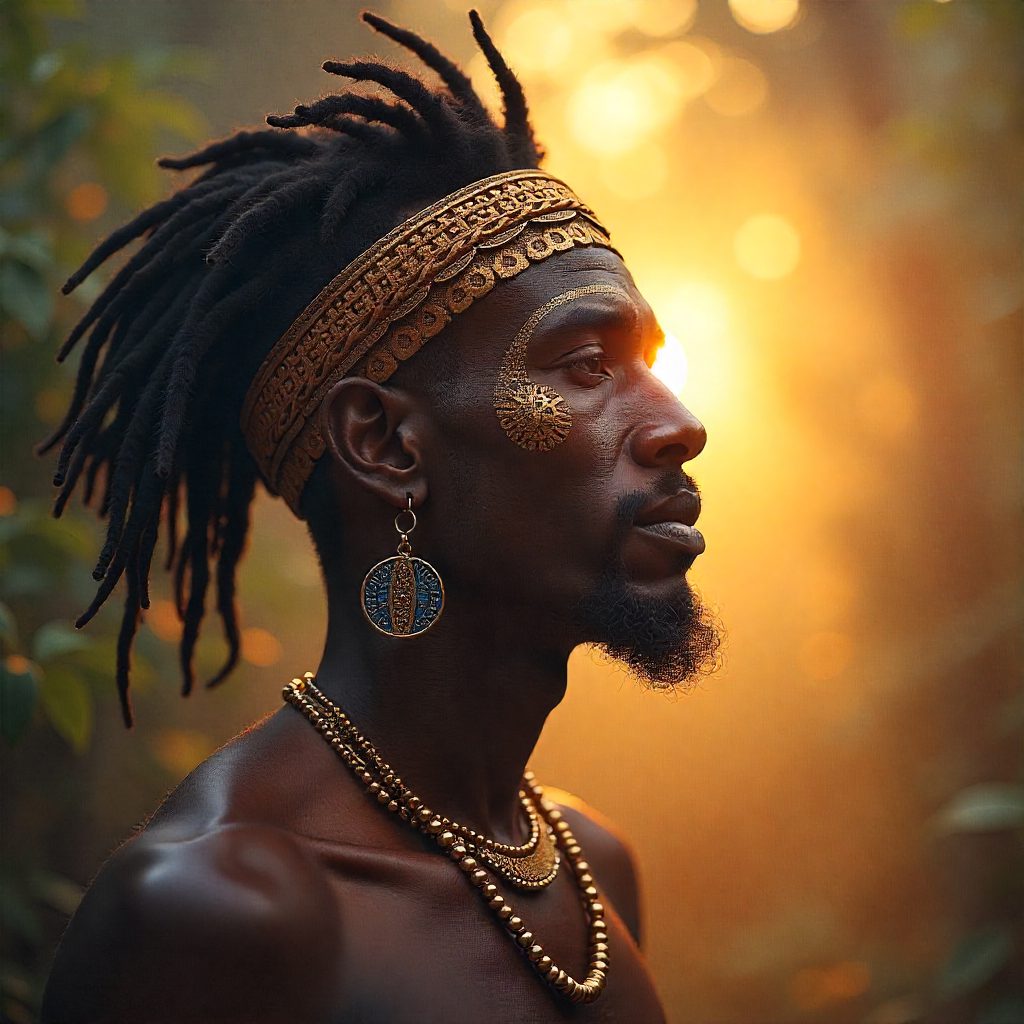
Gbayi’s physical appearance is rarely described within Banda mythology, a characteristic shared with many creator deities from Central and Southern Africa. The absence of defined physical traits reflects Gbayi’s role as an abstract, transcendent being rather than a deity with human form or animal symbolism. Instead, the deity is often associated with the sky, the vastness of creation, and the invisible forces that shape the world. These associations allow followers to conceptualize Gbayi not as a figure to be seen, but as a presence felt through natural phenomena.
Ceremonies connected to Banda spirituality usually avoid portraying Gbayi directly, choosing instead to emphasize masks, drums, and symbolic dances that honor the mbanza spirits operating under Gbayi’s authority. This respectful distance reinforces the belief that the supreme creator exists beyond material representation. The intangible nature of Gbayi also aligns with broader Central African cosmologies, where the divine is understood as a limitless and formless energy responsible for maintaining the balance between humanity and nature.
Family
In Banda tradition, Gbayi exists without a divine family, emerging as the singular origin of all creation. Unlike mythologies that describe gods with complex lineages, Banda cosmology centers on a solitary creator who brings the universe into existence before appointing spiritual beings to manage its functions. This structure emphasizes Gbayi’s ultimate authority while also highlighting the importance of intermediaries.
The closest concept to a “family” surrounding Gbayi is found in the roles played by ancestors and nature spirits. Ancestors act as moral and spiritual extensions of Gbayi’s creative power. They guide the living, provide protection, and ensure continuity between generations. Nature spirits, including river beings, forest guardians, and animal-associated entities, oversee specific aspects of the environment and human activity. All of these beings originate from Gbayi’s initial act of creation, functioning as channels through which divine order flows into the world.
Other names
The name Gbayi is widely recognized in Banda oral literature, but regional variation across Banda-speaking communities can lead to slight differences in pronunciation or emphasis. While Gbayi does not have an extensive list of alternative names, some storytellers refer to the deity with descriptive titles such as “Great Spirit” or “Sky Father,” highlighting divine authority and cosmic significance. These titles do not replace the original name but expand the interpretive layers around the deity.
Comparative mythology shows occasional parallels between Gbayi and supreme beings found in neighboring cultures, such as Gomwa of the Gbaya or remote sky deities referenced in Central African Bantu traditions. Although these connections help scholars trace cultural exchanges, Gbayi remains uniquely rooted in Banda cosmology and is not equivalent to deities from surrounding groups.
Powers and Abilities
Gbayi’s powers are foundational and absolute, shaping every aspect of cosmic order. The primary power is creation itself: Gbayi forms the universe from primordial nothingness, giving life to the earth, humans, spirits, and the natural forces that sustain existence. This creative ability is complemented by omniscience, allowing Gbayi to perceive all things while remaining apart from everyday affairs.
Gbayi establishes moral principles that guide community life. Misfortune—whether illness, drought, or conflict—signals imbalance within this divine order. However, Gbayi rarely intervenes directly. Instead, the mbanza spirits enforce natural laws, while ancestors interpret moral breaches and communicate them through dreams, omens, or ritual divination.
Ritual specialists known as nganga play a vital role in restoring harmony. Through offerings, chants, and ceremonial performances, they address spiritual imbalances and reaffirm the connection between the people and the divine framework created by Gbayi. This system reflects a worldview where divine power is constant yet collaborative, shared between the creator, spirits, and humanity.
Modern Day Influence
The influence of Gbayi continues to shape Banda identity even as modern religions and social changes reshape Central Africa. While Christianity and Islam are widely practiced, Gbayi remains present in cultural memory through oral histories, traditional rites, and community rituals. Celebrations linked to agricultural cycles often incorporate myths about cosmic balance, echoing Gbayi’s teachings on human responsibility and environmental respect.
Contemporary African writers and cultural revival movements increasingly draw upon indigenous cosmologies like Gbayi’s to reclaim and preserve ancestral knowledge. The emphasis on balance between humans and nature also resonates strongly with global ecological conversations, offering traditional Banda philosophy as a model for sustainable living. Through these modern expressions, Gbayi’s legacy continues to evolve while remaining faithful to its origins.
Related Images
Source
Central African folktales (The world’s greatest myths and legends). (2024). Literati Books. https://literatibookstore.com/book/9781804177808
Jackson, J. (2024). Central African folktales. Flame Tree Press.
Knappert, J. (1977). Bantu myths and other tales. Brill.
Werner, A. (1933). Myths and legends of the Bantu. Frank Cass & Co.
101 Last Tribes. (2005). Gwari people. http://www.101lasttribes.com/tribes/gwari.html
History Rise. (2024, September 26). The Banda and Gbaya peoples: Pre-colonial societies in Central Africa. Retrieved December 9, 2025, from https://historyrise.com/the-banda-and-gbaya-peoples-pre-colonial-societies-of-the-central-african-republic/
Vansina, J. (1990). Paths in the rainforest: Toward a history of political tradition in equatorial Africa. Madison: University of Wisconsin Press.
Zahan, D. (1979). The religion, spirituality, and thought of traditional Africa. Chicago: University of Chicago Press.
Mbiti, J. S. (1990). African religions and philosophy (2nd ed.). Oxford: Heinemann.
Kopytoff, I. (1987). The African frontier: The reproduction of traditional African societies. Bloomington: Indiana University Press.
Shaw, R. (2002). Memory and identity in African religion. Oxford: Oxford University Press.
Frequently Asked Questions
Who is Gbayi in Banda mythology?
Gbayi is the supreme creator deity of the Banda people, responsible for forming the universe and establishing the spiritual order that governs life.
Does Gbayi have a physical form?
No. Gbayi is portrayed as a formless, transcendent being associated with the sky and cosmic creation.
Are there other gods connected to Gbayi?
Gbayi stands alone as the creator, but spirits known as mbanza and ancestral beings act as intermediaries derived from Gbayi’s creation.
What powers is Gbayi known for?
Gbayi holds the power of creation, cosmic oversight, and moral authority that shapes Banda cultural and spiritual practices.
Is Gbayi still worshipped today?
While modern religions have spread, Gbayi remains influential in Banda cultural traditions, rituals, and ecological philosophies.
