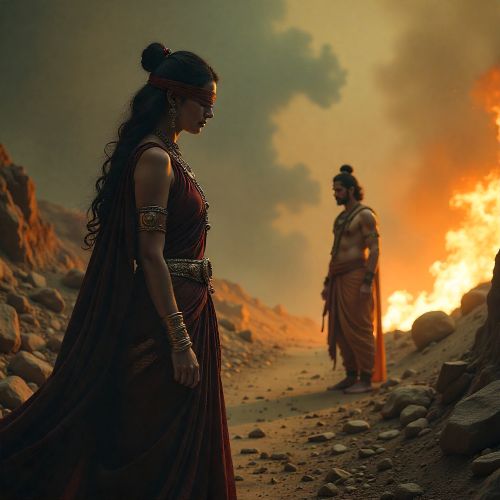

Ravana’s Curse : The Judgment That Shaped the Ramayana
Listen
At a glance
| Description | |
|---|---|
| Mythology | Indian Mythology |
| Cursed Individual(s) | Ravana |
| Cursed By | Nalakuvara |
| Primary Consequence | Death if violating a woman’s consent |
| Symbolism | Limits of power, respect for boundaries |
Ravana’s Curse
Introduction
Ravana’s Curse is one of the most revealing episodes in Indian mythology, offering a rare lens into the moral limits placed even upon the most powerful beings. Ravana, the ten-headed ruler of Lanka, is remembered not only as the antagonist of the Ramayana but also as a scholar, musician, and devout worshipper of Lord Shiva. Yet his intellectual brilliance was overshadowed by unchecked pride and desire. The curse placed upon him explains one of the Ramayana’s most frequently questioned moments: why Ravana, despite abducting Sita, never violated her. Far from being a narrative loophole, Ravana’s curse serves as a moral anchor, reinforcing the epic’s commitment to dharma, consent, and cosmic justice. It also ensures that Ravana’s downfall was not sudden or accidental, but the inevitable result of accumulated transgressions.
Mythological Background
Born to the sage Vishrava and the rakshasi Kaikasi, Ravana inherited both divine intellect and demonic ambition. Through intense penance, he gained extraordinary boons from Brahma, making him nearly invincible against gods, demons, and celestial beings. However, Ravana deliberately excluded humans from these protections, dismissing them as insignificant. This oversight would later prove fatal. Ravana seized Lanka from his half-brother Kubera and established himself as a dominant force across the three worlds. Yet his conquests were not limited to battlefields. Numerous episodes across the Ramayana and Puranic traditions describe Ravana violating ethical and social boundaries, particularly in his treatment of women. These repeated acts of arrogance and violence invited powerful curses that slowly eroded the protections granted by his boons. Ravana’s curse does not arise in isolation but emerges from this larger pattern of moral decay.
Origin of the Curse
The most decisive curse associated with Ravana originates from his assault on Rambha, a celestial apsara. Rambha was not merely a heavenly nymph but was betrothed to Nalakuvara, the son of Kubera, making her Ravana’s daughter-in-law by divine kinship. When Ravana encountered Rambha and attempted to violate her, she resisted and warned him of grave consequences. Ravana ignored her pleas, driven by entitlement rather than desire alone. When Nalakuvara learned of the crime, he pronounced a curse of absolute severity: if Ravana ever forced himself upon a woman against her will again, his head would instantly shatter into pieces. This curse was irreversible and binding, carrying the spiritual authority of Kubera’s lineage. It became the defining restraint that governed Ravana’s actions thereafter.
Nature of the Curse
Ravana’s curse did not strip him of power, nor did it limit his ambitions. Instead, it imposed a precise and terrifying boundary. He could abduct, threaten, and imprison women, but physical violation would result in immediate destruction. This specificity is crucial to understanding Ravana’s behavior toward Sita. Though obsessed with her, Ravana was acutely aware that crossing the final boundary would mean instant death. The curse functioned as karmic enforcement rather than redemption. It did not purify Ravana’s intentions; it merely prevented him from acting on them. In Indian mythology, such curses are often described as corrective instruments, ensuring that cosmic balance is preserved even when free will leads toward adharma.
Victims and Key Figures
Ravana himself stands at the center of the curse, not as a passive recipient but as its architect through repeated moral violations. Rambha, whose resistance initiated the curse, represents the assertion of consent and dignity even within divine hierarchies. Nalakuvara, acting not merely out of anger but moral authority, transforms personal outrage into cosmic law. Sita becomes the most visible figure protected by Ravana’s curse, her untouched captivity reinforcing her purity and moral strength within the Ramayana. Alongside this, the episode of Vedavati deepens the narrative. When Ravana attempted to violate the ascetic princess Vedavati, she immolated herself and cursed him, vowing to be reborn as the cause of his death. Her rebirth as Sita weaves multiple strands of fate into a single outcome, ensuring Ravana’s destruction from several converging karmic threads.
Consequences and Resolution
Ravana’s curse shaped the entire trajectory of the Ramayana’s central conflict. His inability to force himself upon Sita prolonged her captivity, giving Rama time to gather allies and wage war against Lanka. The curse intensified Ravana’s obsession rather than curbing it, leading him to reject counsel, underestimate human strength, and dismiss warnings from his own kin. Ultimately, the curse ensured that Ravana would face Rama on the battlefield, where his boons offered no protection. When Rama, a human incarnation of Vishnu, struck Ravana down, the conditions of multiple curses were fulfilled simultaneously. Ravana’s death was not merely a military defeat but the resolution of accumulated moral debts, restoring dharma to the cosmic order.
Symbolism and Moral Lessons
Ravana’s curse symbolizes the inescapable limits of power divorced from ethics. Knowledge, devotion, and strength are rendered meaningless when consent and restraint are abandoned. The curse reinforces a principle deeply embedded in Indian mythology: that adharma carries consequences regardless of status or intellect. It also serves as one of the earliest mythological affirmations of bodily autonomy and moral accountability. Ravana’s tragedy lies not in his power but in his refusal to govern it. His story warns that unchecked desire corrodes even the most formidable foundations, while dharma ultimately asserts itself through time, fate, and consequence.
Cultural Impact and Legacy
The story of Ravana’s curse continues to influence Indian cultural consciousness across centuries. It explains a critical narrative moment in the Ramayana while reinforcing Sita’s moral authority and resilience. Folk traditions, temple discourses, theatrical retellings, and modern literature frequently revisit the curse as a symbol of divine justice. In philosophical debates, it is often cited when discussing karma, consent, and the ethical limits of power. Even contemporary reinterpretations of Ravana, particularly in South Asian and Sri Lankan narratives that emphasize his scholarship, retain the curse as a necessary counterbalance. Ravana’s curse ensures that he is remembered not as a one-dimensional villain, but as a cautionary figure whose brilliance could not save him from moral failure.




Source
Griffith, R. T. H. (1870-1874). The Ramayana of Valmiki (Vols. 1-5). E. J. Lazarus and Co.
Valmiki. (1910). The Ramayana (R. T. H. Griffith, Trans.). https://www.sacred-texts.com/hin/rama/
Menon, R. (2006). The Ramayana: A Shortened Modern Prose Version of the Indian Epic. Penguin Classics.
Doniger, W. (2019). The Ramayana. Penguin Random House.
Sadhana Sansar. (2025, April 20). Rambha and Ravana: A tale of beauty and a powerful curse. https://www.sadhana-sansar.com/post/rambha-and-ravana-a-tale-of-beauty-and-a-powerful-curse
Bhagavatam Katha. (2024, August 20). The story of Ravana and Vedavati. https://www.bhagavatam-katha.com/the-story-of-ravana-and-vedavati-a-lesson-in-arrogance-and-humility/
Wikipedia. (2024). Ravana. https://en.wikipedia.org/wiki/Ravana
Tamil and Vedas. (2018, March 31). Three curses on Ravana. https://tamilandvedas.com/2018/03/31/three-curses-on-ravana-post-no-4869/
Frequently Asked Questions
What was Ravana’s curse in the Ramayana?
Ravana was cursed that if he ever forced himself upon a woman against her will, his head would instantly shatter, ensuring severe karmic restraint.
Why did Ravana not touch Sita despite abducting her?
Ravana feared the curse placed upon him by Nalakuvara, which would have caused his immediate death if he violated Sita.
Who cursed Ravana and why?
Nalakuvara, son of Kubera, cursed Ravana after he assaulted the celestial apsara Rambha.
Is Ravana’s curse mentioned in the Valmiki Ramayana?
The curse appears in later Ramayana traditions and Puranic sources that expand upon Ravana’s backstory and moral constraints.
What is the moral lesson behind Ravana’s curse?
The story emphasizes consent, accountability, and the inevitability of justice, showing that power without ethics leads to downfall.