

Chishimba : The Bemba Water Spirit of Sacred Falls
Listen
At a glance
| Description | |
|---|---|
| Origin | Bemba Mythology |
| Classification | Spirits |
| Family Members | Nakaela, Ntanda (Wives) |
| Region | Zambia |
| Associated With | Waterfalls, Moral law, Fertility, Protection |
The Mythlok Perspective
Chishimba represents an African understanding of power that does not dominate nature but negotiates with it. Unlike heroic gods who conquer elements, Chishimba enforces restraint, reminding humans that water cannot be owned without consequence. Similar river guardians appear across cultures, yet Chishimba’s strength lies in its localization. The spirit does not roam the world; it stays where memory, land, and responsibility intersect. In this stillness, authority endures.
Chishimba
Introduction
Bemba mythology emerges from a landscape shaped by rivers, mist, and escarpments, where nature is not separate from the sacred but infused with intention and memory. Among the most enduring figures in this tradition is Chishimba, a powerful spirit bound to waterfalls and the moral order surrounding them. Rooted in the beliefs of the Bemba people of northern Zambia, Chishimba reflects an older worldview in which landforms are not passive scenery but living thresholds between human society and unseen forces.
The Bemba trace their ancestral origins to migrations from the Luba Kingdom of the Congo Basin, carrying with them cosmological ideas that adapted to Zambia’s river systems and forested highlands. In this setting, waterfalls became places of concentrated power, where sound, movement, and danger marked the presence of spirits. Chishimba became inseparable from this environment, especially from the sacred Chishimba Falls near present-day Kasama. Rather than functioning as a distant god, Chishimba operates as a guardian presence, enforcing respect, restraint, and ritual behavior around water, land, and kinship.
Physical Traits
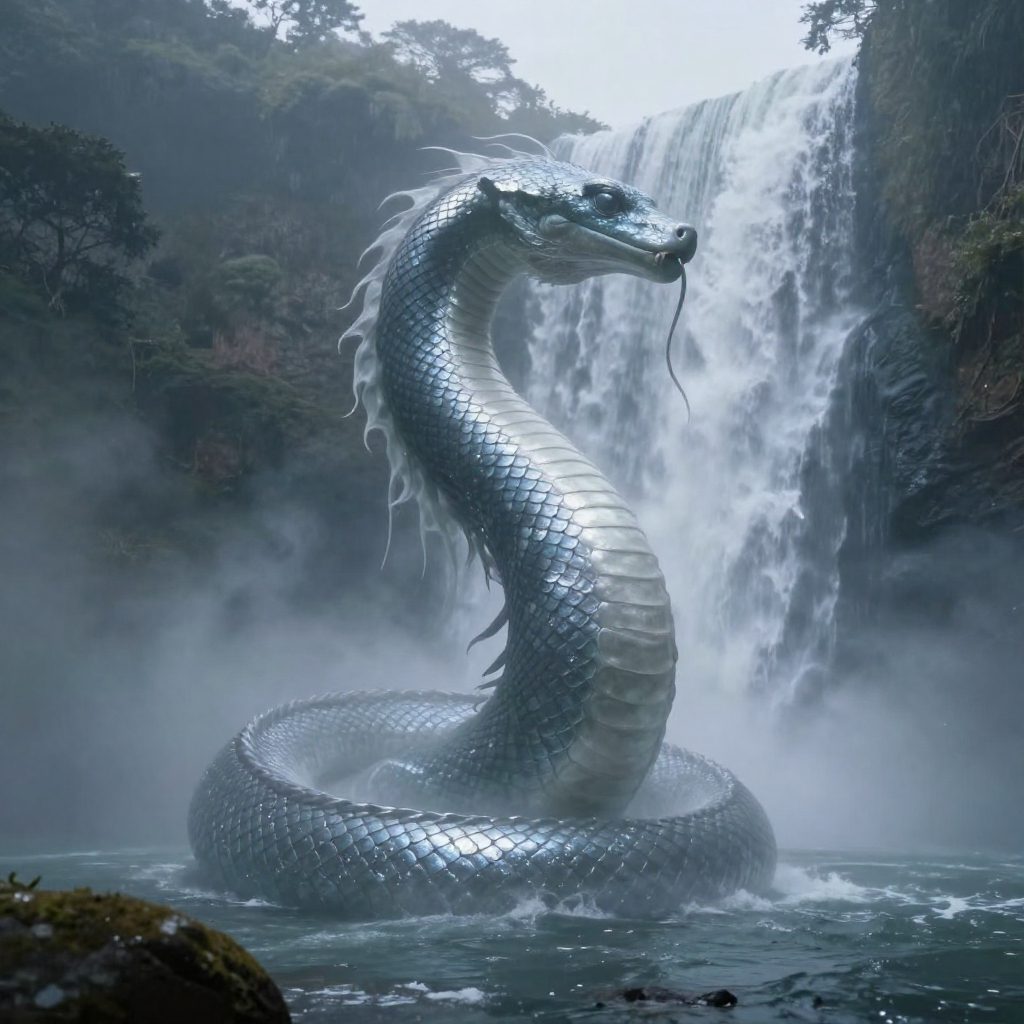
Unlike deities with fixed iconography, Chishimba does not possess a single stable physical form. In Bemba oral tradition, the spirit is most often perceived through the sensory experience of the waterfall itself: the thunder of falling water, the cold mist, and the dark pools at its base. Some narratives describe Chishimba as a vast serpent dwelling within the cascades, its body coiled through rock and current, while others emphasize invisibility, portraying the spirit as an unseen force rather than a visible being.
This fluidity is intentional. Chishimba is not meant to be looked upon casually. When described as serpentine, the imagery evokes both protection and danger, reinforcing the idea that water sustains life but also demands caution. The surrounding cliffs, caves, and spray are treated as extensions of the spirit’s body, making the landscape itself the physical manifestation of Chishimba’s presence.
Family
Chishimba occupies a complex position between spirit and ancestor. In one widely preserved narrative, Chishimba begins as a human figure, a polygamist with two wives, Nakaela and Ntanda, and daughters who become central to the legend. Domestic conflict, favoritism, and insult fracture the household, culminating in a sequence of ritualized leaps into the waterfall. Each fall becomes associated with a member of the family, transforming personal tragedy into sacred geography.
Through this story, Chishimba and his kin are transfigured into ngulu, powerful spirits bound to place. This transformation links family rupture with environmental sanctity, suggesting that moral disorder within the household can reshape the land itself. Other waterfall spirits in northern Zambia, such as Mutumuna and Kapisha, are often understood as spiritual counterparts rather than literal relatives, forming a wider network of guardian beings assigned to specific sites.
Other names
Chishimba is most commonly known as Chishimba Chamakota, a name that ties the spirit directly to the falls. In everyday speech, references may simply describe “the spirit of the falls,” reinforcing the idea that the location and the being are inseparable. Individual cascades within the waterfall system carry names associated with figures from the legend, embedding memory into geography.
While comparisons are sometimes drawn to serpent spirits elsewhere in Africa, Chishimba’s name and identity remain firmly localized. This specificity is crucial, as Bemba belief emphasizes the uniqueness of each sacred site rather than a universalized deity detached from place.
Powers and Abilities
Chishimba’s authority flows from water itself. As guardian of the falls, the spirit governs access, behavior, and ritual conduct in the surrounding area. When respected, Chishimba is believed to ensure balance: steady rainfall, fertile land, and communal stability. When angered, the same waters may turn hostile, darken unnaturally, or bring misfortune through floods, illness, or failed harvests.
Chishimba also functions as a moral enforcer. Taboos against arrogance, sexual misconduct, quarrels, and disrespect near the falls are not symbolic but practical expressions of cosmic law. Priests known as bashimapepo mediate between the community and the spirit, offering sacrifices and interpreting signs in animal behavior, water movement, and dreams. In this way, Chishimba’s power is less about spectacle and more about regulation, shaping how humans coexist with volatile natural forces.
Modern Day Influence
Despite modern infrastructure, Chishimba’s presence has not faded. The Chishimba Falls hydroelectric station, constructed in the mid-twentieth century, coexists with ongoing ritual observance. Offerings are still made, and taboos remain socially enforced, even as tourism infrastructure introduces trails, viewing platforms, and educational signage.
For the Bemba, Chishimba continues to anchor cultural identity, reinforcing respect for ancestral land and non-human agency. Storytelling, guided tours, and community memory ensure the legend is transmitted beyond formal ritual. In broader contexts, Chishimba has become a symbol in discussions of environmental ethics, demonstrating how indigenous belief systems encode sustainable relationships with ecosystems long before modern conservation frameworks emerged.
Related Images
Source
Langworthy, H. W. (1972). Zambia before 1890: Aspects of precolonial history. Longman.
National Heritage Conservation Commission. (n.d.). A guide to Zambia’s heritage. Zambia National Heritage Conservation Commission. https://www.atlasobscura.com/places/chishimba-falls
Oger, L. (2013). Storytelling in Northern Zambia: Theory, method, practice. Open Book Publishers.
https://books.openbookpublishers.com/10.11647/obp.0033.pdf
Tanguy, J. (1948). Les Bemba et leurs voisins.
Zambia Tourism. (n.d.). Chisimba Falls. https://www.zambiatourism.com/destinations/waterfalls/chisimba-falls/
Katanekwa, N. (n.d.). Zambia’s outstanding natural, cultural, & historic sites.
Mwale, M. L. (2025, June 19). Hidden histories of Zambia’s mythical waterfalls. Nkwazi Magazine. Retrieved from https://nkwazimagazine.com/zambias-enigmatic-and-mythical-waterfalls
Mbiti, J. S. (1990). African religions and philosophy (2nd ed.). Oxford: Heinemann.
Nchito, W. (2010). Waterfalls and cultural heritage in Zambia. Journal of African Cultural Studies, 22(3), 245–260.
Frequently Asked Questions
Who is Chishimba in Bemba belief?
Chishimba is a powerful water spirit in Bemba belief, closely associated with the sacred Chishimba Falls in northern Zambia. The spirit is understood as a guardian presence that enforces moral behavior, ritual discipline, and respect for natural forces connected to water.
Is Chishimba a god or a spirit?
Chishimba is not considered a god in the hierarchical sense but is classified as a spirit known as a ngulu. According to oral tradition, Chishimba originated from an ancestral figure who transformed into a spiritual guardian bound permanently to the waterfall.
Why are Chishimba Falls considered sacred?
Chishimba Falls are considered sacred because they are believed to be the dwelling place of the spirit Chishimba and other transformed ancestral figures. The site functions as a spiritual threshold where strict taboos govern conduct, reinforcing the connection between moral order and the natural environment.
What happens if Chishimba is angered?
If Chishimba is angered through disrespect, taboo-breaking, or ritual neglect, misfortune is believed to follow. This may manifest as floods, illness, failed harvests, or unexplained disturbances in the surrounding environment.
Is Chishimba still worshipped today?
Chishimba is still ritually acknowledged today through offerings, taboos, and priestly mediation, even as the site accommodates tourism and hydroelectric development. Traditional beliefs coexist with modern practices, reflecting the enduring cultural authority of the spirit.
