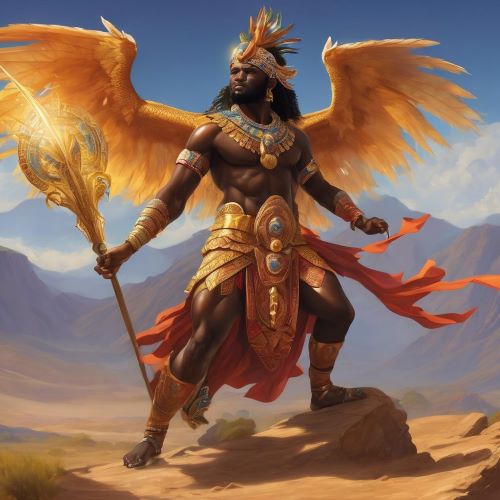

Wagar and the Architecture of Power in the Horn of Africa
Across the Horn of Africa and the ancient Nile world, cultures developed ideas that explained not only how the universe was formed, but how it was held together. One such idea is Wagar, a concept that appears in both Kushite and Somali cultural memory as a principle of binding, order, and continuity. Rather than a single deity or mythic figure, Wagar functions as an invisible framework. It is the rule that connects land to people, ancestors to the living, and authority to responsibility.
In Mythlok terms, Wagar is best understood as a structural myth. It does not act loudly. It governs quietly. It explains why certain actions stabilize society while others unravel it. This makes Wagar especially relevant in cultures where oral transmission, ritual memory, and environmental balance were more important than written law.
Wagar in the Kushite Worldview
In the ancient Nubian and Kushite civilizations, especially those centered around the Kingdom of Kush, cosmic balance was not abstract philosophy. It was political, ecological, and sacred at the same time. Kings were not merely rulers; they were custodians of order. Temples were not just places of worship; they were anchors that aligned human society with cosmic rhythm.
Within this framework, Wagar can be understood as the binding force that legitimizes structure. It explains why kingship was tied to ritual purity, why land and river cycles mattered, and why disorder was seen as contagious. When a ruler failed morally or ritually, it was believed that Wagar weakened. Droughts, invasions, or internal collapse followed not as punishment, but as natural consequences of imbalance.
Unlike later moral systems that separated ethics from nature, Kushite thought treated them as inseparable. Wagar ensured that authority flowed correctly, from ancestors to kings, from gods to land, and from land to people. To violate it was not rebellion alone; it was a fracture in reality itself.
Wagar in Somali Cultural Memory
In Somali culture, Wagar appears less as state ideology and more as social gravity. Somali society historically functioned without centralized monarchy for long periods, yet it maintained cohesion through shared law, lineage, and oral wisdom. Here, Wagar operates as an invisible agreement that binds clan, land, and honor.
Elders, poets, and mediators are the guardians of this force. Their words carry weight not because of coercion, but because they align with Wagar. When disputes are resolved properly, balance returns. When greed, betrayal, or arrogance dominate, fragmentation follows. This pattern mirrors the Kushite understanding, but in a decentralized form.
Importantly, Wagar in Somali thought is not rigid. It adapts. It allows movement, negotiation, and rebalancing. But it does not forgive sustained violation. A leader who breaks trust, a clan that ignores communal responsibility, or an individual who disrupts harmony weakens the binding force that keeps society intact.
A Shared Philosophy of Containment, Not Conquest
What unites Kushite and Somali interpretations of Wagar is their emphasis on containment rather than domination. Power is legitimate only when it stabilizes. Expansion without balance is dangerous. Strength without restraint leads to collapse.
This sets Wagar apart from mythic systems that glorify endless conquest or divine absolutism. Wagar does not reward excess. It rewards alignment. Whether expressed through kingship rituals along the Nile or poetic arbitration in Somali assemblies, the message is consistent. Order is not imposed. It is maintained.
From a comparative perspective, Wagar occupies the same philosophical space as balance concepts found across Africa and beyond, yet it remains distinct in its practical application. It is less about cosmic battle and more about sustained equilibrium.
Wagar as a Living Idea
Wagar did not disappear with ancient kingdoms or precolonial societies. It persists in how communities judge leadership, resolve conflict, and remember the past. In modern contexts, its influence can be felt whenever legitimacy is questioned not on technical grounds, but on moral and communal ones.
For Mythlok, Wagar represents a reminder that mythology is not always about gods with names and faces. Sometimes it is about the rules that decide whether civilizations endure or unravel. Wagar explains why societies collapse even when they appear powerful, and why others survive despite lacking centralized force.
It is the quiet architecture of continuity. And like all such structures, it only becomes visible when it begins to crack.
No posts were found.