
Khon Masks in Thai Culture and Classical Performance
In Thailand, masks are not merely decorative objects or theatrical props. In the case of Khon masks, they are vessels of memory, discipline, and sacred storytelling. Worn in the classical Khon dance drama, these elaborately crafted masks transform human performers into gods, demons, and heroic beings drawn from the epic world of Ramakien. To encounter a Khon mask is to encounter Thailand’s understanding of order, chaos, loyalty, and cosmic duty, expressed not through words alone, but through posture, movement, and silence.
Khon masks stand at the intersection of art, ritual, and performance. They invite exploration not just of how they are made, but of why they endure, and why Thai culture continues to preserve them with such care.
Origins of Khon Masks and Performance Tradition
Khon is one of Thailand’s most formal classical dance traditions, historically performed only for royal courts and sacred occasions. Unlike many theatrical forms, Khon traditionally does not rely on spoken dialogue from the dancers themselves. Instead, narration, music, and song are provided by an orchestra and vocalists, while the masked performers communicate entirely through controlled movement and gesture.
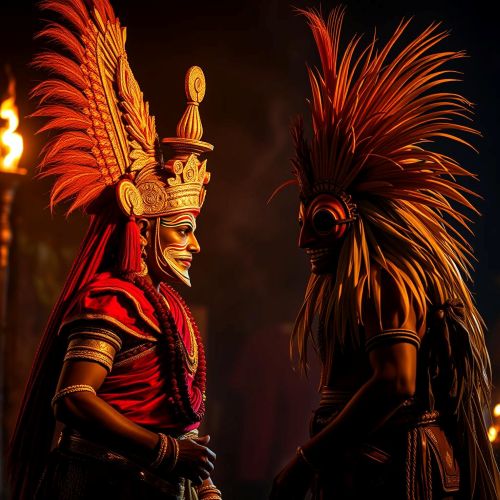
The masks emerged from this need for visual clarity and symbolic precision. Each mask identifies the character instantly, conveying rank, moral alignment, and temperament. Human characters may appear unmasked, but divine beings, monkeys, and demons are almost always masked, reinforcing the idea that they belong to a realm beyond ordinary humanity.
This separation between human face and mythic identity allows the performer to disappear completely into the role, an idea deeply embedded in Thai performance philosophy.
Symbolism Encoded in Khon Masks
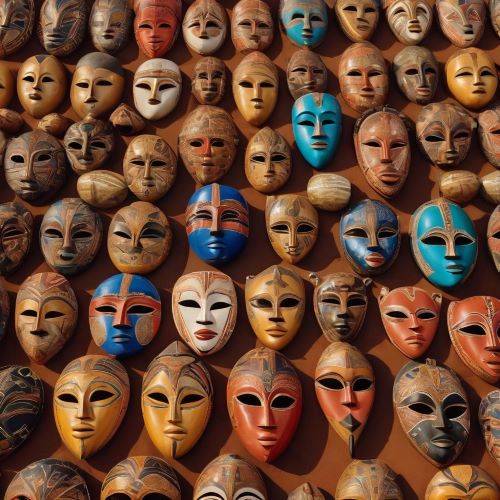
Every Khon mask is governed by strict iconographic rules. Colors, facial expressions, crowns, and even the curve of the mouth are standardized and meaningful. A green face does not simply look striking; it signals a specific character and lineage. Gold inlays and mirrored glass do not exist for ornament alone; they reflect divine radiance and cosmic authority.
The monkey general Hanuman, for example, is instantly recognizable through his white mask, animated features, and expressive mouth. His design communicates agility, intelligence, devotion, and mischief, qualities that are then echoed in the dancer’s leaps and acrobatics. In contrast, the demon king Tosakanth appears with a green face, elaborate crown, and fierce expression, projecting power, pride, and controlled menace.
In this way, Khon masks act as a visual language. Even without understanding the story, an audience can read hierarchy, conflict, and alignment through form alone.
Craftsmanship and Sacred Discipline
The creation of Khon masks is a highly specialized craft passed down through generations. Traditionally made from papier-mâché over clay molds, the masks are layered, dried, carved, painted, and decorated with gold leaf and mirrored fragments. Each step follows established proportions, ensuring that the final piece adheres to classical standards.
The process is not rushed. Artisans treat mask-making with reverence, often observing rituals before beginning work. Historically, masks were stored carefully and handled with respect, reflecting the belief that they carry spiritual presence tied to the characters they represent.
This disciplined craftsmanship mirrors the discipline required of Khon dancers themselves, who train for years to master minute movements of fingers, shoulders, and eyes, even though their own eyes remain hidden behind a painted gaze.
Khon Masks as Cultural Memory
Khon masks preserve more than artistic technique; they preserve Thailand’s ethical imagination. The stories of the Ramakien are not abstract myths but moral landscapes where loyalty to duty, respect for hierarchy, and restraint of desire are repeatedly tested. Through Khon, these values are performed again and again, allowing each generation to witness them embodied.
Because the dancers’ faces are concealed, individual identity dissolves into archetype. This reinforces a worldview in which personal ego is secondary to role and responsibility, an idea that resonates strongly with Thai social and cultural structures.
Khon masks therefore function as cultural anchors. Even when audiences change, and even as performances adapt for modern stages, the masks ensure continuity.
Contemporary Presence of Khon Masks
Today, Khon masks exist both on stage and beyond it. They appear in museums, cultural exhibitions, ceremonial displays, and even contemporary art reinterpretations. While modern performances may shorten narratives or adapt staging for international audiences, the masks themselves remain largely unchanged.
In recent decades, Thailand has actively promoted Khon as an intangible cultural heritage, ensuring that mask-making and performance training continue through formal institutions and royal patronage. The masks have also become powerful cultural symbols, representing Thai identity globally.
At the same time, designers and artists increasingly draw inspiration from Khon masks for fashion, illustration, and digital art, demonstrating their ability to evolve without losing meaning.
Why Khon Masks Still Matter
Khon masks endure because they offer something rare in modern culture: slowness, discipline, and symbolic depth. They ask the viewer to look closely, to read faces that do not change, and to listen to stories carried by movement rather than speech.
In a world saturated with fleeting images, Khon masks remind us that meaning can be layered, inherited, and preserved. They are not relics frozen in the past, but living forms that continue to teach, perform, and transform.
For those willing to explore them, Khon masks open a doorway into Thailand’s epic imagination, where every face tells a story that has been retold for centuries, and will continue to be told long into the future.
No posts were found.