

Anunnaki : Divine Rulers of Fate in Ancient Mesopotamia
| Description | |
|---|---|
| Origin | Mesopotamian Mythology |
| Nature | Neutral |
| Notable Members | Enlil, Enki, Inanna, Utu, Ninhursag |
| Symbolism | Cosmic order, Divine judgment, Fate, Balance of heaven and earth |
| Epics | Epic of Gilgamesh, Atrahasis, Enuma Elish |
Mythlok Perspective
From the Mythlok lens, the Anunnaki are best understood not as lost gods or misremembered aliens, but as an early expression of institutional power projected onto the cosmos. They represent the idea that fate is collective, debated, and decreed rather than arbitrary. In Mesopotamia, divine councils mirrored human governance, reinforcing social order through sacred narrative. Comparable figures appear elsewhere, from the Olympian council of Greece to the Norse Æsir and the Egyptian Ennead, all expressing the same impulse to frame authority as cosmic law. Across cultures, these assemblies reveal how humanity consistently imagined order as something negotiated above, yet felt deeply below.
Annunaki
Introduction
The Anunnaki occupy a central position in the religious imagination of ancient Mesopotamia, appearing across Sumerian, Akkadian, Assyrian, and Babylonian traditions as a collective of supreme deities entrusted with cosmic authority. Their name is commonly translated as “offspring of An” or “princely progeny,” directly linking them to the sky god An, known in later Akkadian tradition as Anu. From the earliest surviving texts of the Post-Akkadian period onward, the Anunnaki are portrayed not as distant abstractions but as active arbiters of fate, convening in divine assemblies to determine the destinies of gods, cities, and humanity itself. Over centuries, their roles shifted fluidly between heaven, earth, and the underworld, reflecting changes in political power, theology, and ritual practice within Mesopotamian society. Their enduring presence in foundational narratives such as the Epic of Gilgamesh and Inanna’s Descent underscores their importance as guardians of cosmic order rather than mere background figures in myth.
Physical Description
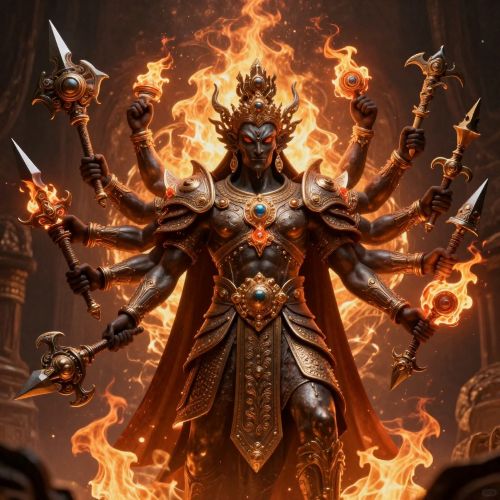
Mesopotamian sources rarely describe the Anunnaki in fixed biological terms, yet art and ritual language offer a consistent symbolic vocabulary that conveys their divine status. They are depicted as anthropomorphic beings of imposing scale, distinguished from humans by horned crowns that signify divinity and hierarchical rank. Many representations emphasize an overwhelming radiance, expressed through the concept of melam, a sacred brilliance believed to inspire awe, fear, and physical sensation in mortals. Cylinder seals and reliefs frequently show richly layered garments, elaborate jewelry, and dignified postures that convey authority rather than individual personality. In some periods, wings or hybrid features appear, not to suggest literal anatomy, but to reinforce their transcendence over earthly limitations. These visual conventions evolved over time, shaped by regional aesthetics and theological emphasis, yet they consistently present the Anunnaki as beings whose presence reshapes the space around them.
Mythological Context
Within Mesopotamian religion, the Anunnaki functioned as a divine council whose deliberations governed both cosmic balance and human fate. Texts describe them assembling to decide matters ranging from the establishment of kingship to the destruction or preservation of humanity. In Sumerian compositions, they are said to “decree the fates of mankind,” a phrase that encapsulates their judicial authority. Their role as underworld judges becomes especially prominent in later traditions, where they preside over the realm of the dead and pass sentence on transgressing deities, as seen when Inanna is condemned during her descent. In flood narratives preserved in the Epic of Gilgamesh, the Anunnaki are portrayed as agents of divine judgment who unleash catastrophe yet later mourn the devastation they sanctioned. This tension between authority and regret reflects a worldview in which divine power is absolute but not detached from consequence.
Origins
The origins of the Anunnaki are rooted in the earliest cosmological myths of Sumer, where heaven and earth existed in primordial unity. This unity was broken by Enlil, whose act of separation established the structured cosmos and defined the domains of the gods. Born from An and the earth goddess Ki, later identified with Ninhursag, the Anunnaki emerged as intermediaries who bridged celestial and terrestrial realms. The earliest known references to them appear in inscriptions from the reign of Gudea and texts of the Third Dynasty of Ur, where the term denotes the most powerful deities of the pantheon. As Mesopotamian religion evolved, Akkadian and Babylonian traditions expanded their number and refined their functions, sometimes distinguishing between Anunnaki of the heavens and those of the underworld. Despite these developments, their core identity as descendants of the sky god and custodians of fate remained intact.
Notable Members
Although no canonical list survives, several major deities are consistently identified as members of the Anunnaki. Enki, known as Ea in Akkadian tradition, embodies wisdom, fresh waters, and creative intelligence, often acting as a protector of humanity against harsher divine decrees. Inanna occupies a complex position as both participant in and subject of Anunnaki judgment, reflecting her liminal role between power and vulnerability. Nanna and Utu represent celestial order and justice, reinforcing the council’s association with cosmic regulation. Over all stands An himself, distant yet supreme, whose authority legitimizes the council’s decisions. Together, these figures illustrate that the Anunnaki were less a uniform class than a constellation of powers bound by shared ancestry and responsibility.
Relationship with Other Beings
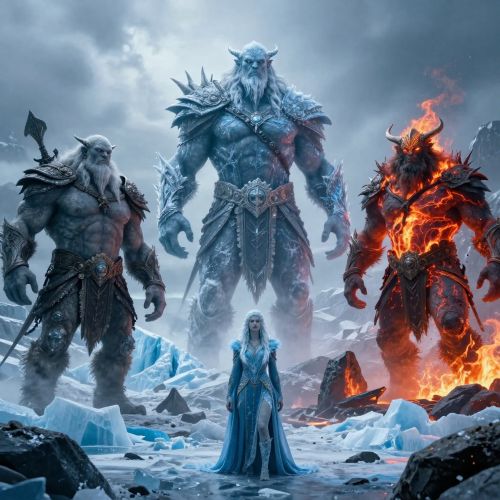
The Anunnaki’s authority extended across a layered divine hierarchy. In Akkadian literature, they are contrasted with the Igigi, a group of younger gods initially tasked with labor on behalf of the senior deities. When the Igigi rebelled, the solution devised by Enki led to the creation of humanity, positioning humans as laborers within a divinely ordered world. This myth establishes the Anunnaki as architects of social and cosmic structure, overseeing both gods and mortals. Their interactions with humans were mediated through temples, rituals, and omens, reinforcing the belief that prosperity or disaster flowed directly from their favor. In the underworld, lesser spirits and demons operate under their jurisdiction, further emphasizing their role as ultimate judges rather than active enforcers.
Similar Beings
Across cultures, the Anunnaki find parallels in other divine assemblies that govern fate and order. The Egyptian Ennead represents a collective of primordial gods responsible for creation and balance, while the Norse Æsir function as a ruling council shaping destiny through conflict and law. In Greek tradition, the Titans occupy a similar generational role as elder deities whose authority precedes the Olympians. Hebrew texts describing the Nephilim and later Enochian traditions of the Watchers echo the motif of beings who descend from heaven and influence the human world. These comparisons suggest that the Anunnaki reflect a widespread ancient archetype of celestial governance rather than an isolated theological concept.
Symbolism and Interpretations
Symbolically, the Anunnaki embody cosmic order, lawful authority, and the inescapability of fate. Their association with both fertility and judgment highlights a worldview in which creation and destruction are inseparable processes governed by divine law. Horned crowns signify potency and rank, while their assembly reflects the political realities of city-states governed by councils and kings. Modern scholarship interprets the Anunnaki as reflections of social hierarchy and religious administration rather than literal beings. Claims that portray them as extraterrestrial visitors arise from selective readings of mythic language, particularly clay-creation narratives, but these interpretations are rejected by historians and Assyriologists as pseudoscientific misrepresentations of symbolic texts.
Modern Influence
In the modern imagination, the Anunnaki have taken on a second life far removed from their ancient context. Pseudohistorical theories popularized in the late twentieth century recast them as alien engineers responsible for human origins, a narrative amplified by television, novels, and video games. While these portrayals diverge sharply from academic understanding, they testify to the enduring fascination with the Anunnaki as figures of hidden knowledge and power. Within scholarly discourse, however, their influence remains firmly grounded in the study of Mesopotamian religion, law, and cosmology, where they continue to illuminate how ancient societies understood authority, justice, and humanity’s place in the universe.


Sources
Black, J., & Green, A. (1998). Anunnaki. In The Electronic Text Corpus of Sumerian Literature (ETCSL). University of Oxford. https://etcsl.orinst.ox.ac.uk
British Museum. (n.d.). Mesopotamian gods and goddesses. https://www.britishmuseum.org/collection/galleries/mesopotamia
Encyclopaedia Britannica. (n.d.). Anunnaki. https://www.britannica.com/topic/Anunnaki
Metropolitan Museum of Art. (n.d.). Art of the ancient Near East. https://www.metmuseum.org/toah/hd/aneu/hd_aneu.htm
Black, J., Cunningham, G., Robson, E., & Zólyomi, G. (2004). The literature of ancient Sumer. Oxford University Press.
Kramer, S. N. (1963). The Sumerians: Their history, culture, and character. University of Chicago Press.
Dalley, S. (2000). Myths from Mesopotamia: Creation, the flood, Gilgamesh, and others (Revised ed.). Oxford University Press.
Jacobsen, T. (1946). Mesopotamian mythology: A review. Journal of the American Oriental Society, 66(4), 274–291. https://doi.org/10.2307/595879
Frequently Asked Questions
Who were the Anunnaki in Mesopotamian belief?
They were a group of powerful gods believed to decree fate and govern cosmic order across Sumerian, Akkadian, Babylonian, and Assyrian traditions.
Are the Anunnaki considered creators of humanity?
Some myths associate them with decisions that led to human creation, but they are not portrayed as direct biological creators in ancient texts.
Did the Anunnaki live in the underworld or the heavens?
Their role shifted over time, with early traditions placing them in heaven and later texts emphasizing their function as underworld judges.
Are Anunnaki alien theories historically accurate?
These interpretations are modern pseudohistorical claims and are rejected by mainstream scholarship.
Why are the Anunnaki still popular today?
They endure as symbols of hidden authority and ancient wisdom, inspiring modern fiction, conspiracy theories, and reinterpretations of myth.