
Poliahu : The Hawaiian Snow Goddess of Mauna Kea
Listen
At a glance
| Description | |
|---|---|
| Origin | Hawaiian Mythology |
| Classification | Gods |
| Family Members | Lilinoe, Waiau, Kahoupokane (Sisters) |
| Region | Hawaii |
| Associated With | Snow, Cold, Balance, Mauna Kea, |
The Mythlok Perspective
Poliahu is not a goddess of opposition but of containment. Where fire expands, she limits. Where destruction reshapes, she stabilises. Across cultures, cold deities often function as threshold keepers rather than conquerors, seen in figures like Skadi of the Norse north or Khione of the Greek highlands, who govern stillness rather than dominion. Poliahu fits this pattern precisely. She represents the pause that allows land to endure. In a modern world driven by excess and acceleration, her presence quietly argues that restraint itself can be a form of power.
Poliahu
Introduction
Poliahu stands as one of the most striking divine figures in Hawaiian sacred tradition, revered as the snow goddess of Mauna Kea, the highest and most spiritually significant mountain in Hawaiʻi. In a land globally associated with warmth and ocean winds, Poliahu embodies a powerful contradiction: snow, cold, and stillness reigning above the tropics. Her presence explains why Mauna Kea can wear a mantle of white while the lowlands remain lush and green, reminding people that Hawaiʻi is a land of layered worlds rather than a single climate or story.
The name Poliahu is often translated as “cloaked bosom” or “temple bosom,” imagery that reflects snow spread across the mountain like sacred cloth laid upon an altar. She is remembered not only for her beauty but for her role as a guardian of balance. Her legendary rivalry with Pele, the volcano goddess, is one of the most enduring elemental narratives in Hawaiian tradition. Through this opposition, Poliahu represents restraint, cooling, and preservation, countering unchecked destruction with quiet authority. Her stories do not portray domination, but equilibrium, reinforcing a worldview where opposing forces must coexist for the land to endure.
Physical Traits
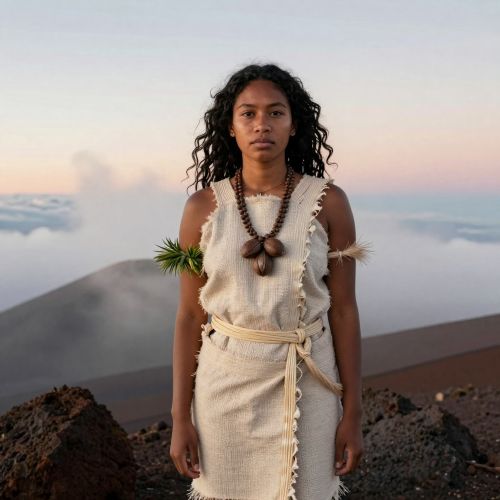
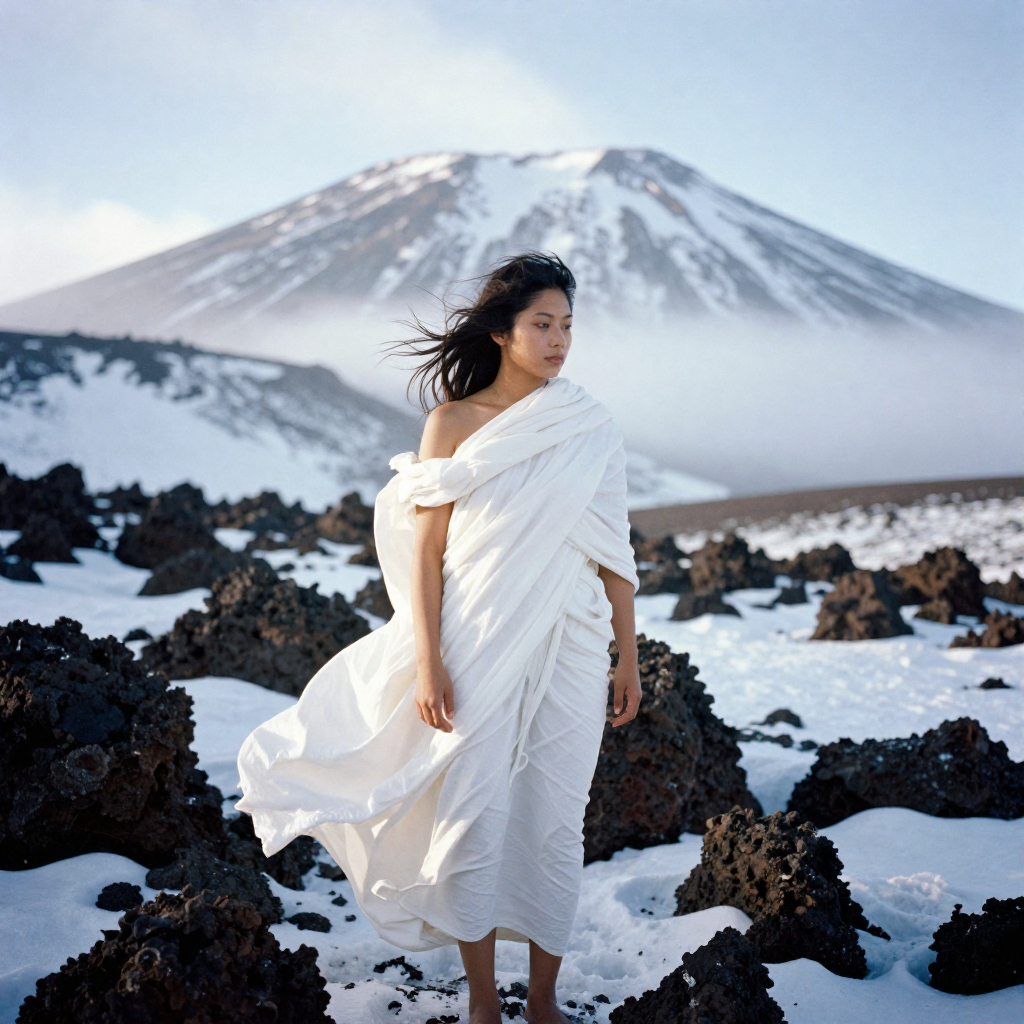
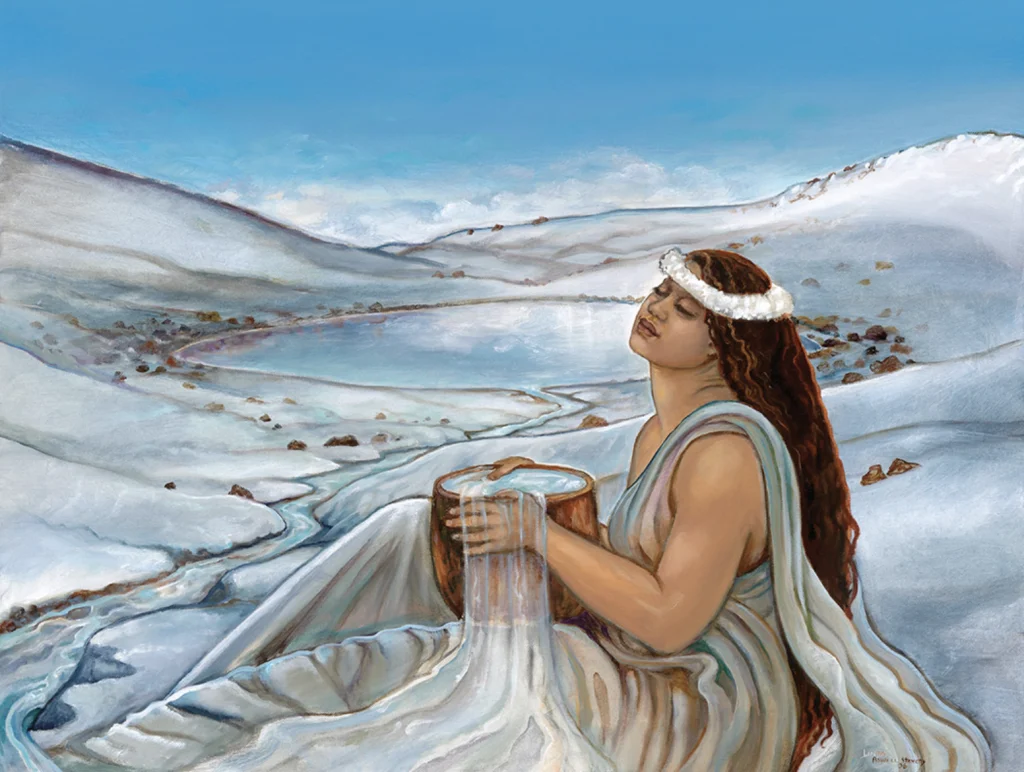
Poliahu is consistently described as breathtakingly beautiful, yet her beauty is inseparable from her environment. She appears as a radiant woman clothed in white kapa, her garments flowing like freshly fallen snow across the slopes of Mauna Kea. Her presence is said to cool the air itself, with chants describing her skin as pale and luminous, reflecting light like ice under the high mountain sun. Her long dark hair contrasts sharply with her snowy mantle, emphasizing her connection to the mountain rather than blending into it.
Unlike fiery deities whose physical forms suggest movement and heat, Poliahu’s appearance conveys stillness and quiet power. She is calm, composed, and distant, embodying the silence of snowfields rather than the chaos of storms. These traits reinforce her symbolic role as a stabilising force. Her beauty is not ornamental but environmental, a visual expression of alpine purity and restraint in a landscape shaped by extremes
Family
Poliahu belongs to a closely linked group of mountain goddesses who govern the cold regions of Hawaiʻi’s high elevations. She is traditionally associated with her sisters Lilinoe, Waiau, and Kahoupokane, each representing different expressions of mountain weather and water. Together, they form a sacred quartet tied to Mauna Kea’s mist, snow, springs, and storms, functioning as custodians of the mountain’s life-giving systems.
Genealogies vary between traditions, but Poliahu is often connected to primordial divine lineages associated with sky, water, and creation. Rather than emphasising family drama or dynastic power, her myths focus on shared responsibility. The sisters act in harmony, reflecting the Hawaiian understanding that natural systems are interdependent. Poliahu’s relative independence within this group further highlights her role as the mountain’s central presence rather than a ruler defined by hierarchy.
Other names
The name Poliahu itself carries layered meaning, combining references to the bosom, temple, and sacred covering. In chants and oral traditions, she is sometimes addressed through descriptive titles that emphasise her sanctity and domain rather than alternate personal names. Phrases invoking her as the sacred woman of Mauna Kea’s cold snows or the spreader of white kapa reinforce her identity as both guardian and embodiment of the mountain.
These variations are not separate identities but poetic extensions of her presence. Hawaiian tradition often favours descriptive reverence over rigid naming, allowing a deity’s role to be articulated through imagery rather than fixed labels. In Poliahu’s case, every name circles back to snow, altitude, and sanctity.
Powers and Abilities
Poliahu’s power lies in her command over cold, snow, frost, and mountain winds. She is believed to blanket Mauna Kea in snow, still volcanic heat, and preserve the mountain’s delicate balance. Her most famous feats occur during her confrontations with Pele, where Poliahu counters lava flows with intense cold, hardening molten rock and halting destruction. These stories mirror real geological processes, where lava meets cooler climates and reshapes the land.
Her abilities extend beyond physical phenomena into moral authority. In legends involving deceitful mortals, Poliahu enacts punishment through freezing stillness rather than violent destruction. This reinforces her role as a judge who restores balance rather than seeking domination. She is also associated with transformation, appearing in human form or as mist, moving between visibility and concealment just as snow can vanish and return.
Modern Day Influence
Poliahu remains deeply relevant in contemporary Hawaiʻi, particularly in discussions surrounding Mauna Kea’s protection. Her identity as the mountain’s guardian is frequently invoked in cultural resistance to development, especially in debates surrounding observatories and land use. For many Native Hawaiians, invoking Poliahu is not symbolic nostalgia but an affirmation of living responsibility toward ancestral land.
Beyond activism, Poliahu appears in art, education, and storytelling as a reminder that Hawaiʻi is shaped by contrast. She challenges simplified tropical imagery and reinforces the idea that identity includes complexity and contradiction. As climate patterns shift and snowfall on Mauna Kea becomes less predictable, Poliahu’s stories gain renewed urgency, representing both what is at risk and what must be respected.
Related Images
Source
Beckwith, M. W. (1970). Hawaiian mythology. University of Hawaii Press.
Cox, J. H., & Allen, W. D. (2013). Hawaiian petroglyphs. Bishop Museum Press.
Emerson, N. B. (1909). Pele and Hi’iaka: A myth of Hawaii. Honolulu Star-Bulletin.
Kamakau, S. M. (1991). Tales and legends of Hawaii: Ka wai a mo’oolelo no Hawaii. Bishop Museum Press.
Keawe, L. (2023, May 8). Deities of Maunakea. Kaʻahele Hawaiʻi. https://www.kaahelehawaii.com/deities-of-maunakea/
University of Hawaiʻi at Hilo. (n.d.). Poliahu and Pele: Legend as information science.
https://hilo.hawaii.edu/maunakea/library/reference.php?view=345
Westervelt, W. D. (1915). Hawaiian legends of volcanoes. G. H. Ellis Press.
Wikipedia contributors. (2024). Poliʻahu. In Wikipedia. Retrieved from https://en.wikipedia.org/wiki/Poli%CA%BBahu
Hawaii Life Vacations. (2018, January 15). The myths and legends of Poliʻahu: The goddess of snow. Retrieved from https://vacations.hawaiilife.com/blog/big-island/myths-legends-poliahu-snow-goddess
Jany, P. (2023). The legend of Poliʻahu and Pele. Ke Kalahea, University of Hawaiʻi at Hilo. Retrieved from https://hilo.hawaii.edu/news/kekalahea/spring-2023/february/legend-of-poliahu-and-pele
Frequently Asked Questions
Who is Poliahu in Hawaiian belief?
Poliahu is the snow goddess of Mauna Kea, associated with cold, balance, and the mountain’s sacred protection.
What is Poliahu known for?
She is known for controlling snow and ice and for her legendary rivalry with Pele, symbolising balance between opposing natural forces.
Is Poliahu connected to Mauna Kea protests?
Yes, she is often invoked as a spiritual guardian representing the mountain’s sanctity and cultural significance.
Does it really snow on Mauna Kea?
Yes, Mauna Kea regularly receives snowfall, especially during winter months, reinforcing Poliahu’s enduring relevance.
How is Poliahu different from Pele?
Poliahu represents restraint, cooling, and preservation, while Pele embodies heat, creation, and destruction.