
Papahānaumoku : The Hawaiian Earth Mother and Island Ancestor
Listen
At a glance
| Description | |
|---|---|
| Origin | Hawaiian Mythology |
| Classification | Gods |
| Family Members | Wākea (Wife), Hoʻohōkūkalani (Daughter) |
| Region | Hawaii |
| Associated With | Creation of islands, Fertility, Land, Ancestry |
The Mythlok Perspective
From the Mythlok perspective, Papahānaumoku reframes creation as responsibility rather than achievement. Unlike traditions that celebrate dominion over nature, Hawaiian cosmology insists on kinship with it. Across cultures, earth mothers symbolize fertility, but Papahānaumoku goes further by making land a literal ancestor. This worldview feels increasingly relevant in a time of ecological strain, where survival depends less on control and more on remembering where we come from.
Papahānaumoku
Introduction
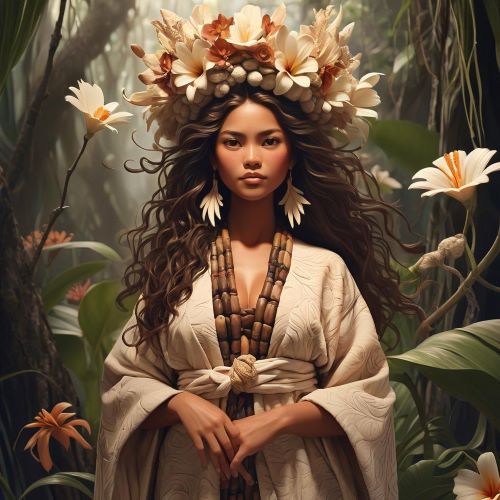
Papahānaumoku, often called Papa, stands at the very foundation of Hawaiian cosmology. She is the Earth Mother, not merely as a poetic idea, but as a living ancestral presence whose body is the land itself. In Hawaiian thought, creation is genealogical rather than mechanical, and Papahānaumoku occupies the deepest generational layer of existence. Through her union with Wākea, the Sky Father, the Hawaiian Islands are born as literal offspring, not symbolic landscapes. This relationship establishes a worldview where land, people, plants, and chiefs all belong to the same extended family.
Papahānaumoku’s significance goes far beyond mythic storytelling. She anchors the idea that humans do not own the land but descend from it. This ancestral logic shapes Hawaiian ethics, governance, and spirituality, especially the principle of mālama ʻāina, the responsibility to care for the land as one would care for an elder. In this sense, Papahānaumoku is not confined to the distant past. She continues to define identity, belonging, and obligation in Hawaiian life today.
Physical Traits
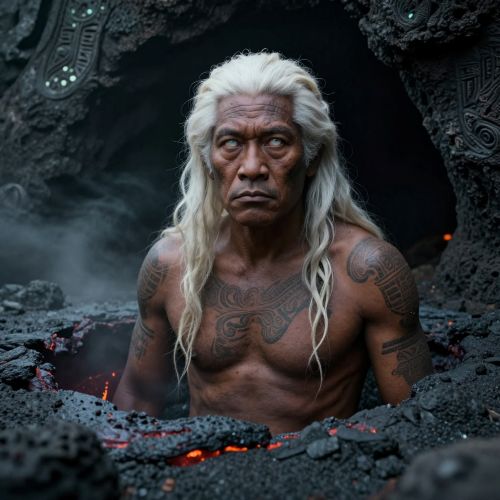
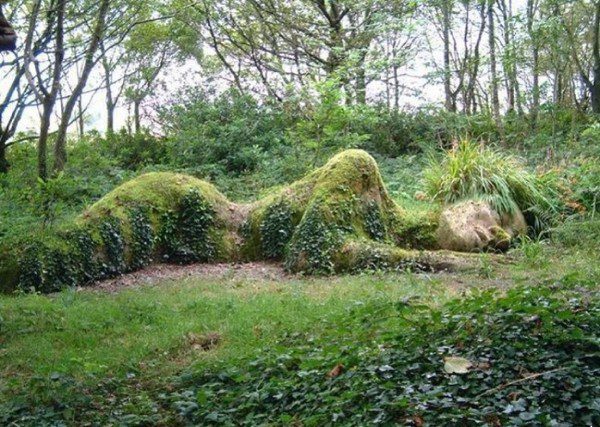
Papahānaumoku is not described through fixed human features in traditional Hawaiian sources. Unlike pantheons that favor sculpted divine bodies, Hawaiian cosmology understands her form as vast, elemental, and omnipresent. She is the soil, the volcanic rock, the mountain ridges, and the fertile plains. Her body is visible in the rise of islands from the sea and in the slow transformation of lava into life-giving earth.
When chants speak of her fertility, they refer not to anatomy but to generative power. The curves of the land, the depth of valleys, and the abundance of crops are expressions of her physical presence. Even ritual offerings made in her honor reflect this understanding. Foods associated with fertility, abundance, and grounding were given not to a statue, but to the land itself. Papahānaumoku’s “appearance” is therefore experienced rather than seen, reinforcing her role as an ever-present maternal force rather than a distant anthropomorphic goddess.
Family
Papahānaumoku’s family relationships define the structure of Hawaiian cosmology. Her partnership with Wākea represents the union of earth and sky, a cosmic balance necessary for life to emerge. From this union come the Hawaiian Islands themselves, each regarded as a living descendant rather than an inert landmass.
Their daughter Hoʻohōkūkalani plays a crucial role in linking divinity, humanity, and agriculture. From her lineage emerges Hāloa, whose stillborn form becomes the first kalo plant, while his living sibling becomes the ancestor of the Hawaiian people. This narrative establishes one of the most profound ideas in Hawaiian culture: humans and staple crops are elder and younger siblings. To care for the land is therefore not symbolic reverence, but familial duty.
Through this genealogy, Papahānaumoku becomes the great ancestress of chiefs, commoners, plants, and ecosystems alike. Authority, food security, and spiritual legitimacy all trace back to her, reinforcing a worldview where survival and governance are inseparable from respect for ancestral land.
Other names
Papahānaumoku is known by several names that reflect different aspects of her identity. Papa is the most commonly used and intimate form, often appearing in chants and oral traditions. Papa-hānau-moku translates to “Papa who gives birth to islands,” emphasizing her creative role in shaping the archipelago.
In some traditions, her identity overlaps with Haumea, a goddess associated with fertility, childbirth, and regeneration. These overlaps do not indicate confusion but reflect the fluid nature of Hawaiian theology, where divine functions flow into one another rather than existing as rigid categories. Her name also appears as part of the compound Papahānaumokuākea, uniting her eternally with Wākea and reinforcing the inseparability of earth and sky in Hawaiian cosmology.
Powers and Abilities
Papahānaumoku’s powers are elemental rather than martial. She creates not through conquest but through emergence. The birth of islands from volcanic forces is understood as a maternal act, aligning geological processes with divine generation. Fertility is her primary domain, extending to soil productivity, human reproduction, and ecological balance.
She also holds the power of renewal. The story of Hāloa’s transformation into kalo presents death not as an ending but as a transformation into sustenance. Healing rituals often invoke her grounding presence, drawing on the idea that physical and spiritual restoration begins by reconnecting with the earth.
Papahānaumoku also embodies moral authority. When land is abused or neglected, imbalance follows. Natural disruptions are traditionally interpreted not as punishment but as reminders that the familial relationship between humans and land has been neglected. Her power lies in maintaining equilibrium rather than enforcing dominance.
Modern Day Influence
Papahānaumoku remains deeply present in modern Hawaiian consciousness. Her name gained global recognition through the Papahānaumokuākea Marine National Monument, one of the largest protected marine areas in the world. This naming was not symbolic branding but a cultural assertion that conservation is an ancestral obligation.
Cultural practitioners continue to honor her through chants, hula, and ceremonies that reaffirm genealogical ties to the land. Environmental movements frequently invoke her as a spiritual foundation for resisting exploitation and unsustainable development. In sovereignty and land rights discourse, Papahānaumoku stands as proof that Hawaiian identity is inseparable from place.
Her influence also extends into education and storytelling, where she is presented not as a distant goddess but as a living ancestor whose body sustains daily life. In an era of climate uncertainty, Papahānaumoku’s mythology offers a model of ecological ethics grounded in kinship rather than control.
Related Images

Source
Beckwith, M. W. (1970). Hawaiian mythology. University of Hawaii Press.
Buck, P. H. (1996). Māori and Polynesian mythologies. Bishop Museum Press.
Emerson, N. B. (1909). Pele and Hiiaka: A myth of Hawaii. Honolulu Star-Bulletin.
Kamakau, S. M. (1991). Ka poʻe kahiko: The people of old (M. K. Pukui, Trans.). Bishop Museum Press.
Lilinoe, J. (2020). Papahānaumokuākea: A sacred name, a sacred place. Papahānaumokuākea Marine National Monument. https://www.papahanaumokuakea.gov/about/name.html
Pukui, M. K., Ebert, E. W., & Kelly, I. F. (1972). Vignettes of old Hawaii. Topgallant Publishing.
Sterling, E. P., & Summers, C. C. (1978). Sites of Oahu. Bishop Museum Press.
UNESCO World Heritage Centre. (2021). Papahānaumokuākea. https://whc.unesco.org/en/list/1326/
Frequently Asked Questions
Who is Papahānaumoku in Hawaiian tradition?
Papahānaumoku is the Earth Mother and ancestral source of the Hawaiian Islands, humans, and staple crops.
What is the relationship between Papahānaumoku and Wākea?
They represent earth and sky whose union produces the islands and establishes Hawaiian genealogy.
Why is Papahānaumoku important to Hawaiian culture today?
She reinforces the belief that land is an ancestor, shaping environmental ethics and cultural identity.
Is Papahānaumoku the same as Haumea?
In some traditions their identities overlap, reflecting shared roles in fertility and regeneration.
What does Papahānaumokuākea mean?
It unites the names of Papahānaumoku and Wākea, symbolizing the sacred connection between land and sky.