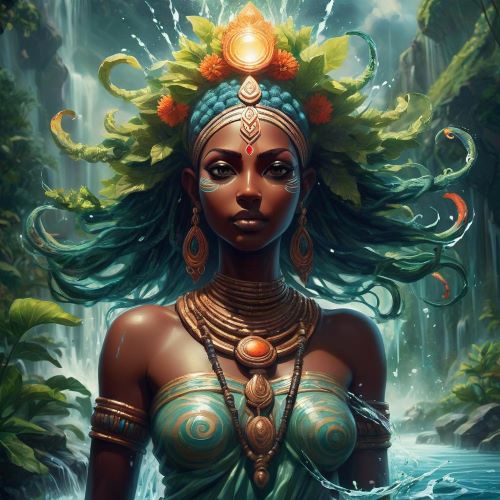

Nyami Nyami : The Zambezi River God of Africa
Listen
At a glance
| Description | |
|---|---|
| Origin | Shona Mythology |
| Classification | Gods |
| Family Members | N/A |
| Region | Zambia and Zimbabwe |
| Associated With | Rivers, Floods, Storms, Fertility, Protection, Earthquakes |
The Mythlok Perspective
Nyami Nyami is not a cautionary monster but a philosophy shaped by moving water. Like river deities in other cultures, he emerges where human ambition meets natural limits. In Mesopotamian thought, floods carried divine judgment; in East Asian traditions, river dragons governed rainfall and balance. Nyami Nyami belongs to this same lineage, yet his warning is sharper. He does not punish out of morality but reacts to disruption. African cosmology preserves here a truth modern engineering often ignores. Nature does not debate power. It answers it.
Nyami Nyami
Introduction
Nyami Nyami is the revered river deity of the Zambezi, worshipped primarily by the Tonga people who inhabit the river valleys of modern-day Zambia and Zimbabwe. Often described as the Zambezi River God or Snake Spirit, Nyami Nyami embodies the raw, living force of water itself. He is not simply a mythic guardian but a spiritual authority believed to control floods, fertility, fish stocks, and the survival of river communities.
The legend of Nyami Nyami gained international attention during the construction of the Kariba Dam in the late 1950s, when catastrophic floods and worker deaths were interpreted by locals as signs of divine anger. To the Tonga, this was not superstition but spiritual cause and effect. The river had been violated, and its guardian responded. Through Nyami Nyami, the Tonga worldview presents nature not as a resource to be dominated, but as a conscious power demanding respect.
Physical Traits
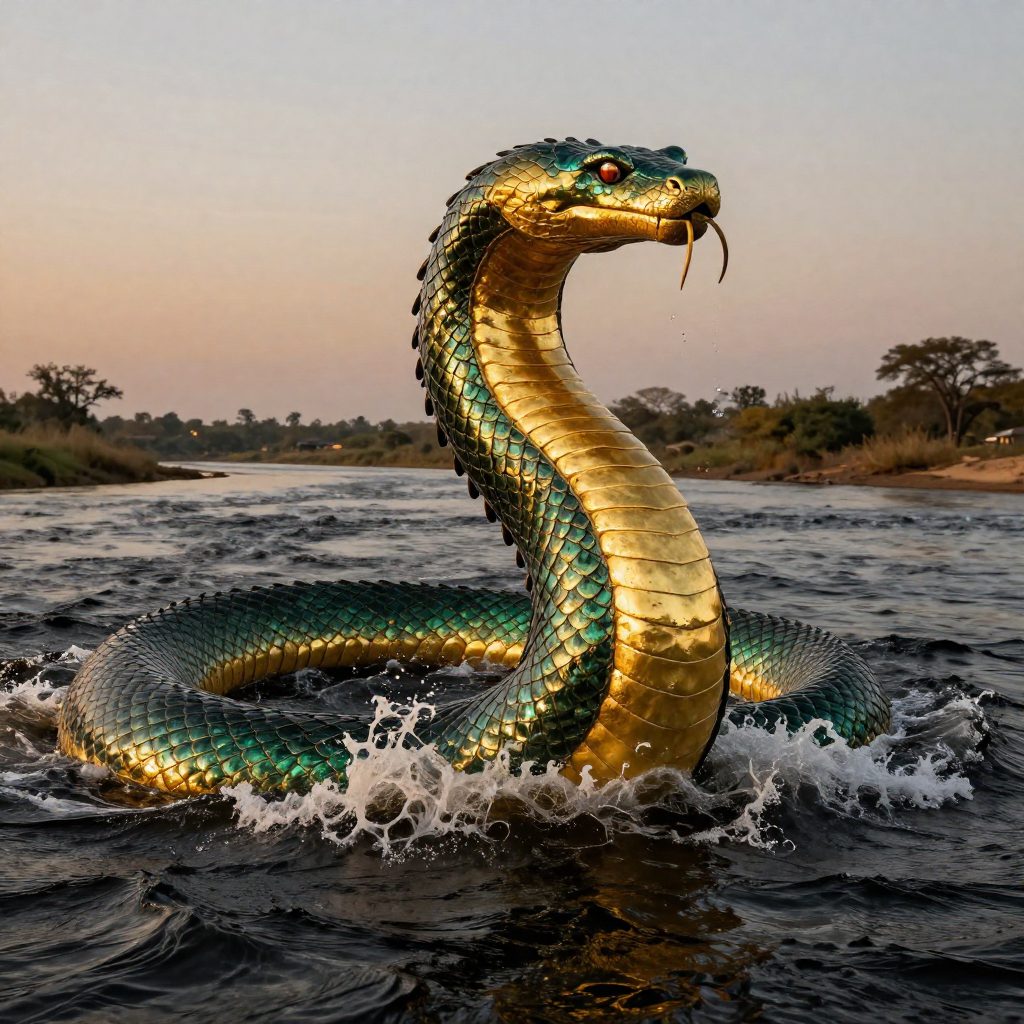
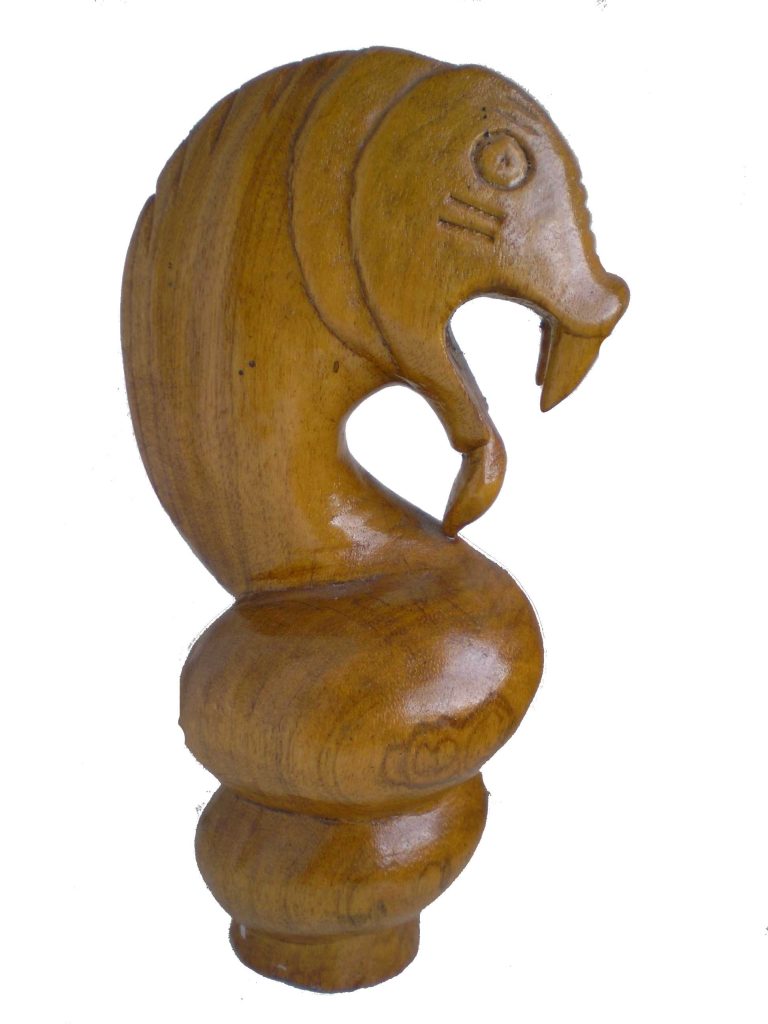
Nyami Nyami is consistently described as a powerful hybrid being, blending aquatic and serpentine features into a form that reflects the Zambezi’s unpredictable nature. His body is long and snake-like, thick enough in some accounts to rival the trunk of a baobab tree, allowing him to coil through deep currents and submerged gorges. His head varies across traditions, appearing either fish-like with wide glowing eyes or more reptilian, resembling a dragon, crocodile, or ancient river beast.
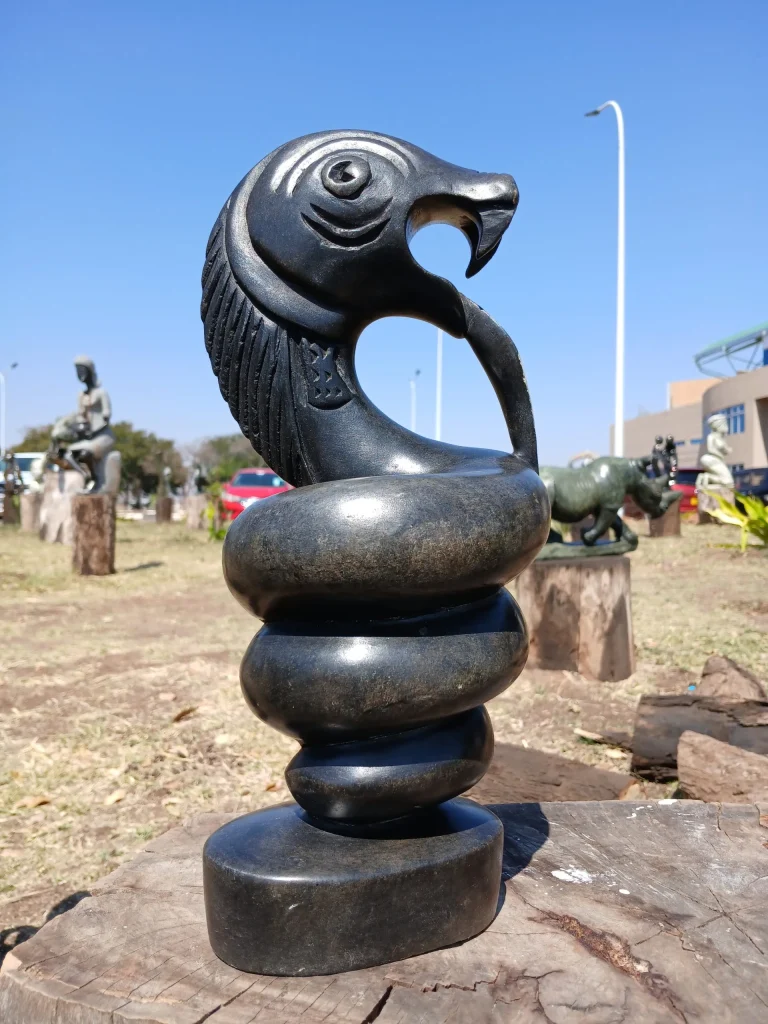
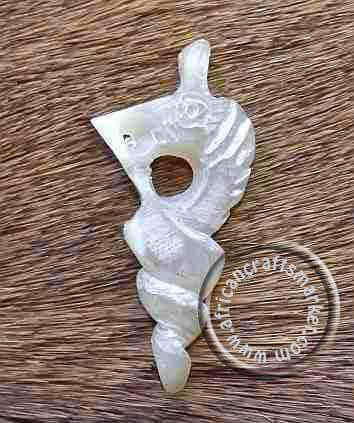
Certain carvings and oral descriptions include fins, a ridged spine, or small wing-like protrusions, though these are symbolic rather than literal. The hybrid form itself represents dominance over both surface and depth, life-giving abundance and sudden destruction. Among river communities, Nyami Nyami’s image is carved into walking sticks, worn as pendants, and etched into ritual objects, not as decoration but as protection.
Family
Central to Nyami Nyami’s mythology is his relationship with his wife, a female river spirit often said to dwell in the depths of the Kariba Gorge. In Tonga belief, the two existed in balance, governing the river together until human intervention fractured their domain. The construction of the Kariba Dam physically and spiritually separated them, leaving Nyami Nyami trapped upstream while his mate remained below.
This forced division is believed to have provoked his rage. Floods, tremors, and structural failures during the dam’s construction are remembered as his attempts to reunite with his wife. Unlike many mythological systems, Nyami Nyami’s story does not emphasize divine offspring. Instead, the river itself becomes the living product of the union, with fish, rainfall, and fertile land treated as blessings that depend on harmony between the two spirits.
Other names
The name Nyami Nyami is derived from a Tonga phrase often translated as “meat meat” or “endless sustenance,” linked to legends in which the god provided regenerating flesh during times of famine. This meaning reinforces his role as a provider rather than a monster.
He is also known regionally as the Zambezi River God, River Snake Spirit, or River Dragon, particularly in translated or colonial-era accounts. Some early European settlers dismissed him as a “lake monster,” a term that stripped the figure of spiritual authority. Among Tonga elders, however, Nyami Nyami remains a god, not a creature, and his name is spoken with ritual caution rather than curiosity.
Powers and Abilities
Nyami Nyami’s powers mirror the Zambezi itself. He controls floods, storms, and droughts, determining when the river nourishes the land and when it reclaims it. His anger is believed to manifest through rising waters, earthquakes, and sudden loss of life, while his favor brings fish abundance, rainfall, and safe passage across the river.
During the Kariba Dam construction between 1957 and 1958, repeated floods destroyed equipment and drowned workers despite modern engineering. Tonga oral history holds that Nyami Nyami caused these disasters deliberately, attempting to break the dam and reunite with his wife. Even today, tremors around Lake Kariba are interpreted as signs of his continued unrest.
Nyami Nyami is also said to command river creatures such as crocodiles and hippos, and to drag those who disrespect the river into its depths. His glowing eyes, often mentioned in stories, symbolize watchfulness rather than menace, reinforcing the belief that nothing done on the river escapes his notice.
Modern Day Influence
Nyami Nyami remains one of Southern Africa’s most enduring spiritual symbols. His image is widely used in jewelry, sculpture, and tourism, especially around Lake Kariba, where pendants bearing his likeness are worn for protection and good fortune. Storytelling traditions ensure that children grow up understanding the river as a living presence, not a passive landscape.
In literature and academic discourse, Nyami Nyami has become a powerful symbol of environmental resistance. His legend is frequently cited in discussions about displacement caused by the Kariba Dam and the broader consequences of large-scale development. Conservation narratives increasingly draw on his story to emphasize indigenous ecological wisdom.
Rather than fading into folklore, Nyami Nyami has evolved into a cultural emblem of balance, warning against unchecked ambition and reminding modern societies that nature responds when boundaries are crossed.
Related Images
Source
Mwiinga, P. (2021). Nyami Nyami: The Zambezi River god. Daily Nation Zambia. https://www.dailynationzambia.com/2021/03/book-review-nyami-nyami-the-zambezi-river-god/
Nyami Nyami. (n.d.). In Wikipedia. https://en.wikipedia.org/wiki/Nyami_Nyami
Siwila, L. C. (2015). Nyami Nyami in Tonga ecofeminism. Journal of the Study of Religion, 28(2). https://scielo.org.za/pdf/jsr/v28n2/07.pdf
Chikwabi, N. M. (2021). Book review: Nyami Nyami. Daily Nation Zambia. https://www.dailynationzambia.com/2021/03/book-review-nyami-nyami-the-zambezi-river-god/
Nyami Nyami: The Spirit, Myth, Nyamo & Zambezi Story. (2025). Vic Falls Zim. https://vicfallszim.co.zw/nyami-nyami/
Zimbabwe’s legendary Nyami Nyami River Monster. (2022). Chez Anami. https://chezanami.org/zimbabwes-legendary-nyami-nyami-river-monster/
The Legend of Nyami Nyami. (2021). Changa Safari Camp. https://changasafaricamp.com/the-legend-of-nyami-nyami/
Dube, C. (2024). Stereotyping, exploitation, and appropriation: The case of Nyaminyami. Africana Religions, 10(1), 72-93. https://scholarlypublishingcollective.org/psup/africana-religions/article/10/1/72/293767
Frequently Asked Questions
Who is Nyami Nyami?
Nyami Nyami is the river god of the Zambezi, worshipped by the Tonga people as the controller of water, fertility, and natural balance.
Is Nyami Nyami real or symbolic?
While mythological, Nyami Nyami represents a spiritual worldview where nature is alive, conscious, and responsive to human actions.
Why is Nyami Nyami linked to the Kariba Dam?
Floods and disasters during the dam’s construction were attributed to his anger over being separated from his wife by the dam wall.
What does Nyami Nyami look like?
He is described as a serpent-fish hybrid with a massive body, glowing eyes, and features reflecting river creatures.
Is Nyami Nyami still worshipped today?
Yes. Ritual respect, storytelling, and symbolic offerings continue among Tonga communities.