Wolphat : The Trickster Spirit of Ifaluk
Listen
At a glance
| Description | |
|---|---|
| Origin | Ifaluk Mythology |
| Classification | Gods |
| Family Members | Lugeilan (Father), Tarisso (Mother) |
| Region | Caroline Islands |
| Associated With | Trickster |
Wolphat
Introduction
In the oral traditions of Micronesia, trickster figures occupy a crucial space between creation and chaos, order and disruption. Among the Ifaluk people of the Caroline Islands, this role is embodied by Wolphat, a powerful and unpredictable figure best understood as the local Ifaluk expression of the pan-Micronesian trickster Olifat. While Olifat appears across many islands under different names, Wolphat reflects the ecological realities, social values, and cosmological beliefs specific to Ifaluk society. His stories explain not only why the world is imperfect, but also how humans acquired fire, tattooing, and certain cultural practices that define island life.
Unlike benevolent creator gods, Wolphat is intentionally disruptive. Myths credit him with unleashing termites, souring fermented drinks, and giving sea creatures their dangerous features, such as shark teeth and stingray barbs. Yet the same figure also delivers transformative gifts that enable human survival and beauty. This paradox places Wolphat at the center of Ifaluk cosmology, where destruction and creation are inseparable forces. Through humor, mischief, and rebellion, Wolphat’s narratives teach adaptability, humility, and resilience—values essential for life on small, environmentally vulnerable islands.
Physical Traits
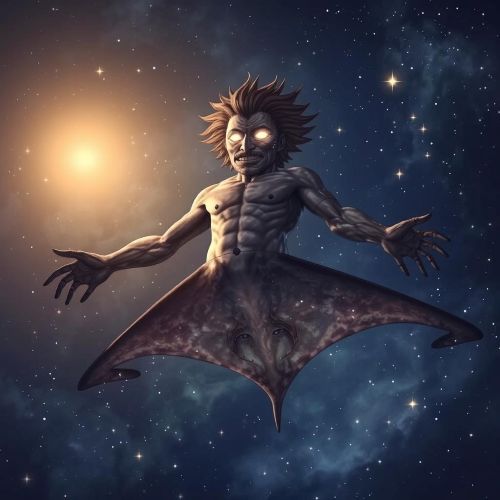
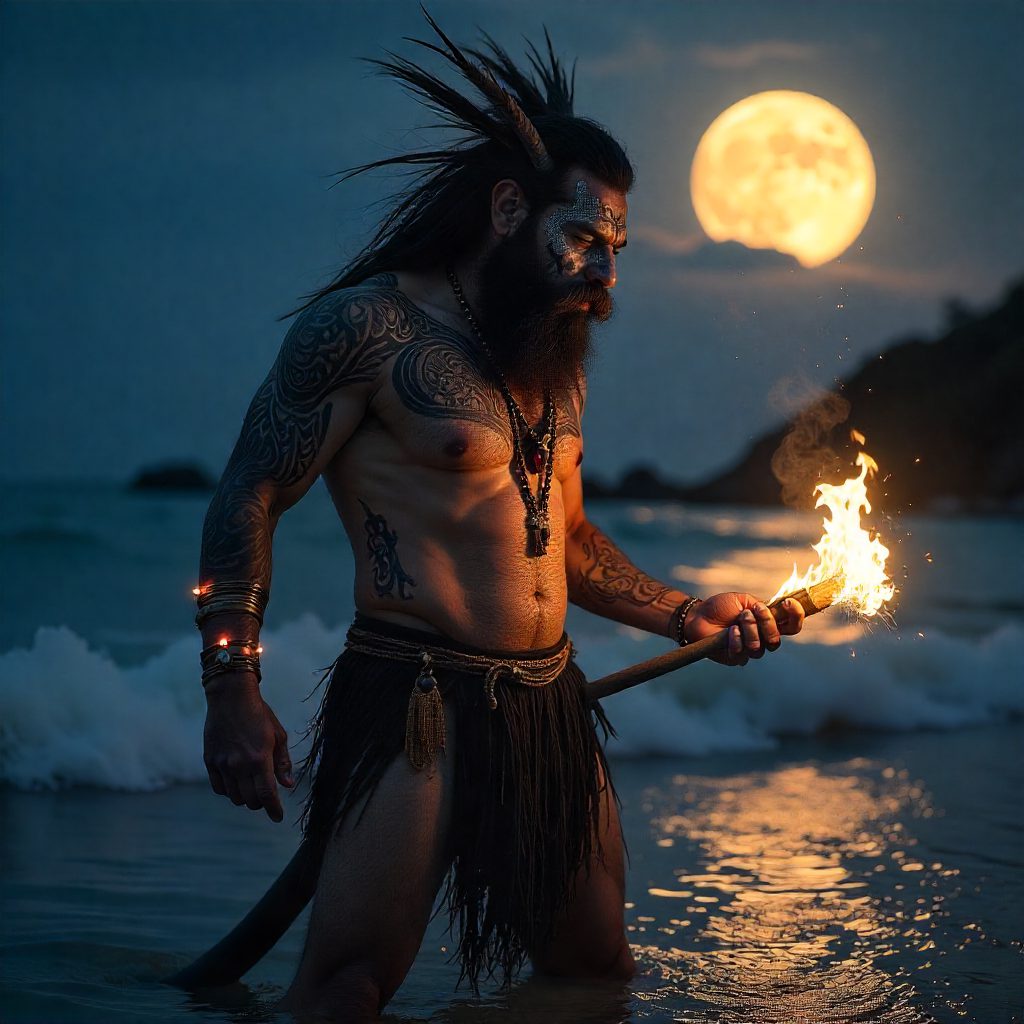
Wolphat’s appearance is striking but never entirely fixed, reinforcing his identity as a shape-shifting trickster rather than a static deity. In many Ifaluk accounts, he appears as a handsome youthful figure whose defining feature is the presence of intricate black tattoo designs covering his body. These tattoos are not merely decorative; they are supernatural in origin and capable of mesmerizing those who see them. Women in particular are said to admire Wolphat’s markings, prompting the spread of tattooing among humans as a cultural practice tied to attraction and identity.
The tattoos themselves are described as being created from soot mixed with breadfruit gum, applied using feathers from seabirds such as the man-of-war bird. Their magical nature is emphasized by their impermanence. In one tale, Wolphat returns without his tattoos, confusing onlookers, only to reapply them later, revealing that their power lies in his will rather than in the markings alone. Beyond these accounts, Wolphat may appear grotesque, animal-like, or even invisible, depending on the lesson of the story. His physical form serves the narrative, shifting to suit deception, seduction, or escape.
Family
Wolphat’s lineage firmly anchors him within the divine hierarchy of Ifaluk belief. He is the grandson of Anulap, the high creator god of Micronesian mythology, and the son of the sky deity Lugeilan (also recorded as Lugeleng). His mother is Tarisso, a mortal woman and daughter of the octopus goddess Hit, linking Wolphat simultaneously to the heavens, the sea, and humanity. This mixed divine-mortal origin explains both his power and his unruly temperament.
His birth is marked by chaos. According to myth, Wolphat emerges violently from his mother’s head, immediately severing his umbilical cord and fleeing contact with humans. From infancy, he exhibits jealousy and cruelty, particularly toward his siblings’ children. One infamous episode involves him sharpening a shark’s teeth to harm his nephews, an act that provokes divine outrage. Despite repeated attempts by other gods to kill or exile him, Wolphat is repeatedly restored to life through Anulap’s intervention. These cycles of death and resurrection reinforce his role as an indestructible force of disruption that even the gods struggle to control.
Other names
Across Micronesia, Wolphat is known by several names that reflect linguistic variation rather than distinct identities. Olifat is the most widespread form, appearing in myths from Yap, Chuuk, and Pohnpei. Other recorded variants include Yelafath, Orofat, Iolofath, and Wolfat, all referencing the same core trickster figure. On Ifaluk, the name Wolphat is preferred and often used specifically in stories concerning tattooing, fire theft, and acts of divine sabotage.
These shifting names highlight the fluid nature of Micronesian oral tradition, where stories migrate between islands and adapt to local dialects, environments, and values. Despite regional differences, the essential traits—cunning intelligence, irreverence toward authority, and transformative mischief—remain constant, ensuring Wolphat’s recognition as part of a shared mythological heritage.
Powers and Abilities
Wolphat’s abilities are rooted less in raw strength and more in deception, adaptability, and defiance of cosmic order. He is a master shapeshifter, capable of transforming into birds, animals, spirits, or inanimate objects to escape punishment. When condemned to death, he routinely cheats fate, faking his demise with red mud and leaves or hiding inside reeds, palm trunks, and baskets. Even when killed, he is resurrected through Anulap’s protection, underscoring his role as a necessary, if dangerous, force.
One of Wolphat’s most significant acts is the theft of fire for humanity. According to Ifaluk myth, he steals a glowing ember carried by a bird associated with the sun, bringing fire to humans despite divine prohibitions. This act aligns him with global trickster-heroes such as Prometheus, positioning Wolphat as both criminal and benefactor. He is also responsible for altering the natural world, granting animals their defensive weapons and introducing hardship as a permanent feature of existence. Through these actions, Wolphat shapes a world that is dangerous, unpredictable, and survivable only through intelligence and cooperation.
Modern Day Influence
Wolphat remains a vital presence in Ifaluk cultural memory, preserved through storytelling, ritual knowledge, and anthropological study. Mid-20th-century researchers such as Melford E. Spiro and Edwin Burrows documented his myths as part of broader analyses of Micronesian social order, often noting the contrast between Wolphat’s violent antics and the generally non-violent ethos of Ifaluk society. This contrast suggests that Wolphat functions as a narrative outlet for taboo impulses rather than a behavioral model.
His association with tattooing continues to influence cultural identity, with designs serving as markers of beauty, maturity, and heritage. As Micronesian communities face climate change and cultural erosion, Wolphat’s legacy as a survivor, rebel, and transformer resonates deeply. He stands as a reminder that adaptation—not perfection—is the true key to endurance.
Related Images
Source
Burrows, E. (1963). Flower in my ear: Arts and ethos of Ifaluk Atoll. University of Hawaii Press.
Spiro, M. E. (1951). Some Ifaluk myths and folk tales. Journal of American Folklore, 64(252), 217-228. https://www.jstor.org/stable/536156
Wikipedia contributors. (2025). Olifat. Wikipedia. https://en.wikipedia.org/wiki/Olifat
Peaceful Societies. (2019). Wolfat enjoys his tattoos. https://peacefulsocieties.uncg.edu/wolfat-enjoys-his-tattoos/
Guam Museum. (2002). Micronesian legends. Bess Press.
Encyclopedia.com. (2025). Micronesian mythology. https://www.encyclopedia.com/humanities/news-wires-white-papers-and-books/micronesian-mythology
Frequently Asked Questions
Who is Wolphat in Micronesian mythology?
Wolphat is the Ifaluk version of the pan-Micronesian trickster Olifat, known for chaos, deception, and world-shaping acts.
Is Wolphat a god or a trickster hero?
He is both, functioning as a divine trickster whose actions disrupt order while enabling cultural transformation.
What is Wolphat famous for?
He is best known for stealing fire for humanity, introducing tattooing, and reshaping nature through mischief.
How is Wolphat related to other Micronesian gods?
He is the grandson of creator god Anulap and son of the sky god Lugeilan and the mortal Tarisso.
Does Wolphat still matter today?
Yes, his stories remain central to Ifaluk identity and are studied globally as examples of the trickster archetype.