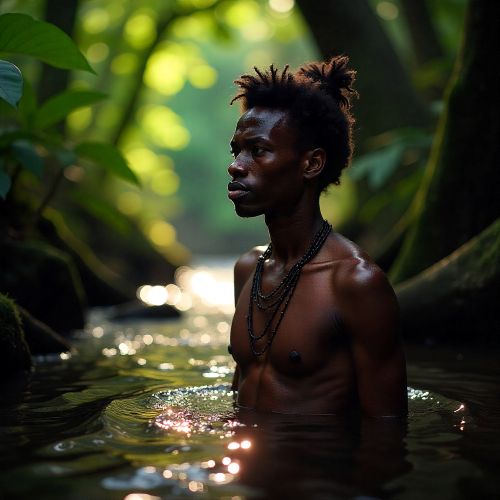


Vungvung : The Leaf Spirit of the Baining Fire Dances
Listen
At a glance
| Description | |
|---|---|
| Origin | Baining Mythology |
| Classification | Spirits |
| Family Members | N/A |
| Region | Papua New Guinea |
| Associated With | Leaf spirits, forest presence |
The Mythlok Perspective
From the Mythlok perspective, Vungvung is not a character to be narrated but a force to be encountered. It represents a worldview where myth lives through action, sound, and endurance rather than through written stories. Vungvung shows how ritual can function as mythology in motion, embedding meaning directly into the body and landscape. Across cultures, similar patterns emerge. Vungvung echoes the masked egungun of Yoruba ritual life and the forest beings of Southeast Asian spirit traditions, where anonymity amplifies sacred presence. Like these traditions, the Baining fire dances reveal a universal human impulse to meet nature not as a resource, but as a living authority that must be respected, endured, and ritually acknowledged.
Vungvung
Introduction
Among the Baining people of the Gazelle Peninsula in Papua New Guinea, ritual performance is not entertainment but a living bridge between the human world, ancestral presence, and the natural environment. Within this ceremonial landscape, Vungvung occupies a distinctive role as a leaf spirit revealed through night dances staged around roaring fires. These performances are inseparable from male initiation rites and communal transitions, where endurance, discipline, and spiritual awareness are tested under extreme conditions.
Vungvung is not a god with myths of creation or conquest, nor a named ancestor remembered through genealogy. It is a presence summoned through movement, sound, and material transformation. When the fire burns low and the forest presses close, Vungvung emerges as an embodiment of the bush itself, a reminder that the land watches, listens, and responds. Through this spirit, the Baining articulate respect for nature, continuity of tradition, and the controlled passage from boyhood into ritual adulthood.
Physical Traits
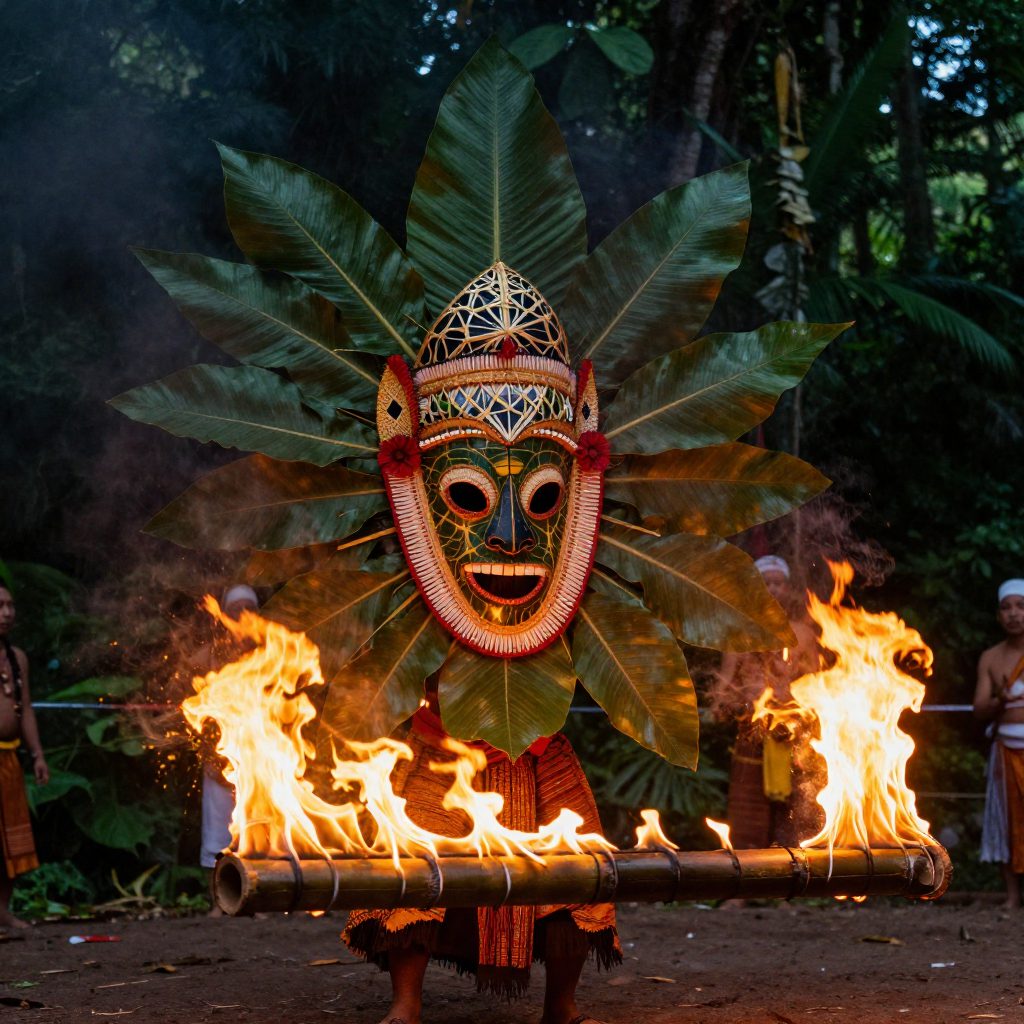
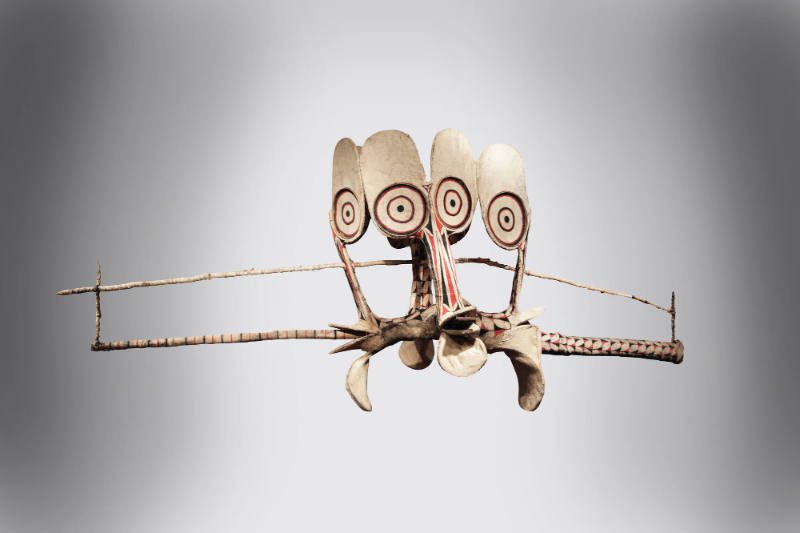
Vungvung is experienced visually through one of the most striking mask constructions in Melanesian ritual life. The mask is monumental, stretching roughly four metres in length and rising over two metres in height, yet its scale is carefully balanced to allow fluid movement around the fire. The structure is formed from a bamboo and cane framework, bound with raffia and overlaid with intricate latticework of pandanus leaves. This vegetal skin is not decorative alone; it declares Vungvung’s identity as a leaf spirit born from the forest canopy.
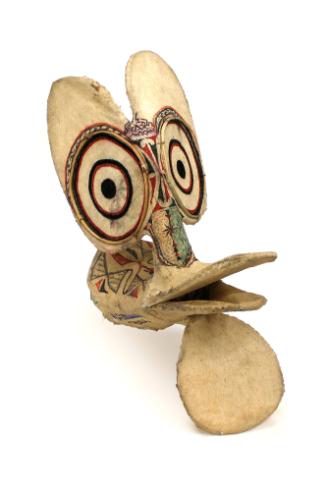
Its defining feature is a long, hollow bamboo tube projecting from the mouth area of the mask, replacing the duck-like beak found in many other kavat forms. When blown, this tube produces a deep, mournful drone that rolls across the clearing, believed to be the audible voice of the spirits. The dancer beneath the structure is fully concealed, their body painted black and often glossed with a mixture of bush honey and water so the figure merges with the night. Green tangket leaves tied around the legs complete the illusion of a being that has stepped directly out of the jungle and into the firelight.
Family
Baining spiritual tradition does not assign Vungvung a family lineage in the way gods or heroic ancestors might possess parents, siblings, or offspring. Instead, Vungvung belongs to a wider collective of bush and forest spirits encountered through ritual rather than story. These spirits are relational rather than genealogical, defined by their connection to place, season, and communal need.
In this sense, Vungvung’s “family” is the land itself and the ancestral presence embedded within it. The spirit exists to reinforce cohesion rather than individuality, reminding participants that identity within Baining culture is inseparable from collective responsibility and environmental balance.
Other names
Ethnographic and museum records consistently identify this spirit and its mask as Vungvung, sometimes written as vung vung. While a few regional or phonetic variations appear in older documentation, there is no evidence of a distinct secondary name with a separate meaning. This consistency suggests that Vungvung occupies a clearly defined role within Baining ceremonial vocabulary, differentiated from other kavat types by both sound and form.
Powers and Abilities
Vungvung’s power is not expressed through combat, magic spells, or mythic feats, but through sensory authority and ritual function. Its droning call, produced by the bamboo tube, is understood as the voice of the bush spirits themselves. The sound is unsettling by design, cutting through conversation and commanding attention, reinforcing obedience and respect during ceremonies.
As the masked figure circles and passes through the firelight, Vungvung embodies the controlled meeting of opposing forces: leaf and flame, darkness and illumination, human endurance and spiritual presence. During certain rituals, infants are briefly held near the mouth of the bamboo tube while the drone sounds, a symbolic act intended to instil discipline and attentiveness from the earliest stages of life. Through movement, sound, and endurance, Vungvung reinforces social order and the seriousness of initiation without violence or spectacle for its own sake.
Modern Day Influence
Vungvung remains a living element of Baining culture, particularly in villages such as Kainagunan, Gaulim, and Vungu, where fire dances continue to be performed for initiations and commemorations. While tourism and outside interest increased during the late twentieth century, leading to performances for visitors, the core ritual knowledge surrounding Vungvung remains closely guarded.
Fragments and complete examples of Vungvung masks are preserved in international museum collections, including institutions such as the Horniman Museum, providing valuable documentation without fully revealing ceremonial meanings. In contemporary Baining identity, Vungvung has become both a cultural emblem and a reminder that tradition adapts cautiously, preserving its inner logic even as the outside world looks on.
Related Images
Source
Horniman Museum and Gardens. (n.d.). Ritual object: Part of a vungvung mask. https://www.horniman.ac.uk/object/1997.5/
Gallasch, H. (n.d.). The Baining – A night to remember. Oceanic Art Society. https://www.oceanicartsociety.org.au/the-baining-a-night-to-remember/
Wikipedia contributors. (2024). Baining people. Wikipedia. https://en.wikipedia.org/wiki/Baining_people
Soul O Travels. (2024, February 17). Tribe profile: The Baining people of Papua New Guinea.
https://soul-o-travels.com/2024/02/17/tribe-profile-the-baining-people/
Oceanic Art Society. (2025, January 14). The Baining – A night to remember. https://www.oceanicartsociety.org.au/the-baining-a-night-to-remember/
Hermkens, A. K. (2018). Barkcloth and the Permeability of Spirits. JSTOR.
https://www.jstor.org/stable/48640853
Frequently Asked Questions
What is Vungvung in Baining tradition?
Vungvung is a leaf spirit revealed through masked fire dances performed during night ceremonies linked to male initiation among the Baining people.
Is Vungvung a god or a spirit?
Vungvung is best understood as a nature spirit rather than a god, representing the presence of the forest and ancestral forces.
Why does the Vungvung mask have a bamboo tube?
The bamboo tube produces a deep droning sound believed to be the voice of the spirits, reinforcing authority and ritual seriousness.
Are Vungvung fire dances still performed today?
Yes, they continue in select Baining communities, primarily for initiations and important communal events.
Can outsiders fully understand Vungvung rituals?
No, many aspects of Vungvung ceremonies are intentionally restricted, preserving their spiritual integrity within the community.