


Tudava : The Hero Who Shaped Trobriand Society
Listen
At a glance
| Description | |
|---|---|
| Origin | Tobriand Islanders Mythology |
| Classification | Mortals |
| Family Members | N/A |
| Region | Papua New Guinea |
| Associated With | Agriculture, Gardening |
Tudava
Introduction
Tudava occupies a central place in the mythology of the Trobriand Islanders of Papua New Guinea, a society celebrated for its matrilineal traditions, complex yam-based economy, and deep spiritual connection to ancestors. In Trobriand cosmology, myths are not abstract tales but lived frameworks that shape agricultural rhythms, social relations, and moral codes. Within this world, Tudava stands out as a culture hero whose actions explain the origins of gardening, kinship obligations, and the struggle between human resilience and supernatural danger.
Across the Milne Bay archipelago, the stories of Tudava reflect a worldview where the realms of humans, spirits, and the island landscape are inseparably linked. His myth draws from themes of survival, ingenuity, and ancestral guidance—elements that continue to influence Trobriand identity. Whether confronting cannibalistic beings or teaching the foundations of cultivation, Tudava embodies the Islanders’ understanding of how knowledge and social order emerge from the trials of the past.
Physical Traits
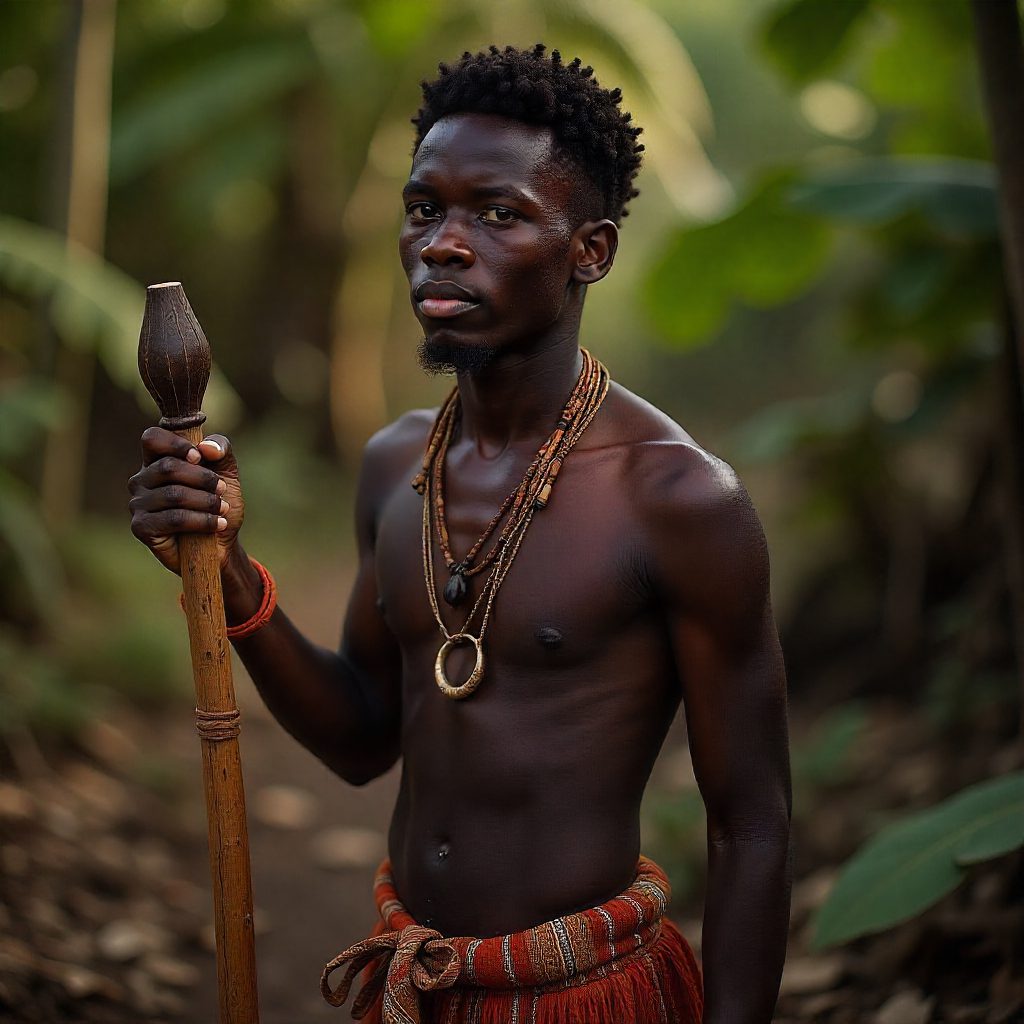
Tudava is not described with the exaggerated grandeur typical of divine figures in other mythologies. Instead, he appears with the physical qualities of a young man shaped by the demands of island life—energetic, agile, and capable of navigating forests, village terrain, and the threats that lurk beyond the settlement. Although some stories hint at supernatural endurance, they do so subtly, suggesting that his power comes less from physical transformation and more from the ancestral vitality that animates him.
Ethnographic accounts describe cultural symbolism surrounding the body, such as the use of coconut oil representing fertility and strength. This element sometimes appears in Tudava’s depictions, reinforcing his association with growth, regeneration, and the continuity of life. Yet throughout the narratives, Tudava’s body remains recognizably human, making his achievements accessible and inspirational rather than remote or godlike.
Family
Family plays a significant role in Tudava’s story, reflecting the Trobriand Islanders’ matrilineal social structure, where inheritance and identity flow through the mother’s line. His mother is a pivotal figure whose protection ensures his survival during early threats, including encounters with cannibals such as Dokanikani. Her magical knowledge shields him, laying the foundation for his later rise as a culture hero.
The myth also highlights the importance of maternal uncles, who traditionally hold authority within the matriline. Tudava’s interactions with uncles—sometimes cooperative, sometimes strained—serve as metaphors for the negotiation of power within Trobriand households. In some versions, Tudava’s later marriage to his mother’s brother’s daughter reflects symbolic closure, restoring harmony to a kinship network that had once failed him. Through these dynamics, the myth reinforces social norms, obligations, and the primacy of matrilineal continuity.
Other names
Unlike many mythic figures who accumulate multiple epithets, Tudava is largely referred to by a single, stable name across oral traditions. Variants such as Ikuli Tudava appear in some narrative cycles, distinguishing him from related figures or generational counterparts, but they never alter his fundamental identity.
The consistency of his name reflects the Trobrianders’ emphasis on oral accuracy. Because myths transmit agricultural knowledge, ritual instruction, and cosmological truths, stability in naming helps preserve the myth’s function across villages and generations. Thus, Tudava remains a clear and recognizable character, anchored within the cultural memory of the Islands.
Powers and Abilities
Tudava’s abilities derive primarily from intelligence, ancestral magic, and the strategic use of knowledge rather than brute force. One of his most well-known feats involves defeating the cannibal Dokanikani, who is tricked into devouring himself under the influence of spells crafted by Tudava’s mother. This reflects the Trobriand belief in sopa—illusion magic capable of shaping perception and altering reality.
His greatest contribution, however, lies in his teachings on gardening. The Trobriand Islanders view yam cultivation as both economic activity and sacred duty. Tudava’s instructions on planting, tending, and ritual observance laid the foundations of this system, integrating agriculture with social hierarchy, exchanges, and seasonal ceremonies. Through these teachings, Tudava’s influence extends beyond heroic triumph into the everyday lives of the community, shaping practices that remain integral to Trobriand society.
Modern Day Influence
Although modern influences have reached the Trobriand Islands, Tudava’s presence endures. Gardening rituals still draw on myths associated with him, and yam houses continue to symbolize wealth, prestige, and ancestral connection. Trobriand cricket—an adapted sport transformed during the colonial period—includes songs, gestures, and magic that reference Tudava’s mythic strategies and protective power.
Anthropologists such as Bronisław Malinowski and later scholars have highlighted how Tudava’s story legitimizes social authority and strengthens continuity amid change. Today, oral retellings, community festivals, and educational efforts ensure that Tudava remains a cultural anchor, representing resilience, identity, and the enduring link between myth and everyday life. Even in globalized contexts, his legacy helps the Trobrianders articulate who they are and how their ancestral teachings still shape the rhythms of their world.
Related Images


Source
Baldwin, B. (1971). Trobriand legends. Annals Australia.
Leach, J. (n.d.). Trobriand oral literature. Trobriands in Depth. http://trobriandsindepth.com/Trob%20oral%20literature.html
Malinowski, B. (1922). Argonauts of the Western Pacific. Routledge.
Mosko, M. (2014). Malinowski’s magical puzzles. HAU: Journal of Ethnographic Theory, 4(1), 1-47. https://www.journals.uchicago.edu/doi/full/10.14318/hau4.1.001
Senft, G. (2017). Imdeduya. MPI. https://pure.mpg.de/pubman/item/item_2352913_8/component/file_2467814/Senft_Imdeduya
Trobriands in Depth. (2010). Trobriand myths and tales. http://trobriandsindepth.com/myths.html
Weiner, A. (1988). The Trobrianders of Papua New Guinea. Holt, Rinehart and Winston.
Wikipedia contributors. (2023). Trobriand people. Wikipedia. https://en.wikipedia.org/wiki/Trobriand_people
Weiner, A. B. (1988). The Trobrianders of Papua New Guinea. New York: Holt, Rinehart and Winston.
Mosko, M. S. (2014). The anthropology of Trobriand cricket: Sport and social relations in Papua New Guinea. Cambridge: Cambridge University Press.
Young, M. W. (1983). Magicians of Manumanua: Living myth in the Trobriand Islands. Berkeley: University of California Press.
Frequently Asked Questions
Who is Tudava in Trobriand mythology?
Tudava is a central culture hero who taught the Trobriand Islanders gardening practices and defeated supernatural threats such as cannibals, shaping social and spiritual traditions.
What is Tudava known for?
He is most famous for introducing agricultural knowledge, especially yam cultivation, and for his clever victory over the cannibal Dokanikani.
Does Tudava have supernatural powers?
His abilities revolve around ancestral magic, illusion (sopa), and wisdom rather than physical strength, reflecting Trobriand beliefs about knowledge and ritual power.
How does Tudava influence Trobriand society today?
His legacy appears in gardening rituals, yam symbolism, Trobriand cricket performances, and oral storytelling that remains central to cultural identity.
Are there other names for Tudava?
While he is primarily known by one name, variants like Ikuli Tudava appear in some narrative cycles, though his identity remains consistent across traditions.
