


Tubuan : The Ancestral Spirit That Shaped Tolai Society
Listen
At a glance
| Description | |
|---|---|
| Origin | Tolai Mythology |
| Classification | Spirits |
| Family Members | N/A |
| Region | Papua New Guinea |
| Associated With | Ancestral Protection |
Tubuan
Introduction
The Tubuan is one of the most revered figures in Tolai mythology, originating from the Duke of York Islands and East New Britain in Papua New Guinea. More than a mythic character, the Tubuan functions as a living cultural institution central to Tolai identity. It appears in ceremony as a masked spirit that bridges the earthly realm and the world of ancestors, acting with spiritual weight and social authority. Historically, the Tubuan emerged during events restricted to initiated men, reinforcing secrecy, discipline, and social order within the community. Before colonial intervention, Tubuan performances governed important aspects of Tolai life, from legal decisions to inter-clan negotiations, operating like a spiritual court whose judgments were binding. Its enduring presence, despite missionary prohibitions and administrative control, reflects the resilience of Tolai tradition and the powerful symbolism attached to this spirit figure.
Physical Traits
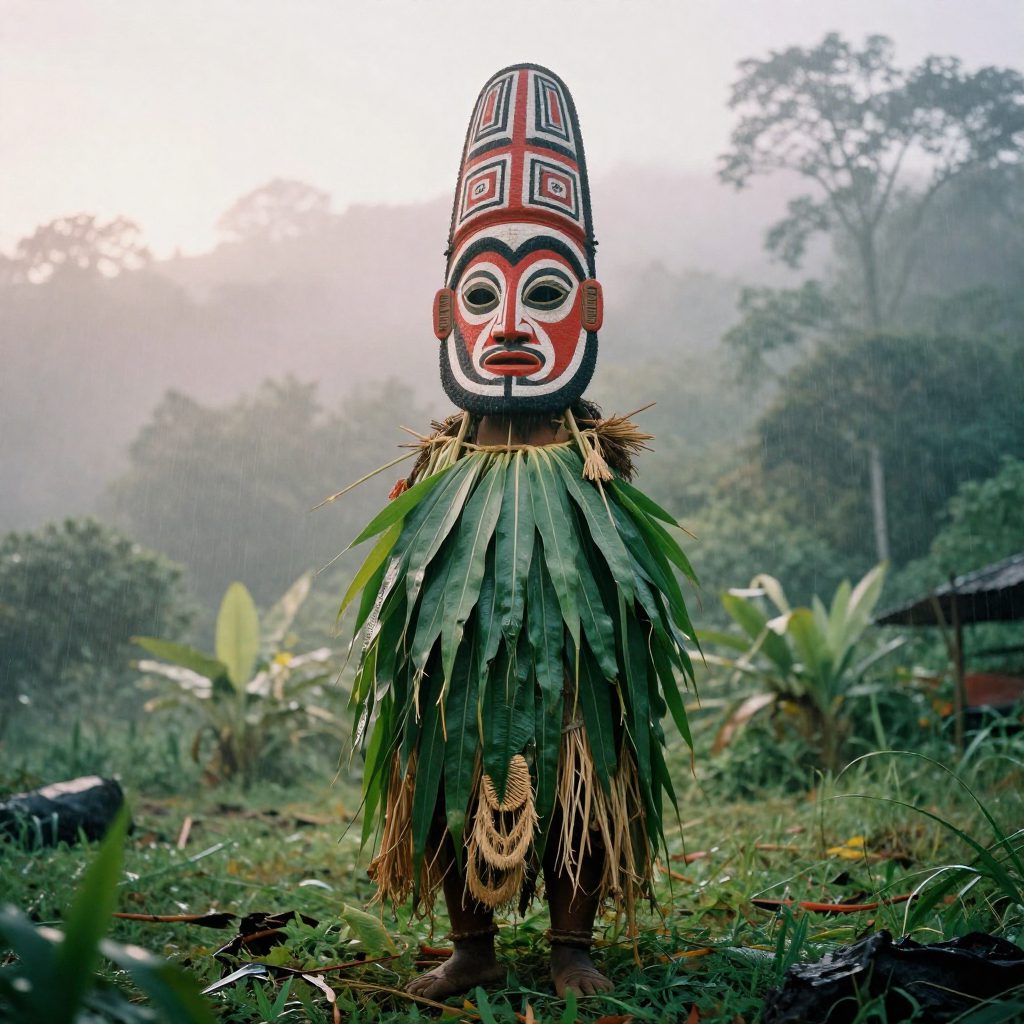
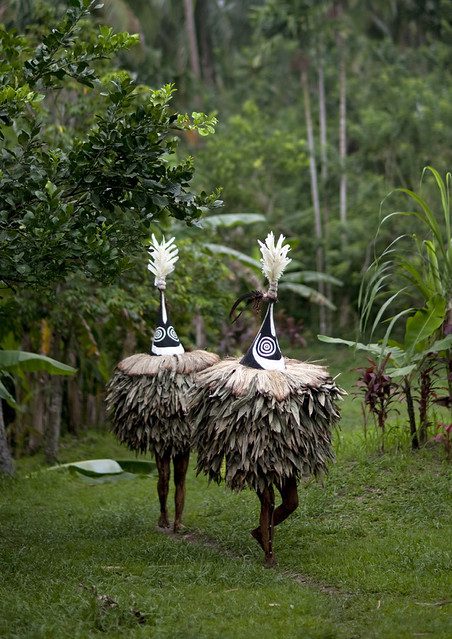
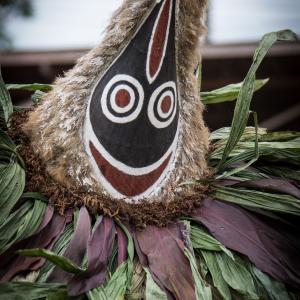
The Tubuan is instantly recognizable by its commanding form, designed to evoke both awe and reverence. The most striking feature is its tall, conical or dome-shaped mask, constructed from cane, bark cloth, and natural pigments. Painted in vivid red, black, and white, the mask’s geometric patterns communicate clan identity and spiritual significance. Below the mask, the dancer’s body is concealed within an expansive skirt made from fresh dracaena leaves, allowing the Tubuan to move with a rustling, rhythmic sway during performances. This full-body disguise removes any hint of individuality, ensuring that the Tubuan appears as a true spirit, not a human performer.
The mask’s stylised face—with its pronounced eyes and open mouth—enhances the sense of an otherworldly presence. Clan-specific variations introduce minor but meaningful differences in design, sometimes incorporating shells or fibre ornamentation. The physical structure is intentionally imposing: its silent, measured movements and towering shape reinforce the mystery and authority that the Tubuan embodies within ceremonial life.
Family
In Tolai cosmology, the Tubuan’s “family” is not defined by biological lineage but by ritual affiliation and ancestral connection. The spirit is linked to the matrilineages that hold ownership rights over specific Tubuans, a system passed down through generations. While men animate and manage the Tubuan in public ceremonies, the right to create or inherit a Tubuan figure comes from maternal ancestry. This blend of matrilineal ownership and male ritual authority reflects the dual structure of Tolai cultural organisation.
Mythologically, the Tubuan is sometimes paired with a female counterpart—often referred to as Vun Mor—who appears in certain ceremonies as a symbolic sister or spouse. Both spirits are occasionally associated with foundational culture heroes such as To Kabinana, connecting the Tubuan tradition to primordial origins and the earliest shaping of Tolai society. Through this complex system of spiritual kinship, every Tubuan serves as a conduit linking the living community to its ancestors.
Other names
Although “Tubuan” is the primary term used throughout Tolai regions, the figure exists within a broader system of related masked spirits. The Tubuan is often mentioned alongside the Duk-Duk, a spirit figure with a distinct mask shape and separate ceremonial purpose. While the Tubuan represents authority, continuity, and clan prestige, the Duk-Duk traditionally served a more judicial role, often appearing to punish wrongdoing or to enforce community law.
Some clans maintain unique names for their Tubuans, usually linked to ancestral figures or founding clan members. These names, considered sacred, are rarely spoken outside ritual contexts. Smaller variants such as the Midi appear in certain ceremonies, distinguished by specific mask patterns or decorative elements. Across academic literature, the Tubuan may also be labelled as a “Tolai Mask Spirit,” though this general term fails to capture the deep cultural complexity the figure represents within local belief systems.
Powers and Abilities
The Tubuan’s power operates on both spiritual and social levels. Traditionally, it was believed to embody ancestral authority, allowing it to bless communities, protect sacred spaces, and enforce taboos. Its appearance during rituals was thought to bring ancestral presence into the physical world, ensuring that ceremonies remained sacred and orderly.
The Tubuan historically wielded significant judicial power. Before colonial rule, it could impose fines, resolve disputes, and punish violations of cultural law—sometimes through symbolic destruction such as burning a wrongdoer’s property. Because women and uninitiated men were forbidden to look directly at the Tubuan, even accidental encounters were believed to result in misfortune or illness, reinforcing the spirit’s aura of supernatural danger.
In ritual performances, the Tubuan uses its presence to sanctify important events such as initiations, funerals, and clan gatherings. Its movements, accompanied by bamboo percussion beats, are understood as a form of spiritual communication, reaffirming ancestral guidance and ensuring the prosperity and harmony of the community.
Modern Day Influence
Today, the Tubuan continues to shape Tolai cultural identity, functioning as both a heritage symbol and a living ritual tradition. Despite decades of missionary pressure to dismantle indigenous practices, Tolai communities preserved the Tubuan through strategic adaptation—maintaining sacred secrecy while allowing certain public appearances during cultural festivals. Events such as the National Mask Festival in Kokopo showcase the Tubuan as an emblem of Tolai pride and Papua New Guinea’s rich cultural diversity.
The Tubuan also played a symbolic role in the political activism of the Mataungan Association, becoming a sign of resistance against colonial administration. In contemporary contexts, it appears in provincial emblems, local art, and educational programs, demonstrating its continued relevance to community governance and cultural continuity. While Christianity has reshaped some ritual interpretations, the Tubuan remains an integral part of Tolai identity, embodying resilience, ancestral memory, and ongoing cultural transformation.
Related Images
Source
Epstein, A. L. (1998). Tubuan: The survival of the male cult among the Tolai. In Modern Papua New Guinea (pp. 45-60). University of Papua New Guinea Press.
Tateyama, H. (2006). Tubuan: History, tradition, and identity among the Tolai of Papua New Guinea [Doctoral dissertation, University of British Columbia]. UBC Library Open Collections. https://open.library.ubc.ca/soa/cIRcle/collections/ubctheses/831/items/1.0092976
The National. (2021, May 15). Tubuans a symbol of Tolai culture. https://www.thenational.com.pg/tubuans-a-symbol-of-tolai-culture/
Garland Magazine. (2017, November 30). Embodied history: Remaking and returning the midi. https://garlandmag.com/article/embodied-history/
No Leg Room. (2023, July 17). Tradition. https://nolegroom.ca/2023/07/17/tradition/
Tateyama, H. (2025). Tubuan: History, tradition, and identity among the Tolai of Papua New Guinea. UBC Press. https://books.google.com/books/about/Tubuan_History_Tradition_and_Identity_Am.html?id=rQXwAQAACAAJ
Vogel, F. (2016). Tolai Tubuan performance at the National Mask Festival. Journal de la Société des Océanistes, 142-143, 155-170. https://journals.openedition.org/jso/7550
Holy Spirit Seminary. (n.d.). Rempi to Rebiamul. https://hssbomana.org/history/Rempi_to_Rebiamul.pdf
Errington, F., & Gewertz, D. (1995). Articulating identities: Colonial encounters and the politics of representation in Papua New Guinea. University of California Press.
Neumann, K. (1992). Not the way it really happened: Constructing the Tolai past. The Journal of Pacific History, 27(2), 202–220.
Frequently Asked Questions
What is the Tubuan in Tolai mythology?
The Tubuan is a masked ancestral spirit representing law, authority, and cultural continuity within Tolai society.
What does the Tubuan mask symbolize?
Its geometric mask and leafy costume symbolise anonymity, spiritual power, and the presence of ancestral forces.
Who controls the Tubuan rituals?
Initiated men control and perform Tubuan rituals, but ownership rights are held through matrilineal clans.
How did colonialism affect the Tubuan tradition?
While missionaries attempted suppression, the Tubuan survived by adapting its practices and becoming a symbol of Tolai resistance.
Is the Tubuan still performed today?
Yes, it remains active in Tolai ceremonies and cultural festivals and is recognised nationally as an important cultural heritage figure.
