
Taktsang : Bhutan’s Cliffside Sanctuary of the Tiger’s Nest
At a glance
| Description | |
|---|---|
| Mythology | Tibetan Mythology |
| Country | Bhutan |
| Closest airport | Paro International Airport (PBH) |
| Type | Constructed |
| Accessibility | 06/10 |
Mythlok Perspective
From the Mythlok perspective, Taktsang represents a Himalayan philosophy where elevation is not about supremacy, but surrender. Unlike monumental sacred sites such as Angkor Wat, which expands across flat land to express cosmic order through scale, Taktsang withdraws upward into isolation, reducing human presence to near insignificance. The climb is integral to its meaning, echoing ascetic mountain sanctuaries like Meteora, yet Taktsang differs by embedding itself into the cliff rather than resting atop it. In this way, Bhutanese Vajrayana thought frames enlightenment as coexistence with instability. Where many traditions build to endure, Taktsang teaches that spiritual clarity emerges when permanence is abandoned and balance is continuously negotiated between stone, breath, and belief.
Taktsang
Introduction
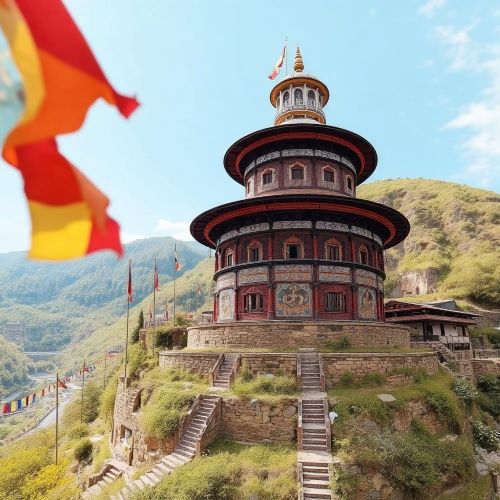
Perched impossibly against a vertical granite cliff in western Bhutan, Taktsang—widely known as Paro Taktsang or the Tiger’s Nest—stands as one of the most striking sacred landscapes in the Himalayan world. Rising nearly 900 meters above the Paro Valley floor and located about ten kilometers north of Paro town, the monastery appears to float between sky and stone. Its whitewashed walls and gilded roofs contrast sharply with the dark rock face, creating an image that has come to symbolize Bhutan itself. Taktsang is not merely an architectural wonder but a living spiritual center rooted deeply in Vajrayana Buddhist tradition. For pilgrims and travelers alike, the journey to Taktsang is understood as both a physical ascent and an inward passage toward reflection, discipline, and reverence.
Connection with Mythology
The mythological heart of Taktsang is inseparable from Padmasambhava, also revered as Guru Rinpoche. According to Bhutanese and Tibetan tradition, Padmasambhava arrived at this cliff in the eighth century while spreading Tantric Buddhism across the Himalayan regions. Legend recounts that he flew to the site on the back of a tigress, an emanation of his consort Yeshe Tsogyal, in order to subdue obstructive spirits inhabiting the valley. This dramatic arrival gave the site its name, which translates directly to “Tiger’s Nest.”
Within a cave embedded in the cliff, Padmasambhava is believed to have meditated for three years, three months, three weeks, three days, and three hours. During this period, he manifested in multiple forms, including the wrathful Dorje Drolo, symbolizing the transformative power of enlightened fury against ignorance. In Himalayan spiritual geography, Taktsang is regarded as a beyul, or hidden sacred landscape, where spiritual energies remain especially potent. The mythology surrounding Taktsang does not portray conquest of nature but harmonization with it, reinforcing Bhutanese Buddhism’s emphasis on balance rather than domination.
Ways to Get There
Reaching Taktsang requires intention and physical effort, qualities that mirror the site’s spiritual ideals. The monastery lies in the upper Paro Valley of Bhutan, with the nearest air access via Paro International Airport. From Paro town, visitors travel by road to the base of the mountain, where the pilgrimage trail begins.
The ascent typically takes two to three hours one way, depending on pace and acclimatization. The trail climbs steadily through pine forests draped with prayer flags, crossing small streams and offering intermittent viewpoints of the monastery across the gorge. Horses are available for part of the ascent, though the final steep section leading to the monastery must be completed on foot. While the trek is physically demanding, it is deliberately structured as a contemplative journey. Many pilgrims consider the effort an integral part of receiving blessings from Taktsang itself.
What to Look For
The Taktsang complex consists of several interconnected temples and meditation spaces built directly into the cliff. At its spiritual core lies the sacred meditation cave associated with Padmasambhava, preserved as a place of deep veneration. Surrounding shrines house statues and murals depicting the eight manifestations of Guru Rinpoche, each representing different enlightened qualities.
Architecturally, Taktsang exemplifies Bhutanese craftsmanship adapted to extreme terrain. Wooden balconies, narrow stairways, and stone foundations appear organically fused with the rock face. Inside, wall paintings illustrate episodes from Buddhist cosmology and the life of Padmasambhava, many restored after damage caused by a devastating fire in 1998. Beyond the structures themselves, the sweeping views of the Paro Valley create a powerful sense of scale, reminding visitors of the monastery’s deliberate placement between earth and sky.
Importance in cultural history
Taktsang occupies a central place in Bhutan’s religious and cultural identity. Although the sacred cave predates the structure, the monastery was formally constructed in the late seventeenth century under the patronage of Desi Tenzin Rabgye, a key political and spiritual leader of Bhutan. Its establishment reinforced Bhutan’s alignment with Vajrayana Buddhism and helped consolidate religious practices distinct from neighboring regions.
Over centuries, Taktsang has served as a major pilgrimage destination for Bhutanese communities and Himalayan Buddhists beyond the kingdom’s borders. Its near-total destruction by fire in 1998 and subsequent restoration by 2005 stand as a testament to Bhutan’s commitment to preserving sacred heritage using traditional methods. Today, Taktsang is more than a monument; it is a living symbol of resilience, spiritual continuity, and the Bhutanese philosophy that cultural preservation and spiritual wellbeing are inseparable.
Best time to travel
The most favorable periods to visit Taktsang are from March to May and from September to November. During these months, weather conditions are generally stable, skies are clear, and trail conditions are safer. Spring brings blooming rhododendrons along the path, while autumn offers crisp air and expansive visibility across the valley.
The monsoon season, typically from June to August, can make the trail slippery and less accessible, while winter months may bring snow and icy conditions. Regardless of season, beginning the hike early in the morning is recommended to avoid crowds and to experience the monastery in a quieter, more contemplative atmosphere.




Source
Rubin Museum of Art. (n.d.). Taktsang, the Tiger’s Lair. Project Himalayan Art.
https://rubinmuseum.org/projecthimalayanart/essays/taktsang-monastery/
Traveltriangle. (2023, June 20). Paro Taktsang: A guide to explore this temple in Bhutan. https://traveltriangle.com/blog/paro-taktsang/
Wikipedia. (2025). Paro Taktsang. https://en.wikipedia.org/wiki/Paro_Taktsang
Himalayas Discovery. (n.d.). Taktsang Monastery (Tiger’s Nest) – the Landmark of Bhutan. Retrieved January 11, 2026, from https://www.himalayasdiscovery.com/bhutan-travel-guide/paro/places-to-visit/taktsang-monastery.html
Ardussi, J. A. (1999). Gyalse Tenzin Rabgye and the Founding of Taktsang Lhakhang. Journal of Bhutan Studies, 1(1), 36–63.
Druk Asia. (2024, June 25). The Tiger’s Nest In Bhutan: The Taktsang Monastery. https://www.drukasia.com/bhutan/paro/taktsang-monastery/
Encounters Travel. Tiger’s Nest Monastery. https://www.encounterstravel.com/us/blog/tigers-nest-monastery
Frequently Asked Questions
What is Taktsang famous for?
Taktsang is famous for its dramatic cliffside location and its association with Guru Padmasambhava, making it Bhutan’s most sacred and iconic monastery.
Why is Taktsang called the Tiger’s Nest?
The name comes from the legend that Padmasambhava flew to the site on the back of a tigress to meditate and subdue negative forces.
How difficult is the hike to Taktsang?
The hike is moderately challenging, involving a steady uphill climb that takes several hours, but it is manageable for most visitors with average fitness.
Is Taktsang still an active monastery?
Yes, Taktsang remains an active religious site where monks reside and perform rituals, and visitors are expected to observe respectful conduct.
When is the best season to visit Taktsang?
Spring and autumn are considered the best seasons due to clear weather, comfortable temperatures, and safer trail conditions.