


Nkya : The Restless Figure in Nkole Creation Belief
Listen
At a glance
| Description | |
|---|---|
| Origin | Nkole Mythology |
| Classification | Spirits |
| Family Members | Ruhanga (Brother) |
| Region | Uganda |
| Associated With | Creation, Impatience, Human limitation, Tools, |
Nkya
Introduction
Nkole oral tradition, preserved among the Banyankole people of southwestern Uganda, places the creator Ruhanga at the center of existence. Yet creation itself does not begin in silence. Nkya appears in these narratives as the restless presence that breaks cosmic stillness. Living alongside Ruhanga in an empty, formless void, Nkya experiences boredom, discomfort, and dissatisfaction with nothingness. His complaints become the spark that drives creation forward, pushing Ruhanga to shape the sun, moon, earth, animals, vegetation, and ultimately the foundations of human life.
Rather than ruling or commanding, Nkya functions as a catalyst. He embodies the earliest human impulse to seek meaning, shelter, and sustenance. Through him, Nkole stories explain why the world is imperfect, demanding patience, labor, and wisdom. These tales were passed orally by elders in cattle camps and homesteads, reinforcing values tied to pastoral survival, restraint, and respect for divine order. Nkya is not worshipped in the formal sense, but remembered as the figure through whom existence gained texture and consequence.
Physical Traits
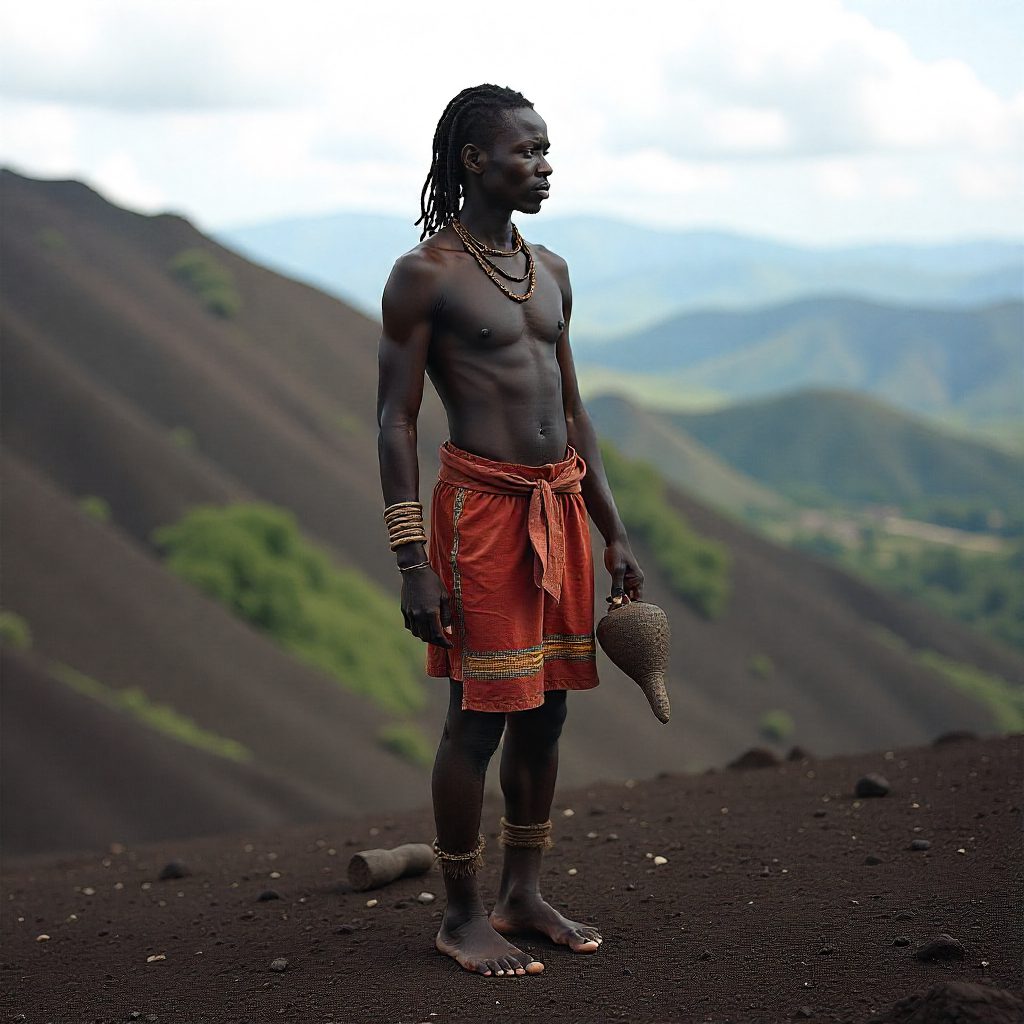
Nkya is consistently described without supernatural grandeur. Unlike Ruhanga, who remains unseen and abstract, Nkya is portrayed as fully corporeal, resembling the first human rather than a god. His body is vulnerable to heat, fatigue, and injury. In some versions, his hands burn when he eats food before it cools, and his limbs lack the strength to break branches without tools. These details are intentional, grounding Nkya firmly in physical limitation.
He carries no radiant aura, animal hybrid form, or divine markings. His appearance reflects the human condition at its most basic stage, dependent on learning and adaptation. Ruhanga provides Nkya with tools such as a knife, axe, and hammer, underscoring that survival comes through innovation rather than innate power. This portrayal aligns closely with Banyankole pastoral realism, where endurance, skill, and patience are more valuable than brute force.
Family
Nkya’s only clearly defined familial relationship is with Ruhanga, identified as his elder brother. This bond is central to Nkole creation narratives and establishes a hierarchy where authority and wisdom rest with Ruhanga, while experience and trial belong to Nkya. No spouse, offspring, or lineage is attributed directly to him. Humans do not descend biologically from Nkya but emerge through Ruhanga’s creative acts following Nkya’s demands.
In this sense, Nkya represents proto-humanity rather than an ancestor figure. Some regional variants influenced by neighboring traditions portray Nkya interacting with early animals and birds, but these relationships are functional rather than familial. The absence of descendants reinforces his symbolic role as a prototype rather than a progenitor, mirroring Nkole social emphasis on divine kingship traced to Ruhanga rather than secondary figures.
Other names
Nkya does not possess a wide range of alternate names, which distinguishes him from many African deities who accumulate titles over time. In most accounts, he is simply referred to as Nkya, often described contextually as Ruhanga’s younger brother. Oral descriptors emphasize his impatience or dissatisfaction rather than assigning formal epithets.
Some storytellers use phrases that translate loosely to “the restless one” or “the complainer,” but these function as narrative identifiers rather than proper names. Academic references occasionally frame him relationally as “Nkya of Ruhanga,” highlighting that his identity is inseparable from the creation episode itself. His limited nomenclature reflects his role as a narrative force rather than an object of ritual devotion.
Powers and Abilities
Nkya possesses no supernatural powers of his own. He does not create, destroy, or command natural forces. His significance lies in his influence rather than ability. By voicing discomfort with emptiness, darkness, hunger, and exposure, Nkya prompts Ruhanga to act. The emergence of celestial bodies, livestock, crops, and tools follows Nkya’s complaints, positioning him as the instigator of change rather than its executor.
His actions teach consequences. When he eats too quickly, he burns himself. When he rushes tasks, he fails. These moments transform Nkya into a moral teaching figure, illustrating the dangers of impatience and excess. In Nkole philosophy, his lack of power is itself instructive, reinforcing the belief that humans must work within limits established by a higher cosmic order.
Modern Day Influence
Although Nkya is no longer invoked ritually in most contemporary settings, his presence endures through storytelling, education, and cultural symbolism. Among the Banyankole, creation narratives featuring Nkya are still shared during cultural gatherings, often as cautionary tales emphasizing patience, discipline, and respect for divine balance. These stories resonate strongly in pastoral communities facing environmental uncertainty and economic change.
Christian influence in Uganda has led to interpretive parallels between Nkya and Adam, framing him as a flawed first man whose impatience shapes human hardship. In academic and digital spaces, Nkya has gained renewed attention through folklore preservation projects and platforms such as Mythlok, where interest in lesser-known African mythic figures continues to grow. His story now circulates globally as part of broader conversations on origin myths, human limitation, and the psychology of creation.
Related Images


Source
Binyankole Cultural Foundation. (2023). Oral traditions of Ankole creation myths. Kampala: Uganda Heritage Press.
Britannica Editors. (2015). Ruhanga. In Encyclopædia Britannica. https://www.britannica.com/topic/Ruhanga
Kagwa, A. (2018). The customs of the Baganda (2nd ed.). Columbia University Press. (Adapted for Nkole parallels).
Kwekudee. (2013, July). Banyankole (Ankole) people: Uganda’s famous cattle people. Kwekudee-Trip Down Memory Lane. https://kwekudee-tripdownmemorylane.blogspot.com/2013/07/banyankole.html
Nyakatura, J. B. (1970). Anatomy of an African kingdom: A history of Bunyoro-Kitara. Doubleday.
Roscoe, J. (1909). The Baganda: An account of their customs and beliefs. Macmillan. (Nkole cross-references).
Uganda National Cultural Centre. (2022). Textual analysis of social dynamics in selected Ankole myths [PDF]. Kyambogo University. https://kyuspace.kyu.ac.ug/bitstreams/d714e746-120a-47dc-891e-f5409382022c/download
Mbiti, J. S. (1990). African Religions and Philosophy (2nd ed.). Oxford: Heinemann.
Akiiki, B. (1971). Religion and Social Change in Ankole. Kampala: Makerere University Press.
Taylor, J. H. (1962). The Western Bantu Mythologies. London: Oxford University Press.
Wrigley, C. C. (1959). Kingship and Myth in Ankole. Uganda Journal, 23(2), 145–162.
Frequently Asked Questions
Who is Nkya in Nkole belief?
Nkya is a mythic figure in Nkole oral tradition whose dissatisfaction with emptiness prompted Ruhanga to create the world
Is Nkya a god or a human figure?
Nkya is best understood as a proto-human figure rather than a god, representing early humanity’s limitations and desires.
What is Nkya’s relationship with Ruhanga?
Nkya is described as Ruhanga’s younger brother, whose complaints drive the act of creation.
Does Nkya have supernatural powers?
No, Nkya possesses no inherent supernatural abilities and relies entirely on tools and divine provision.
Why is Nkya important in Nkole culture?
Nkya symbolizes impatience, human limitation, and the consequences of desire, offering moral lessons still shared today.
