

Mulonga : The First Man in Kaonde Tradition
Listen
At a glance
| Description | |
|---|---|
| Origin | Kaonde Mythology |
| Classification | Mortals |
| Family Members | Mwinambuzhi (Wife) |
| Region | Zambia |
| Associated With | Human origin, Mortality |
The Mythlok Perspective
Mulonga is not remembered as a hero who defied death, but as the moment humanity accepted it. Within the Mythlok framework, he represents human existence as intentionally limited rather than tragically flawed. Unlike traditions that frame mortality as a fall or punishment, Mulonga’s story presents it as an inherited condition shaped by divine order. Comparable to other first-human figures, he stands apart in his quiet symbolism, reminding us that meaning arises not from escaping limits, but from living consciously within them.
Mulonga
Introduction
Mulonga occupies a foundational position in Kaonde oral tradition as the first human being created by the supreme creator deity, Leza. Among the Kaonde people of north-western Zambia, his story explains not only the origin of humanity but also the deeper reasons behind mortality, gender distinction, and the fragile balance between divine intention and human limitation. Unlike creator gods who remain distant from human experience, Mulonga represents humanity itself in its earliest, most vulnerable form. His myth does not glorify conquest or supernatural power but instead reflects the Kaonde understanding of existence as something granted, shaped, and ultimately constrained by divine order.
The narrative of Mulonga is transmitted orally through elders, initiation teachings, and ceremonial storytelling. These accounts are not fixed scriptures but living traditions that adapt while preserving core meanings. At its heart, the story of Mulonga asks why humans die, why suffering exists, and why life unfolds within limits. Through Mulonga, Kaonde cosmology frames humanity as neither cursed nor exalted, but intentionally bounded, existing within a moral and natural order that must be respected rather than overcome.
Physical Traits
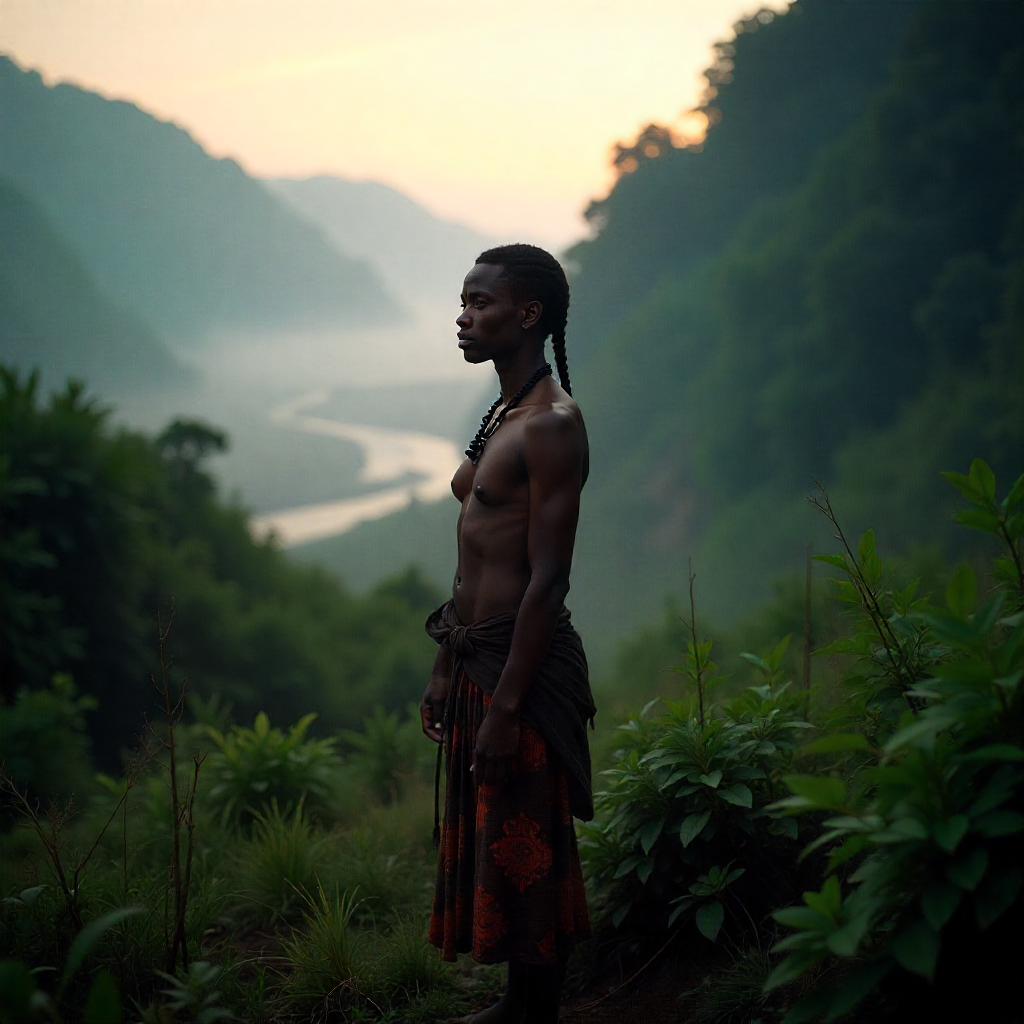
Mulonga is described as physically strong, compact, and resilient, embodying the ideal human form before the differentiation of gender. Early versions of the myth emphasize that Mulonga, like his counterpart Mwinambuzhi, was created without sexual organs. This detail is not incidental but central to Kaonde cosmology, symbolizing an original state of undivided humanity where reproduction had not yet entered the world.
His strength is repeatedly emphasized in oral accounts, not as a tool of domination but as a marker of endurance. Mulonga represents the physical readiness required for survival in a demanding landscape of forests, rivers, and shifting seasons. He is fearless not because he lacks danger, but because danger is inherent to existence. In this sense, Mulonga’s physicality is symbolic rather than heroic. His body reflects the Kaonde view that the human form is sufficient for life as intended by Leza, without the need for divine invulnerability or immortality.
Family
Mulonga’s primary familial relationship is with Mwinambuzhi, the first woman. Together, they form the original human pair, though not immediately in a reproductive sense. Their partnership initially represents balance rather than lineage. Mulonga’s strength complements Mwinambuzhi’s gentleness, establishing a model of coexistence rather than hierarchy.
Their transformation into ancestors occurs only after Leza grants them reproductive organs, marking the beginning of human continuity. This act places family itself within divine authority, reinforcing the Kaonde belief that kinship, fertility, and descent are not accidental but sacred developments. Mulonga is therefore not a patriarch in the political sense, but a symbolic ancestor whose existence makes humanity possible. All later generations trace their origin not to his power, but to his acceptance of divine limits.
Other names
In Kaonde oral tradition, Mulonga is rarely surrounded by a wide range of alternative names. Instead, his identity is preserved through descriptive titles that emphasize his role rather than mythic grandeur. He is often referred to simply as the First Man or the Primordial Ancestor, terms that anchor him firmly within human history rather than divine hierarchy.
In comparative retellings, Mulonga may be aligned with broader Bantu concepts of original humanity, though his name remains distinctly Kaonde. This linguistic stability reflects the importance of continuity in Kaonde storytelling. Mulonga’s name does not evolve dramatically because his function does not change. He is remembered not for acts, but for consequences, especially the moment when mortality becomes permanent for humankind.
Powers and Abilities
Mulonga does not possess supernatural powers in the conventional sense. His significance lies in symbolic authority rather than magical capability. As the first human shaped directly by Leza, Mulonga exists closer to the divine origin than any later generation, yet he remains fully human.
His most profound “ability” is representational. Through Mulonga, the Kaonde explain why humans are mortal. In several versions of the myth, a test or choice presented to early humanity results in death becoming permanent. Mulonga’s role in this outcome frames mortality not as punishment, but as a boundary established through divine order and human action.
Mulonga also embodies courage, endurance, and acceptance. These traits are not supernatural gifts but moral qualities that define how humans are expected to live. His story teaches that humanity’s strength lies not in escaping limits, but in living meaningfully within them.
Modern Day Influence
Mulonga continues to shape Kaonde cultural identity, particularly in rituals surrounding marriage, birth, and death. His story informs traditional views on partnership, emphasizing balance rather than dominance between genders. In funerary practices, Mulonga’s narrative provides a framework for understanding death as an inherited condition rather than an individual failure.
In contemporary Zambia, Mulonga appears in academic studies, cultural preservation programs, and oral history projects aimed at safeguarding Kaonde heritage. His myth is also used in comparative mythology to explore parallels with other first-human figures across Africa and beyond. Rather than fading under modernization, Mulonga remains a reference point for discussions on identity, origin, and the human condition.
Related Images
Source
Melland, F. H. (1923). In witch-bound Africa: An account of the primitive Kaonde tribe. Seeley, Service & Co. https://ia801406.us.archive.org/35/items/inwitchboundaf00mell/inwitchboundaf00mell.pdf
African Proverbs, Sayings and Stories. (n.d.). Kaonde myth of creation. https://afriprov.tangaza.ac.ke/afri-story/kaonde-myth-of-creation/
Traditional Zambia Blog. (2020). Kaonde – Zambia’s traditional history.
https://traditionalzambia.home.blog/tribes-of-zambia/second-bantu-invasion/luba/kaonde/
Kaonde Archives. (2020). History of the Kaonde. https://kaondewordpress.wordpress.com/history/
Chibanza, S. J. (1974). A biography of Simon Jilundu Chibanza III. CORE.ac.uk.
https://core.ac.uk/download/91694.pdf
Mwewa, C. (2021). Zambian stories of migration and power (2nd ed.). Independent Publishing.
Franken, M. (2014). Functions of Siluyana and Cilunda royal court languages. Academia.edu. https://www.academia.edu/61297118/Functions_of_Siluyana_and_Cilunda_royal_court_languages_at_Lealui_and_Mwansabombwe_palaces_in_
Frequently Asked Questions
Who is Mulonga in Kaonde belief?
Mulonga is the first human created by Leza in Kaonde tradition and stands as the ancestral origin of all humanity. His existence explains how human life began within a divinely ordered world.
Is Mulonga a god or a human?
Mulonga is human, not a god, and was created directly by the supreme deity Leza. He represents humanity in its earliest form, defined by strength but limited by mortality.
What does Mulonga’s story explain?
Mulonga’s myth explains why humans are mortal and why death is a permanent part of existence. It also accounts for the emergence of gender and human vulnerability within divine boundaries.
Who was Mulonga’s partner?
Mulonga’s partner was Mwinambuzhi, recognized as the first woman in Kaonde belief. Together, they became the ancestors of humanity after being granted the ability to reproduce.
Why is Mulonga still important today?
Mulonga remains important as a cultural symbol explaining life, death, and human limitations. His story continues to shape Kaonde identity, moral values, and traditional worldviews.
