
Makemake : The Supreme Creator God of Easter Island
Listen
At a glance
| Description | |
|---|---|
| Origin | Rapa Nui Mythology |
| Classification | Gods |
| Family Members | N/A |
| Region | Easter Island |
| Associated With | Creation, Fertility, Birds |
Makemake
Introduction
Makemake is the most important deity in the mythology of Rapa Nui, commonly known as Easter Island. Emerging as the island’s supreme god after the decline of Moai statue worship in the seventeenth century, Makemake represented a decisive shift in religious thought driven by ecological stress, social upheaval, and political transformation. Revered as the creator of humanity and a god of fertility, his rise coincided with the collapse of ancestor-based cults and the violent conflicts that followed deforestation and resource scarcity.
Rather than focusing on monumental stone ancestors, Makemake’s worship centered on survival, renewal, and divine legitimacy. He became the spiritual anchor of the Tangata manu, or Bird-man cult, a competitive ritual system that governed leadership and resource distribution. Through this cult, Makemake embodied the fragile balance between human ambition and nature’s limits. Oral traditions and ceremonial chants, possibly once recorded on the undeciphered Rongorongo tablets, preserved his sacred authority, making Makemake not just a god of origins, but a symbol of endurance in a collapsing world.
Physical Traits
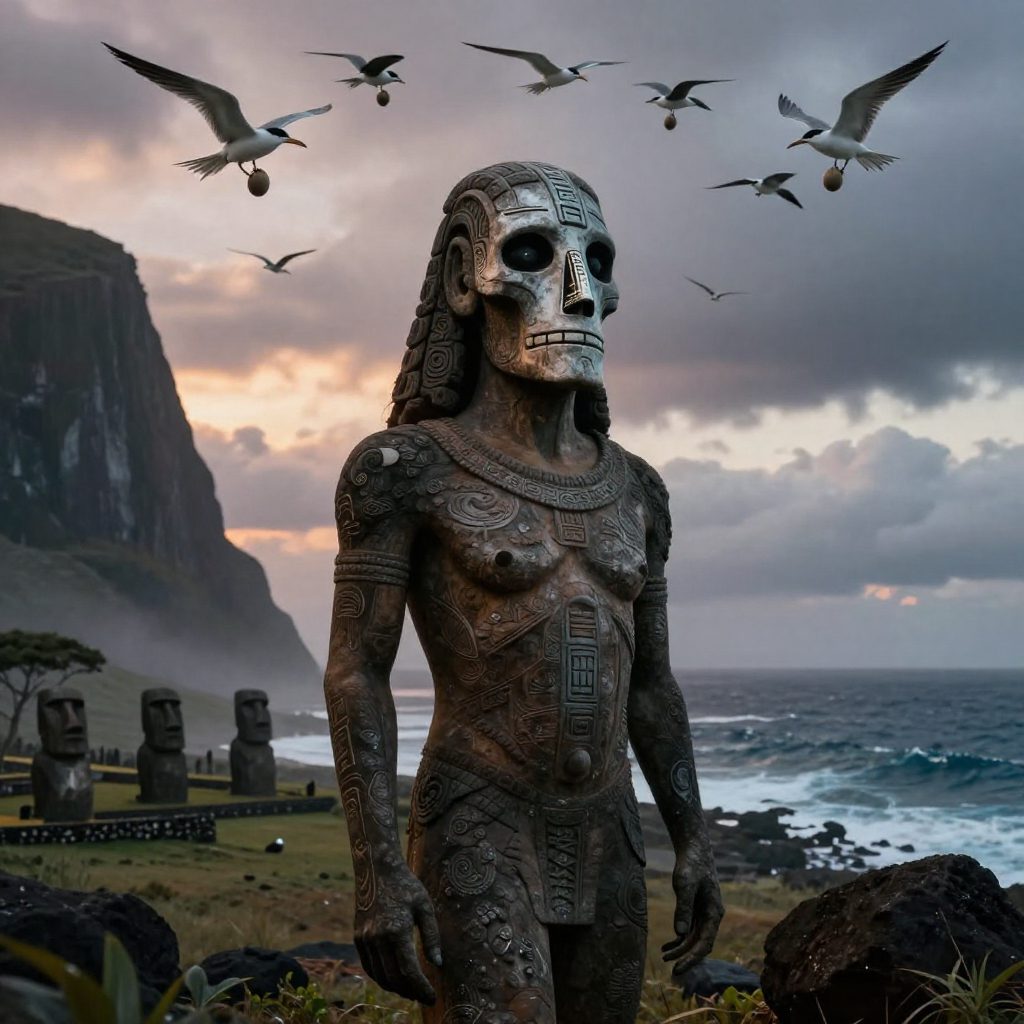
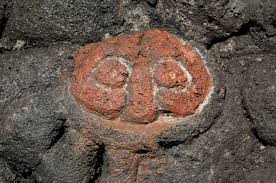
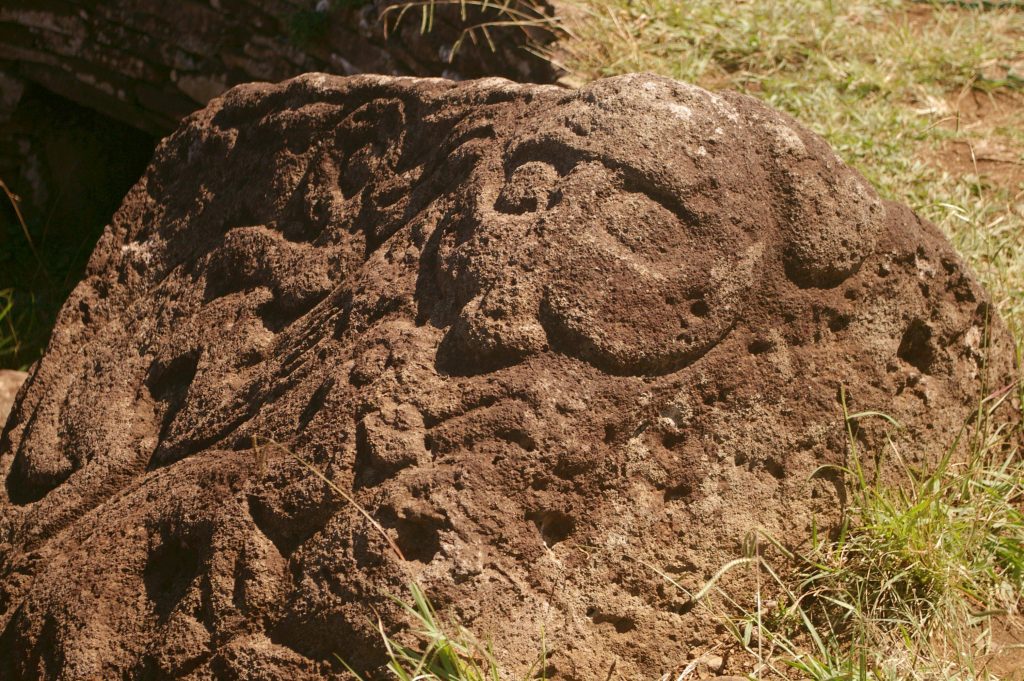
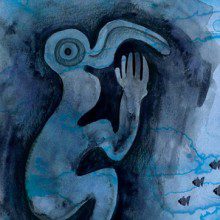
Makemake’s physical representation is strikingly abstract when compared to other Polynesian deities. Rapa Nui petroglyphs consistently depict him as a disembodied face or skull-like form with exaggerated, hollow eyes and a pronounced phallic nose. These features are not decorative but symbolic. The eyes represent vigilance, divine awareness, and supervision over ritual acts, particularly the Bird-man competitions. The phallic nose emphasizes fertility, generative power, and the continuation of life.
Unlike the anthropomorphic gods found elsewhere in Polynesia, Makemake lacks limbs or a complete body in most depictions. This deliberate absence reinforces his transcendent nature, suggesting a presence that exists beyond physical constraints. Carved primarily into volcanic rock at Orongo and surrounding ceremonial sites, his imagery often appears alongside birds, eggs, and vulva motifs, linking him directly to creation, reproduction, and cyclical renewal. The stark minimalism of his iconography reflects Rapa Nui’s isolation and its evolution of a distinct spiritual language.
Family
Makemake occupies an unusual position within Polynesian mythological structures because he lacks a clearly defined divine consort. He is portrayed as a solitary creator whose generative power does not depend on partnership. This absence of a wife reinforces his role as a self-sufficient force of creation rather than a participant in cosmic genealogy.
However, Makemake is frequently invoked alongside a subordinate deity named Haua, who functioned as his ritual companion. Haua was associated with lunar cycles and timing, particularly relevant to fertility rites and Bird-man ceremonies. Some traditions also mention figures such as Vî‘e Hoa, Vî‘e Kenatea, and other supernatural attendants connected to ritual observances. A small number of offspring names appear in fragmented oral genealogies, but these do not form a coherent divine family. Instead, Makemake’s most enduring “descendants” are humanity itself, whom he created directly, positioning him as an ancestral progenitor rather than a familial patriarch.
Other names
Makemake’s name appears in several orthographic variations, including Make-make and Make Make, reflecting differences in transcription and oral transmission rather than distinct identities. These variations do not indicate separate aspects or epithets but are phonetic adaptations within Rapa Nui language practices.
Scholars have long debated whether Makemake represents a localized form of the widespread Polynesian god Tane. While thematic parallels exist, particularly regarding creation and fertility, Makemake’s iconography, cult practices, and lack of a genealogical framework suggest an independent evolution shaped by Rapa Nui’s extreme isolation. In modern contexts, the name Makemake gained international visibility when it was assigned to a dwarf planet discovered in 2005, reinforcing his association with creation on a cosmic scale.
Powers and Abilities
Makemake’s primary power is creation. In foundational myths, he forms humanity from earth, stone, or clay, breathing life directly into human beings. This act establishes him as the ultimate source of life and social order. His creative authority extends beyond humans to fertility in all forms, governing reproduction, agriculture, and ecological balance.
He is also the divine patron of birds, particularly the sooty tern, whose annual nesting cycle formed the basis of the Tangata manu ritual. By controlling the arrival of these birds, Makemake dictated the rhythm of leadership succession. The victorious Bird-man ruled for a year under his mandate, gaining sacred authority and access to resources.
Makemake also influenced spiritual divination. Priests and seers sought visions and signs from him to determine ritual timing and select competitors. Unlike war gods, Makemake’s power lay not in destruction but in renewal, legitimacy, and survival, offering stability during one of the island’s most volatile historical periods.
Modern Day Influence
Makemake’s legacy remains visible across cultural, scientific, and artistic domains. In astronomy, the dwarf planet Makemake was named in his honor, following the International Astronomical Union’s convention of naming trans-Neptunian objects after creator deities. Its reddish hue has often been symbolically linked to Rapa Nui’s volcanic landscape.
On Easter Island, Makemake’s image continues to appear in tattoos, carvings, ceremonial reenactments, and festival performances such as Tapati Rapa Nui. Petroglyph replicas and Bird-man motifs dominate cultural tourism, reinforcing his role as a symbol of identity and resilience.
Globally, Makemake has entered popular consciousness through documentaries, museum exhibitions, and academic discourse on ecological collapse and sustainability. In contemporary interpretations, he is often viewed as a cautionary deity, embodying both creative power and the consequences of environmental mismanagement. Through these modern lenses, Makemake remains profoundly relevant.
Related Images
Source
Englert, S. (1934). La Tierra de Hotu Matu’a: Historia, costumbres, y leyendas de la Isla de Pascua. Santiago: Imprenta Universitaria.
Métraux, A. (1940). Ethnology of Easter Island. Bernice P. Bishop Museum Bulletin 160. Honolulu: Bishop Museum Press.
Metraux, A. (1957). Easter Island: A stone-age civilization of the Pacific. Andrew Mellon Press.
Routledge, K. (1919). The mystery of Easter Island: The story of an expedition. London: Hazell, Watson & Viney. ISBN 0-932813-48-8.
Fischer, S. R. (2005). Island at the end of the world: The turbulent history of Easter Island. Reaktion Books.
Godchecker. (2019). MAKEMAKE – the Rapa Nui Supreme God. https://www.godchecker.com/polynesian-mythology/MAKEMAKE/
Wikipedia. (2023). Makemake (deity). https://en.wikipedia.org/wiki/Makemake_(deity)[2]
Imaginarapanui. (2022). Make Make, the creator god of Easter Island. https://imaginarapanui.com/en/make-make-easter-island-god/
Frequently Asked Questions
Who was Makemake in Rapa Nui mythology?
Makemake was the chief god of Easter Island, revered as the creator of humanity and a fertility deity associated with the Bird-man cult.
Is Makemake the same as the Polynesian god Tane?
While Makemake shares similarities with Tane, most scholars consider him a distinct deity shaped by Rapa Nui’s isolation and unique cultural history.
What was the Bird-man cult dedicated to Makemake?
The Tangata manu cult was an annual ritual competition where leaders sought divine legitimacy through Makemake by retrieving the first sooty tern egg.
Why is Makemake depicted as a face or skull?
His abstract depiction symbolizes fertility, divine vigilance, and transcendence rather than physical form.
Why is a planet named Makemake?
The dwarf planet Makemake was named after the god due to his role as a creator deity, aligning with astronomical naming traditions.