
Kelpie : The Shape-Shifting Water Spirit of Scottish Folklore
Listen
At a glance
| Description | |
|---|---|
| Origin | Scottish Mythology |
| Classification | Hybrids |
| Family Members | N/A |
| Region | Scotland |
| Associated With | Shapeshifting, Water, Deception, Strength, Drowning |
Kelpie
Introduction
The Kelpie occupies a powerful place in Scottish folklore as one of its most recognisable and unsettling supernatural beings. Described most often as a shape-shifting water spirit that inhabits rivers, lochs, and deep streams, the Kelpie reflects an ancient cultural awareness of the dangers posed by water in a rugged landscape. Its legends are deeply rooted in oral storytelling traditions that predate written records, passed down through generations as both entertainment and warning. Almost every region of Scotland claims its own Kelpie tale, linking the creature to specific bodies of water and reinforcing its presence as a living part of the land rather than a distant myth.
In Scottish Gaelic tradition, the Kelpie is closely associated with the term each-uisge, meaning “water horse,” though folklore sometimes distinguishes between the two depending on region and temperament. Regardless of name, the Kelpie consistently represents a force that is alluring yet lethal. It embodies the beauty of Scotland’s waterways alongside their unpredictability, serving as a supernatural explanation for drownings and disappearances long before modern safety awareness existed. Rather than a singular story, the Kelpie exists as a network of local beliefs, making it one of the most geographically widespread spirits in Scottish tradition.
Physical Traits
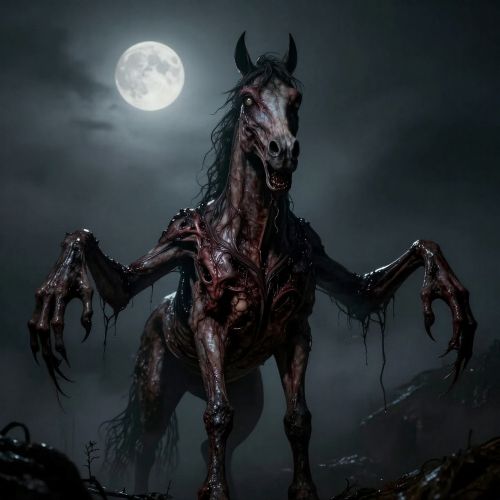
The Kelpie’s most famous form is that of a horse standing quietly near the edge of a loch or river, often appearing tame, strong, and unusually beautiful. Folklore descriptions frequently mention black, dark grey, or white coats that gleam as if perpetually wet. This visual detail reinforces the creature’s connection to water and makes it immediately striking against the Scottish landscape. The horse form is intentionally deceptive, inviting trust and curiosity rather than fear.
Closer observation, however, often reveals unsettling traits. Traditional stories describe the Kelpie’s skin as cold, clammy, or sticky to the touch, causing riders who mount it to become magically bound. In tales where the Kelpie appears in human form, it is usually as an attractive young man or woman, yet small details betray its true nature. Hooves hidden beneath clothing, constantly damp hair, or an aversion to crossing dry ground are common signs. This dual appearance allows the Kelpie to move seamlessly between the familiar and the uncanny, reinforcing its role as a predator rather than a monster that relies on brute force alone.
Family
The Kelpie does not belong to a defined divine lineage or family structure in the way gods or legendary heroes do. Instead, it exists as a solitary spirit, tied more closely to place than ancestry. Its closest relatives are thematic rather than genealogical, connecting it to a wider Celtic tradition of water spirits that inhabit dangerous or liminal environments.
Within Scotland, the Kelpie is often compared to the each-uisge, which is typically portrayed as more violent and associated with sea lochs and coastal waters. Beyond Scotland, similar beings appear across Celtic regions, including the Manx cabbyl-ushtey and the Welsh ceffyl dŵr. These shared figures suggest a common mythic response to water as both essential and deadly. Rather than forming a family tree, the Kelpie belongs to a cultural ecosystem of spirits shaped by geography, climate, and lived experience.
Other names
The name “Kelpie” itself likely derives from Scottish Gaelic words such as cailpeach or colpach, meaning heifer or colt, grounding the creature firmly in rural life and livestock imagery. This linguistic origin reinforces the idea that the Kelpie was never distant or abstract but closely tied to everyday encounters with animals and land.
Regional variations in name reflect Scotland’s diverse oral traditions. In some areas, the creature is referred to simply as the water horse, while island communities developed their own names, such as the nuggle in Shetland or the tangie in Orkney. While these beings share core characteristics, their behaviour and symbolism shift slightly depending on local beliefs. This fluid identity mirrors the nature of water itself, changing shape without losing essence.
Powers and Abilities
Shapeshifting is the Kelpie’s defining power and the foundation of its danger. Whether appearing as a horse, a human, or occasionally other animals, the Kelpie uses familiarity as its primary weapon. Unlike overtly monstrous beings, it relies on trust and curiosity to draw victims close. Once physical contact is made, the Kelpie’s enchanted skin binds the victim, preventing escape.
Folklore consistently attributes immense strength to the Kelpie, far beyond that of any natural animal. It is capable of dragging multiple victims into deep water simultaneously, where they are drowned and, in some accounts, devoured. Water itself appears to respond to the Kelpie’s presence, with sudden currents or storms accompanying its movements. In rare stories, humans who manage to steal the Kelpie’s bridle gain control over the creature and force it to perform labour, such as hauling stones for bridges or farms. These tales serve as exceptions that highlight wit over power, reinforcing moral themes common in folk storytelling.
Modern Day Influence
The Kelpie has never faded from Scottish cultural consciousness and continues to evolve within modern storytelling. One of the most visible contemporary representations is The Kelpies, the monumental horse-head sculptures in Falkirk unveiled in 2014. While inspired by industrial heritage, their scale and form unmistakably echo the mythic water horse, transforming ancient folklore into a modern landmark.
In literature, the Kelpie appears in poetry, fantasy novels, and children’s stories, often reinterpreted but rarely stripped of its dangerous nature. Robert Burns referenced the Kelpie in the eighteenth century, linking it to moral and religious symbolism, while modern fantasy treats it as a creature of moral ambiguity rather than pure evil. Video games, films, and role-playing worlds frequently include Kelpies as aquatic spirits that test human judgment. Through these reinterpretations, the Kelpie remains relevant, continuing its role as a symbol of nature’s beauty, deception, and unforgiving power.
Related Images
Source
Don, L. (2016). The secret of the kelpie. Floris Books.
Gregor, W. (1883). Kelpie stories from the north of Scotland. The Folk-Lore Journal, 1(1), 292-294.
Websites
Historic UK. (2024). The Kelpie, mythical Scottish water horse. https://www.historic-uk.com/CultureUK/The-Kelpie/
Scotland.org. (2015). Scottish myths, folklore and legends. https://www.scotland.org/inspiration/scottish-myths-folklore-and-legends
Mythos Anthology. (2024). Kelpie. https://mythosanthology.com/kelpie/
Wikipedia. (2024). Kelpie. https://en.wikipedia.org/wiki/Kelpie
Wear Folklore. (2025). KELPIE. https://wearfolklord.com/blogs/creature-feature/kelpie
Timberbush Tours. (2018). Scottish folklore: The legend of the Kelpies. https://www.timberbush-tours.co.uk/news-offers/scottish-folklore-kelpies
Briggs, K. M. (1976). A Dictionary of Fairies: Hobgoblins, Brownies, Bogies, and Other Supernatural Creatures. London: Penguin Books.
Mackillop, J. (2004). Dictionary of Celtic Mythology. Oxford: Oxford University Press.
Henderson, L. (2007). Scottish Folklore and Folk Belief: A Guide to the Folklore of Scotland. Edinburgh: Birlinn.
McNeill, F. M. (1959). The Silver Bough: A Four Volume Study of Scottish Folklore and Folk Belief. Glasgow: William MacLellan.
Frequently Asked Questions
What is a Kelpie in Scottish folklore?
A Kelpie is a shape-shifting water spirit from Scotland known for luring people into rivers and lochs where they drown.
Is the Kelpie the same as the each-uisge?
They are closely related, but the each-uisge is often considered more violent and associated with sea lochs.
Can a Kelpie appear as a human?
Yes, folklore describes Kelpies taking human form, often retaining hidden hooves or damp features.
Are Kelpies evil or misunderstood spirits?
They are generally portrayed as dangerous spirits rather than purely evil, embodying nature’s risks.
Do people still believe in Kelpies today?
While belief is symbolic today, Kelpie legends remain culturally significant across Scotland.