


Kakungu : The Ancestral Giant of Suku Lore
Listen
At a glance
| Description | |
|---|---|
| Origin | Suku Mythology |
| Classification | Spirits |
| Family Members | N/A |
| Region | Democratic Republic of Congo (DRC) |
| Associated With | Protection, Initiation |
Kakungu
Introduction
In Suku mythology, Kakungu stands as one of the most formidable and spiritually charged figures associated with the mukanda initiation tradition of southwestern Congo. More than a mask or ceremonial prop, Kakungu is believed to embody an ancestral spirit whose presence oversees the transition of boys into adulthood. Known for its imposing size and dramatic appearance, the Kakungu figure enters ritual spaces as a guardian, a healer, and a symbol of continuity between the living and their ancestors. During initiation seasons, the community does not perceive Kakungu as a performer but as an active spiritual being entrusted with the power to protect, discipline, and restore balance. This dual nature—as mythic entity and ritual guardian—has made Kakungu one of the most enduring figures in Suku cultural memory.
Physical Traits
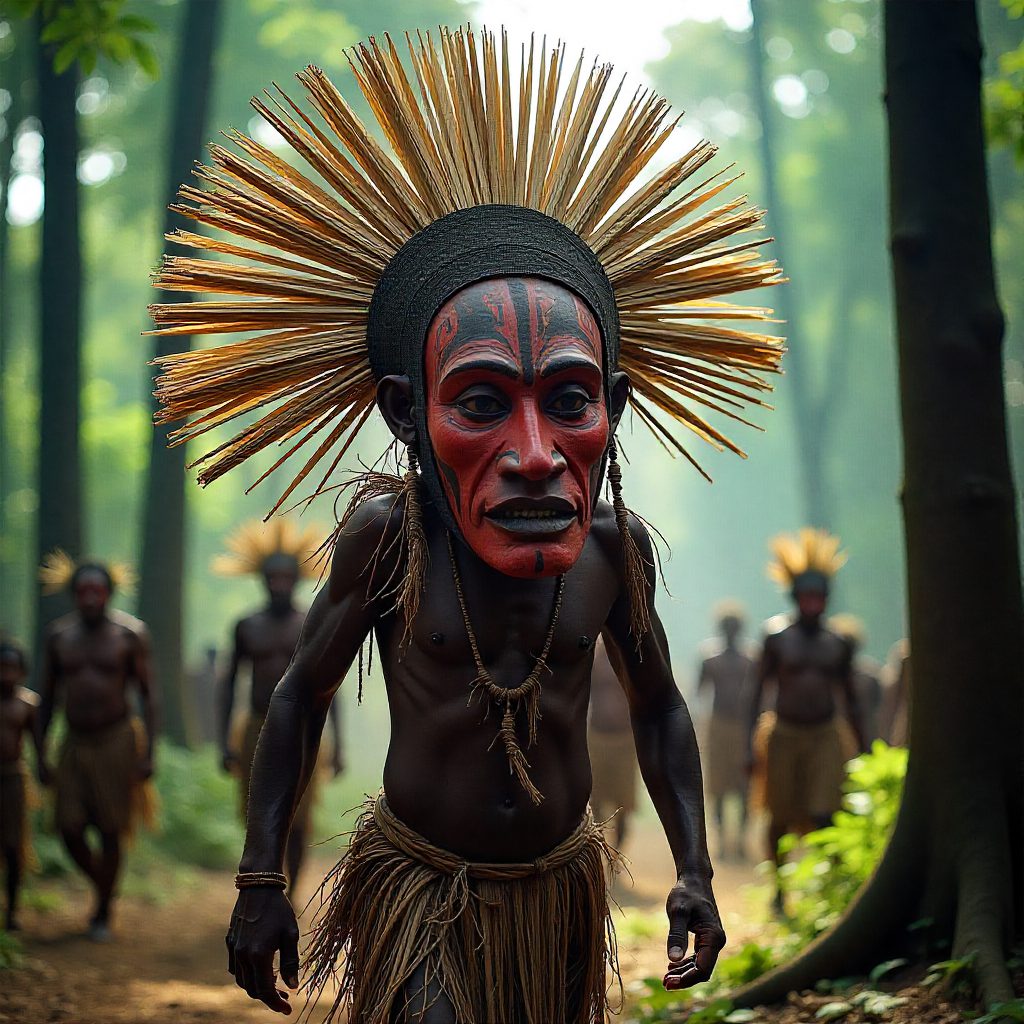
The physical form of Kakungu is defined by a towering mask that creates the illusion of a giant spirit walking among humans. This mask, carved from wood and often painted in rich earthy tones, is distinguished by its large, exaggerated features. The drooping cheeks and pronounced facial structure soften its fierce appearance, creating a balance between benevolence and authority. The most striking detail is the red pigmentation often applied to the cheeks, symbolising vitality, fertility, and spiritual energy.
A voluminous raffia headdress or costume surrounds the mask, extending the wearer’s height until Kakungu appears larger than any human present. The movement of raffia—rustling, swaying, and expanding with each step—amplifies the impression of supernatural force. Folklore describes Kakungu as capable of astonishing jumps and sudden bursts of motion, a physical expression of the ancestral power believed to animate the figure. This combination of scale, colour, and dynamic presence makes Kakungu one of the most visually powerful ritual embodiments in Central African tradition.
Family
Within the hierarchy of mukanda spirits, Kakungu is regarded as the eldest and most authoritative figure. Rather than belonging to a biological family, Kakungu exists within a lineage of ritual beings that preside over initiation camps. These beings are represented by masks of differing personalities—some humorous, some didactic, some fearsome—but Kakungu occupies the highest spiritual rank.
He is seen as the patriarch of the initiation sphere, the one who ensures the survival of initiates during circumcision rites and guides them through the symbolic journey of death and rebirth. Other masked spirits may entertain or teach, but Kakungu alone safeguards the boundary between danger and protection. His “family” is therefore both spiritual and ceremonial: a constellation of ancestral guardians who form the foundation of Suku male initiation.
Other names
Kakungu is primarily known by this name among the Suku, though some scholars and neighbouring communities refer to him using alternate spellings such as Kakuungu. In ethnographic studies, he is sometimes described using titles like “the Red Giant” or “Mukanda Guardian,” referring to his appearance and ritual role. These additional names do not change his identity but highlight different facets of his mythic and ceremonial presence. Regardless of linguistic variation, the core concept remains the same: Kakungu is the dominant protective spirit of Suku initiation rites.
Powers and Abilities
The powers associated with Kakungu are both protective and disciplinary, reflecting his role as an ancestor-spirit with authority over young initiates and the wider community. His most important ability is safeguarding initiates during circumcision, a moment that carries both physical risk and spiritual significance. Through ritual invocation, Kakungu is believed to prevent excessive bleeding, ward off harmful forces, and ensure a safe transition into adulthood.
Kakungu is also regarded as a hunter of threats. In Suku belief, he is capable of pursuing witches, malevolent spirits, and anyone who endangers the initiation camp. His ability to “jump” rapidly is linked to this mythic task, representing his capacity to react quickly to invisible dangers. The red cheeks associated with Kakungu symbolise fertility and life-force, granting him the power to bless initiates with future prosperity and reproductive health.
In his disciplinary role, Kakungu maintains order through fear and respect. His presence alone commands silence and reverence, ensuring that the sacred process of initiation occurs without disruption. Through ritual performance, he embodies ancestral authority, bridging the worlds of the living and the dead.
Modern Day Influence
Although many mukanda practices have adapted to contemporary life, Kakungu remains a potent cultural symbol for the Suku and for scholars of African ritual traditions. Kakungu masks are displayed in major museums, where they are studied not only for their craftsmanship but also for their cultural meaning. Increasingly, curators emphasise that Kakungu is not merely an object of art but a representation of a living spiritual character.
Modern artists, performers, and cultural practitioners draw inspiration from Kakungu’s imposing form and mythic resonance. Themes of initiation, masculinity, ancestral memory, and transformation have found renewed expression in contemporary works influenced by Kakungu. In diaspora traditions that trace their origins to Central Africa, echoes of Kakungu’s protective and disciplinary attributes can be found in rituals that invoke ancestral guardianship.
For the Suku community, Kakungu continues to symbolise identity and lineage. Even when not physically enacted, he survives in oral tradition, visual culture, and collective memory as a reminder of ancestral authority and the deep spiritual framework that governs the passage into adulthood.
Related Images

Source
Decalo, S. (1997). Historical Dictionary of the Democratic Republic of the Congo. Scarecrow Press.
Drewal, H. J. (1992). Minkisi: Power Figures of Central Africa. Fowler Museum at UCLA.
MacGaffey, W. (1987). Religion and Society in Central Africa: The Bakongo of Lower Zaire. University of Chicago Press.
“Suku people.” (2018). In Wikipedia. Retrieved from https://en.wikipedia.org/wiki/Suku_people
Vansina, J. (1990). Paths in the Rainforests: Toward a History of Political Tradition in Equatorial Africa. University of Wisconsin Press.
Kreamer, C. M. (Ed.). (1993). Kongo: Power figures, ritual, and music. Philadelphia Museum of Art.
Sterner, R. (2019). Spirit and Power: The Nkondo Figure and Ritual Among the Kongo. Journal of African Art.
“Kakungu: The Suku Protective Mask.” (2025). African Ritual Arts Journal, 12(2), 45-59.
Frequently Asked Questions
Who is Kakungu in Suku mythology?
Kakungu is a powerful ancestral spirit represented through a giant mask in Suku initiation rites, serving as protector and guardian of young initiates.
Why does Kakungu have red cheeks?
The red pigmentation symbolises life-force and fertility, reinforcing Kakungu’s role in guiding initiates into adulthood.
What is the purpose of the Kakungu mask?
The mask channels Kakungu’s spiritual presence during rituals, allowing him to protect, discipline, and bless the initiation camp.
Is Kakungu part of a larger group of spirits?
Yes. Kakungu is the eldest and most authoritative among the mukanda spirits involved in Suku male initiation.
Does Kakungu still influence modern culture?
Kakungu remains an important cultural icon in museums, scholarship, and artistic interpretations of Central African ritual heritage.
