
Io Matua Kore : The Supreme Origin in Māori Tradition
Listen
At a glance
| Description | |
|---|---|
| Origin | Maori Mythology |
| Classification | Gods |
| Family Members | N/A |
| Region | New Zealand |
| Associated With | Creation |
The Mythlok Perspective
From the Mythlok perspective, Io Matua Kore represents an elemental philosophy rather than a ruler deity. Where many supreme gods dominate creation, Io withdraws, allowing reality to emerge through balance instead of force. Comparable to concepts like Brahman or the Tao, Io embodies origin without intervention. This positions Māori cosmology as deeply process-oriented, valuing restraint, silence, and potential over command and spectacle.
Io Matua Kore
Introduction
Io Matua Kore, most often translated as “Io the Parentless,” occupies the highest and most abstract position within certain Māori cosmological traditions. Unlike the more familiar atua who shape forests, seas, and winds, Io exists before form, before genealogy, and before light itself. His presence is located within Te Kore, the state of absolute potential, from which all later realms of existence unfold. Through this cosmological movement, Te Kore gives rise to Te Pō, the long night of becoming, and eventually to Te Ao Mārama, the world of light and manifestation.
Accounts of Io Matua Kore were first recorded in the late nineteenth and early twentieth centuries through teachings preserved by tohunga and transmitted within restricted whare wānanga. These teachings were deliberately kept tapu and were never intended for public ritual, iconography, or widespread worship. This secrecy later fueled academic debate, with some scholars questioning whether the systematized form of Io theology reflects pre-contact belief or post-contact synthesis. Despite this, multiple iwi, including Ngāti Kahungunu, maintain that Io traditions predate European arrival and represent a deeply internal, philosophical layer of Māori cosmology rather than a public religion.
Understanding Io Matua Kore is essential for grasping how Māori thought approaches creation not as an event, but as a process of unfolding awareness, where existence emerges gradually from silence, restraint, and ordered potential.
Physical Traits
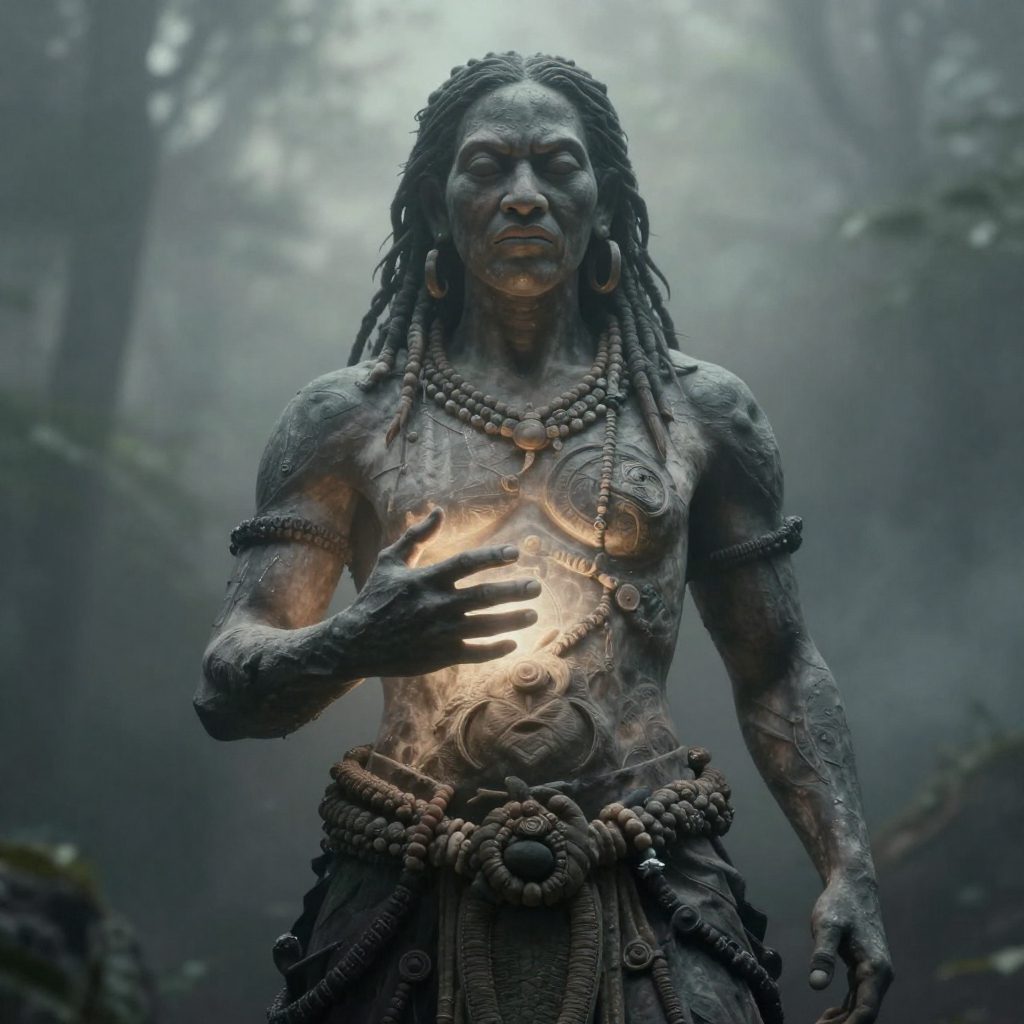
Io Matua Kore is deliberately without physical description. Unlike other atua who appear in anthropomorphic or elemental forms, Io is defined by absence rather than presence. He is often referred to as Io-mata-ngaro, meaning “Io of the hidden face,” emphasizing that no human eye can perceive him directly. In some traditions, he is also described as Io-mataaho, visible only as diffused radiance rather than embodied form.
This formlessness is not a limitation but a theological statement. Io is not located within nature; nature is located downstream from him. He resides in the highest, most sacred realm of existence, sometimes named Te Rauroha or Rangiatea, a conceptual rather than spatial domain. Any attempt to assign physical characteristics would contradict his role as the unconditioned source from which all conditioned reality flows.
Family
Io Matua Kore is parentless by definition, existing beyond whakapapa rather than within it. However, he is not separate from genealogy; he is its origin point. From Io flows the structure that allows genealogy to exist at all. In this sense, Io is not a father figure but the condition that makes descent possible.
Some regional traditions describe complementary forces emerging alongside Io within Te Kore, initiating differentiation and movement. From this emergence arise the primal states that eventually lead to Ranginui and Papatūānuku, whose separation allows the world of light to form. Other traditions trace extended divine lineages through intermediary manifestations such as Io-rangi, reflecting local theological variations rather than contradiction. Rather than a single fixed genealogy, Io Matua Kore stands above lineage systems, anchoring them while remaining untouched by them.
Other names
Io Matua Kore is known through multiple epithets, each reflecting a specific dimension of his nature rather than a separate identity. Io-nui emphasizes supreme magnitude, while Io-taketake affirms him as the unchanging foundation of all things. Io-te-wānanga identifies him as the source of sacred knowledge, the wellspring from which esoteric wisdom flows into the world.
Other names such as Io-te-waiora present Io as the source of vitality and balance, while Io-matua reinforces his role as origin without ancestry. These names were traditionally invoked only in high-level ritual recitation, not spoken casually, reinforcing the conceptual distance between Io and ordinary religious devotion.
Powers and Abilities
The power of Io Matua Kore is not expressed through action but through condition. He does not intervene, command, or punish. Instead, he establishes the metaphysical environment within which all creation operates. From Io emerges the possibility of order, differentiation, and continuity.
Io is associated with the containment and release of knowledge, particularly through the kete of wisdom that later atua access. His authority legitimizes tapu, mana, and the moral structure underlying Māori cosmology. In some traditions, Io is described as regulating balance, ensuring that creation unfolds according to harmony rather than excess.
All other divine powers derive indirectly from Io, making him the silent source behind every act of creation, conflict, and renewal within the cosmos.
Modern Day Influence
Io Matua Kore continues to shape Māori philosophical thought, especially within educational, spiritual, and artistic contexts. Rather than functioning as an object of worship, Io serves as a conceptual anchor, reinforcing ideas of restraint, interconnectedness, and sacred origin.
In contemporary Māori art and literature, Io is often referenced symbolically to explore themes of identity, silence, and cosmological depth. Within academic discourse, Io remains central to discussions about indigenous metaphysics and the legitimacy of oral knowledge systems. Environmental ethics grounded in kaitiakitanga also echo Io’s principle that all existence originates from a singular, sacred source and must therefore be treated with reverence.
Related Images

Source
Best, E. (1924). The Maori (Vol. 1). Harry H. Tombs.
Jury, H. T. W. (1913). The lore of the whare-wananga: The wisdom of the Maori (S. P. Smith, Trans.). Polynesian Society. (Original work published 1854)
Reed, A. W. (1963). Treasury of Maori folklore. A. H. & A. W. Reed.
Simmons, D. R. (1977). Iconography of New Zealand Maori carving and painting. Auckland University Press.
Tregear, E. (1891). Maori-Polynesian comparative dictionary. Government Printer.
White, J. (1887). The ancient history of the Maori, his mythology and traditions (Vol. 1–6). G. Didsbury, Government Printer.
Wikipedia. (2025, March 16). Io Matua Kore. https://en.wikipedia.org/wiki/Io_Matua_Kore
Te Ara Encyclopedia of New Zealand. (2004, January 31). Traditional Māori religion – ngā karakia a te Māori. https://teara.govt.nz/en/traditional-maori-religion-nga-karakia-a-te-maori
Frequently Asked Questions
Who is Io Matua Kore in Māori belief?
Io Matua Kore is the parentless, supreme source of existence in certain Māori traditions, existing before creation and genealogy.
Is Io Matua Kore worshipped like other Māori gods?
No, Io was traditionally known only to high-ranking priests and was never publicly worshipped or represented in images.
How is Io Matua Kore relevant today?
Io continues to influence Māori philosophy, environmental ethics, education, and contemporary cultural expression.
What does Io Matua Kore represent?
He represents absolute origin, sacred potential, balance, and the metaphysical foundation of reality.
Is Io Matua Kore controversial among scholars?
Yes, some scholars debate whether Io theology was systematized post-contact, though many iwi affirm its pre-contact origins.