


Gowargay : Ancestral Water Spirit from Murri Tradition
Listen
At a glance
| Description | |
|---|---|
| Origin | Murri Mythology |
| Classification | Spirits |
| Family Members | N/A |
| Region | Australia |
| Associated With | Waterholes, Spiritual law, Danger |
The Mythlok Perspective
From the Mythlok perspective, Gowargay embodies the Murri understanding that nature enforces its own laws. Unlike heroic figures who guide or protect, Gowargay corrects through consequence. Similar roles appear globally, from Slavic river spirits to African water guardians, yet Gowargay remains distinctly Murri, bound to place rather than personality. Across cultures, water is rarely gentle. Gowargay reminds us that survival begins with respect, not dominance.
Gowargay
Introduction
Gowargay is a significant ancestral being within Murri mythology, particularly among the Yuwaalaraay and closely related language groups of north-western New South Wales and southern Queensland. In Murri oral tradition, Gowargay is remembered as a dangerous water spirit often described as a “water emu,” inhabiting deep waterholes, billabongs, and slow-moving rivers. These stories do not present Gowargay as a mere monster, but as a living expression of spiritual law embedded in the land itself.
Within Murri cosmology, ancestral beings like Gowargay are inseparable from place. They are not symbolic inventions but presences formed during the Dreaming, when spiritual forces shaped landscapes, established laws, and defined how humans must live in balance with their environment. Gowargay’s presence serves as a warning rather than a threat, reinforcing the understanding that water is both life-giving and lethal when approached without respect or knowledge.
Rather than offering protection or guidance, Gowargay represents consequence. Its stories were traditionally shared to ensure survival, teaching younger generations which places were dangerous, sacred, or forbidden. Through Gowargay, Murri mythology preserves environmental knowledge, social responsibility, and the understanding that the natural world actively responds to human behaviour.
Physical Traits
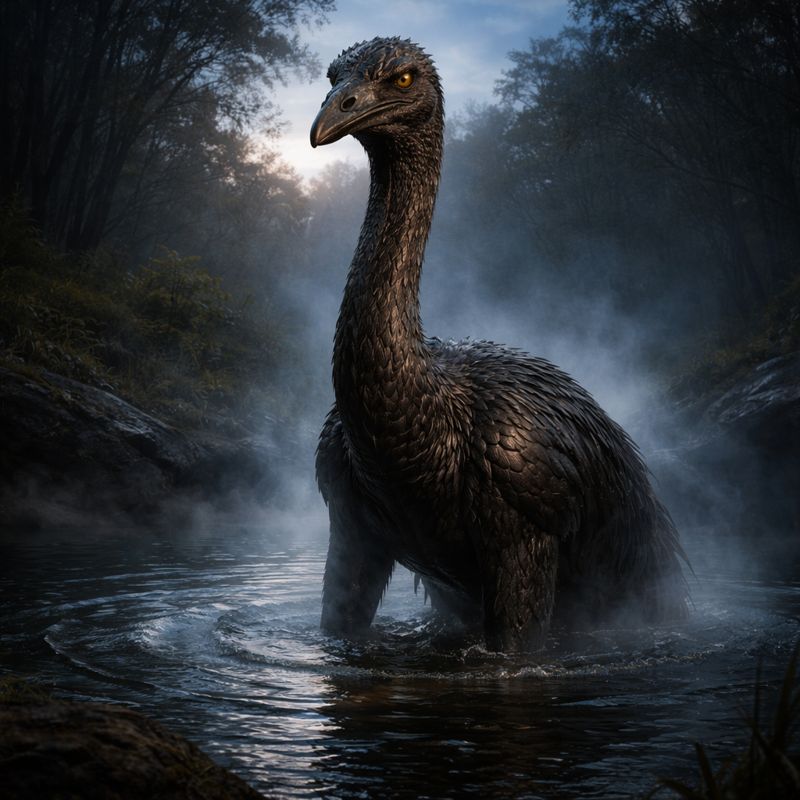
In Murri storytelling, Gowargay is most commonly described as an enormous, featherless emu-like being, far larger and more imposing than any known animal. Its bare skin is often imagined as dark, slick, or leathery, reinforcing its unnatural and ancestral nature. The absence of feathers is especially important, as it marks Gowargay as something other than an ordinary emu, separating it from the everyday world and placing it firmly within the spiritual realm.
Its long neck and powerful legs echo the familiar emu form, making it recognisable, yet deeply unsettling. Gowargay is said to move easily between land and water, lurking beneath the surface before revealing itself through violent disturbances in the water. In some tellings, its movements generate sudden whirlpools, drawing people under before they have time to react.
These physical descriptions are not intended as biological detail. In Murri mythology, appearance communicates function and authority. Gowargay’s immense size, stripped-down form, and aquatic dominance visually express its ancient origin and its role as an enforcer of Dreaming law tied specifically to water.
Family
The idea of family in Murri mythology is spiritual rather than genealogical. Gowargay is not described through human concepts of parents or offspring, but through ancestral connection. Many Yuwaalaraay accounts associate Gowargay with older water-based ancestral forces, including serpent beings linked to the Rainbow Serpent tradition.
This association places Gowargay within a wider spiritual network responsible for shaping waterways and governing how humans interact with them. Rather than acting independently, Gowargay functions as a localised expression of these primordial forces, enforcing their laws at specific sites. Its authority is inherited from the Dreaming itself rather than from a named lineage.
Gowargay is typically portrayed as solitary, reinforcing its role as a boundary being encountered only when rules are broken. Its “family” is the land, the water, and the ancestral order that continues to operate through them.
Other names
The name Gowargay appears in several recorded spellings, including Gauarge, reflecting differences in Murri dialects and early transcription by non-Indigenous recorders. These variations do not indicate separate beings, but rather the fluid nature of oral language traditions.
The English term “water emu” is a descriptive label rather than a traditional name, used to convey Gowargay’s form to outsiders unfamiliar with Murri cosmology. Within Indigenous contexts, names are often place-bound and situation-specific, meaning that additional local names may exist but remain unrecorded in written sources.
These naming variations highlight the importance of understanding Gowargay as a Murri ancestral character whose identity is rooted in spoken tradition rather than fixed textual definition.
Powers and Abilities
Gowargay’s primary power lies in its control over water, particularly its ability to create whirlpools that pull people beneath the surface. This ability is not random violence. In Murri mythology, Gowargay acts when individuals ignore warnings, disrespect sacred waters, or behave carelessly in dangerous places.
Beyond physical harm, Gowargay embodies spiritual consequence. Its actions reinforce the idea that the land and waters are alive, aware, and responsive. Gowargay does not communicate through speech but through action, delivering lessons that remain etched in communal memory.
Gowargay is also understood to be indestructible. Attempts to hunt or kill it are futile, emphasising that it exists beyond human power. This reinforces its status as an ancestral spirit rather than a creature that can be mastered or removed.
Modern Day Influence
For Murri communities today, Gowargay remains an important cultural figure, remembered through storytelling, education, and connection to Country. While fewer stories are shared publicly due to cultural sensitivity, the underlying lessons continue to inform how water sites are treated and respected.
In broader Australian folklore, Gowargay is sometimes misunderstood as a cryptid or prehistoric survivor. While these interpretations attract curiosity, they strip the figure of its cultural meaning. Within Murri mythology, Gowargay is not a mystery to be solved but a law to be understood.
In an era of climate change, flooding, and environmental degradation, Gowargay’s warning feels increasingly relevant. Its story reminds modern audiences that Indigenous knowledge systems recognised the power of nature long before scientific language existed to describe it.
Related Images
Source
Parker, K. L. (1905). The Euahlayi tribe: A study of Aboriginal life in Australia. Project Gutenberg Australia.
https://gutenberg.net.au/ebooks/e00022.html
Encyclopaedia of Cryptozoology. (n.d.). Gauarge. Fandom. https://cryptidarchives.fandom.com/wiki/Gauarge
Heuvelmans, B. (1955). On the track of unknown animals. Hill & Wang.
Parker, K. L. (1898). Australian legendary tales. David Nutt.
Wikipedia contributors. (2025). Murri people. Wikipedia. https://en.wikipedia.org/wiki/Murri_people
Wikipedia contributors. (2025). List of Australian Aboriginal mythological figures. Wikipedia.
https://en.wikipedia.org/wiki/List_of_Australian_Aboriginal_mythological_figures
Drinnon, D. A. (2010). Frontiers of zoology blog: Surviving mihirungs.
Australian Institute of Aboriginal and Torres Strait Islander Studies. (1993). Yuwaalaraay dictionary. AIATSIS.
Berndt, R. M., & Berndt, C. H. (1989). The Speaking Land: Myth and Story in Aboriginal Australia. Ringwood: Penguin Books.
Reed, A. W. (1978). Aboriginal Myths, Legends and Fables. Sydney: A.H. & A.W. Reed.
Dixon, R. M. W. (2002). Australian Aboriginal Words in English: Their Origin and Meaning. Oxford: Oxford University Press.
Clarke, P. A. (2016). Australian Aboriginal Mythology and Environmental Knowledge. Journal of Folklore Research, 53(2), 123–145.
Frequently Asked Questions
Who is Gowargay in Murri mythology?
Gowargay is an ancestral water spirit from Murri and Yuwaalaraay tradition associated with dangerous waterholes and Dreaming law.
Is Gowargay a god or a monster?
Gowargay is neither. It is an ancestral being that enforces spiritual and environmental laws.
Why is Gowargay described as a water emu?
Its form resembles a giant, featherless emu, making it familiar yet unsettling, reinforcing its spiritual authority.
Did Murri people believe Gowargay was a real animal?
Gowargay is understood as a spiritual presence tied to place, not a biological creature.
What lesson does Gowargay represent?
The story teaches respect for water, land, and the consequences of ignoring ancestral knowledge.
