

Fao : The Niuean God of Humans and Creation
Listen
At a glance
| Description | |
|---|---|
| Origin | Niuean Mythology |
| Classification | Gods |
| Family Members | Huanaki, Laga-iki, Tagaloa, Lagi-atea |
| Region | Niue |
| Associated With | Creation of land, Ancestry, Migration |
The Mythlok Perspective
From the Mythlok perspective, Fao represents a distinctly Oceanic understanding of creation where land is not granted instantly but earned through effort and cooperation. Unlike singular creator figures found elsewhere, Fao’s incomplete power emphasizes balance rather than supremacy. When compared with earth-raising figures in other cultures, his story feels less like conquest and more like emergence. The island rises because relationship and shared strength make it possible, reflecting a worldview where humanity, land, and divinity are inseparable parts of the same living system.
Fao
Introduction
Niue, often called the Rock of Polynesia, is a small but culturally deep island in the South Pacific whose oral traditions preserve one of the most distinctive mythic systems in Polynesia. At the heart of these traditions stands Fao, one of the five principal tupua or deities of Niue. Fao is remembered primarily as the god of humans and an ancestral figure who bridges the divine and mortal worlds. His presence in Niuean storytelling is not abstract or distant. Instead, he is woven directly into the land itself, its emergence from the ocean, and the origins of the people who inhabit it.
Unlike many Polynesian traditions that emphasize expansive pantheons shared across islands, Niuean belief places strong importance on localized gods whose actions are tied to specific cliffs, reefs, and villages. Fao’s stories describe migration, struggle, cooperation, and settlement, reflecting how Niueans historically understood their arrival on a harsh coral island shaped by the sea. Together with Huanaki, Fao is portrayed not only as a creator figure but also as a cultural ancestor, reinforcing the idea that Niuean identity descends directly from divine beginnings rather than distant heavens.
Physical Traits
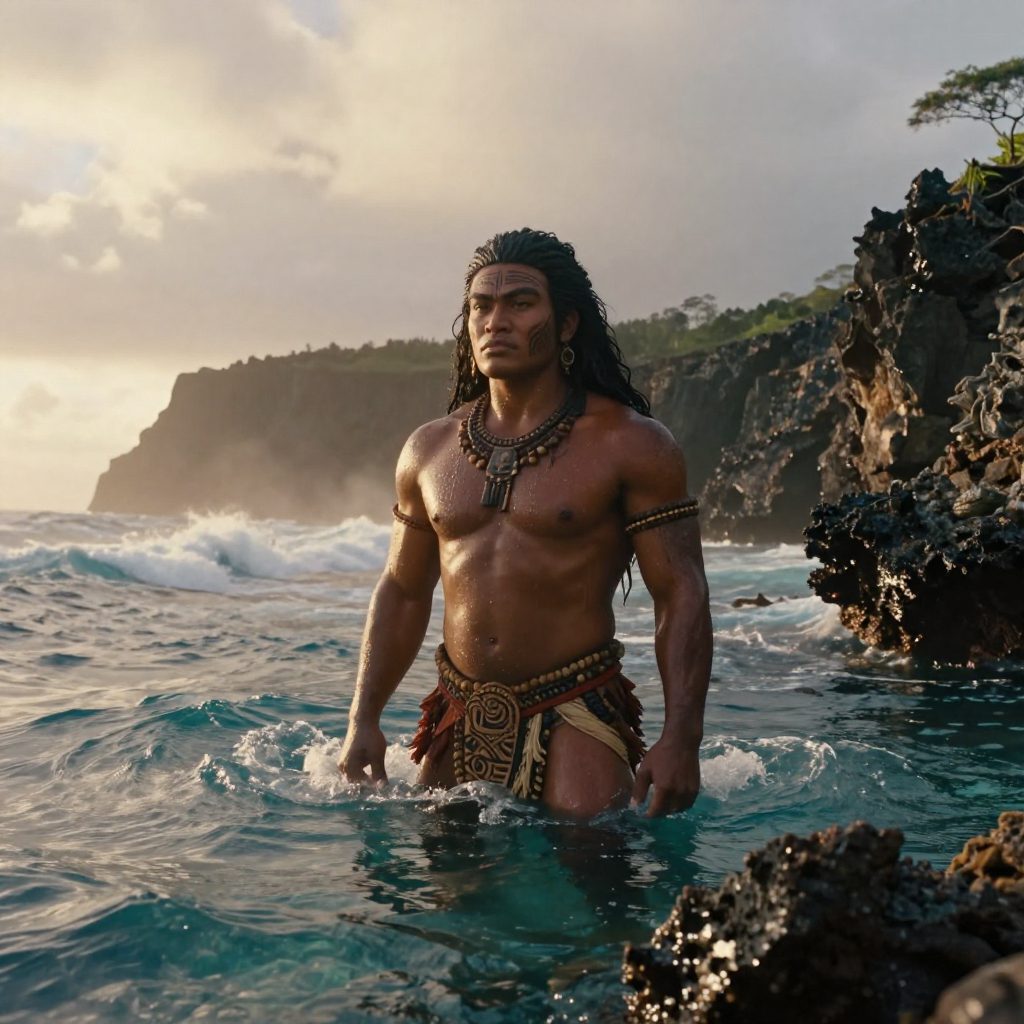
Niuean mythology does not dwell on detailed physical descriptions of its gods, and Fao is no exception. Rather than specifying appearance, oral tradition emphasizes what he does and where he acts. Fao is consistently understood as a powerful, human-like being capable of crossing vast ocean distances and emerging from beneath the sea without harm. His strength is conveyed symbolically through movement and impact rather than bodily detail.
One of the most enduring images associated with Fao is his emergence from a pool on the reef, followed by his ascent to Toga-liulu, where he establishes his dwelling. His physical presence is implied in myths describing his attempt to raise Niue from the ocean floor. These narratives suggest immense force and endurance, yet they also stress limitation. Fao’s efforts alone are not enough, and the land only fully rises when Huanaki joins him. This balance between power and incompleteness reflects a broader Polynesian worldview in which strength gains meaning through cooperation.
Family
Fao belongs to the inner circle of Niue’s divine order, counted among the five principal tupua who govern the island’s mythic history. This group includes Huanaki, Laga-iki, Tagaloa, and Lagi-atea. Together, they form a divine family that oversees creation, death, migration, and the structure of human society. Fao’s closest association is with Huanaki, who appears repeatedly as his companion and co-creator.
In several traditions, Fao and Huanaki are treated not merely as gods but as ancestral figures whose descendants populate Niue. Through this lineage, villages and chiefly lines trace their origins back to divine beginnings, blurring the boundary between mythology and genealogy. Other accounts describe the tupua leaving their homeland of Fonuagalo after being neglected or undervalued, a narrative that frames migration as both a spiritual and social act. Fao’s place within this divine family reinforces the Niuean belief that land, leadership, and kinship are inseparable.
Other names
Fao’s name remains remarkably consistent across Niuean oral traditions. Unlike widely shared Polynesian deities whose names vary across regions, Fao is a distinctly local figure whose identity is tied almost exclusively to Niue. Minor variations in pronunciation appear in oral retellings, but there are no widely attested alternative names or epithets.
The most common descriptive term attached to him is tupua, a word that conveys both divinity and spiritual presence. This lack of multiple names reflects Fao’s role as a foundational ancestor rather than a god defined by numerous specialized aspects. His identity is stable, grounded, and closely bound to place.
Powers and Abilities
Fao’s powers center on creation, ancestry, and the shaping of land. One of his defining acts is the attempt to raise Niue from beneath the sea, a myth that mirrors the island’s geological history as an uplifted coral formation. Although he initiates this process, the land only fully emerges when Huanaki adds his strength, reinforcing the theme of shared divine responsibility.
As the god of humans, Fao is also associated with the origin of people and social order. Myths describe him traveling great distances from regions such as Tonga or Samoa, swimming across the ocean to reach Niue. These journeys reflect the historical migration patterns of Polynesian peoples and encode them within sacred narrative. Fao’s authority extends to ritual recognition and the proper conduct of feasts, underscoring the importance of acknowledgment and respect within Niuean society. His powers are less about domination and more about enabling life to take root on a difficult land.
Modern Day Influence
Fao continues to shape Niuean cultural consciousness in subtle but enduring ways. His stories are preserved through oral teaching, school curricula, and cultural festivals that emphasize Niue’s unique heritage within the Pacific. For visitors, local guides and cultural centers often recount the tale of Fao and Huanaki to explain the island’s nickname and rugged landscape.
Among Niuean diaspora communities, these myths serve as anchors of identity, connecting people back to ancestral land even when living abroad. Scholars studying Polynesian traditions frequently highlight Fao as an example of how localized mythologies can preserve historical memory, environmental awareness, and social values. His association with land formation resonates strongly in modern conversations around conservation, reinforcing the idea that Niue’s environment is not merely natural space but sacred inheritance.
Related Images
Source
Cowan, J. (1923). The story of Niuē: Genesis of a South Sea island. Journal of the Polynesian Society. https://www.jstor.org/stable/20701941
Feilo, Z. (2023). Tales of Niue Nukututaha. Little Island Press. https://littleisland.nz/books/shop/tales-niue-nukututaha
Nunn, P. D. (2004). Myths and the formation of Niue Island, Central South Pacific. Journal of Pacific History, 39(1), 69-86. https://www.jstor.org/stable/25169674
Taoga Niue. (2022). History. https://taoganiue.nu/history/
Te Papa Tongarewa. (2012). Niue: The Rock of Polynesia. https://blog.tepapa.govt.nz/2012/10/09/niue-the-rock-of-polynesia/
Wikipedia contributors. (2025). Fao (god). Wikipedia. https://en.wikipedia.org/wiki/Fao_(god)[2]
Wikipedia contributors. (2025). Niuean mythology. Wikipedia. https://en.wikipedia.org/wiki/Niuean_mythology
Niue Government. (2006). Niue National Strategic Plan: Tāoga Niue. https://faolex.fao.org/docs/pdf/niu184018.pdf
Smith, S. Percy. (1902). Niue Island and Its People. Wellington: Whitcombe & Tombs.
Craig, R. D. (1989). Dictionary of Polynesian Mythology. Honolulu: Greenwood Press.
Gunson, N. (1990). Understanding Polynesian Religion. Canberra: ANU Press.
Rutherford, N. (1971). The Friendly Islands: A History of Tonga. Melbourne: Oxford University Press.
Frequently Asked Questions
Who is Fao in Niuean tradition?
Fao is one of the five principal tupua of Niue and is revered as the god of humans and a foundational ancestral figure.
What role did Fao play in the creation of Niue?
Fao attempted to raise Niue from the sea, initiating the island’s formation before completing the task with Huanaki’s help.
Is Fao unique to Niue?
Yes. Unlike many Polynesian gods, Fao is a localized deity whose myths are specific to Niue.
How is Fao connected to Niuean ancestry?
Many traditions treat Fao as a direct ancestor, linking human genealogy to divine origins.
Does Fao still influence Niuean culture today?
His stories continue to shape cultural identity, education, tourism, and environmental values.

