
Kyai Nagasasra : The Legendary Javanese Sacred Keris
At a glance
| Description | |
|---|---|
| Mythology | Indonesian Mythology |
| Type | Carried |
| Power | 06/10 |
Mythlok Perspective
From the Mythlok perspective, Kyai Nagasasra represents a distinctly Southeast Asian understanding of power as something contained rather than embodied. Unlike divine weapons that act independently, this keris expresses authority through alignment between object, wielder, and cosmic order. Comparable ideas appear in Japanese sacred swords like Kusanagi and in African regalia where power resides in consecrated artifacts, not deities themselves. Across cultures, legitimacy often flows through objects that channel balance rather than command it outright.
Kyai Nagasasra
Introduction
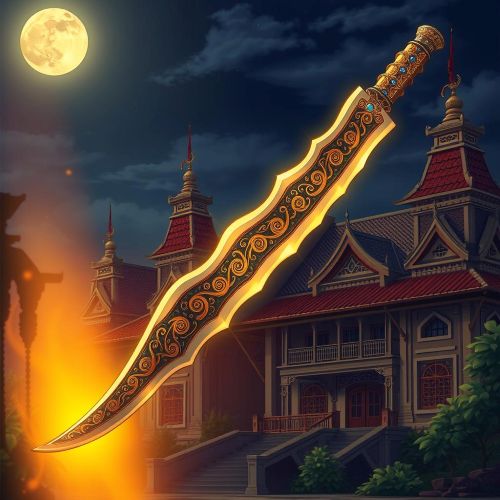
Among the many sacred weapons preserved in Javanese cultural memory, Kyai Nagasasra occupies a rare and almost mythical position. More than a keris, it is regarded as a living pusaka, a blade believed to carry intention, spirit, and destiny within its steel. Revered in Indonesian tradition, Kyai Nagasasra is consistently associated with royal authority, cosmic balance, and the final centuries of the Majapahit world. Its identity is inseparable from its dramatic form, marked by thirteen undulating luk, and from its symbolic pairing with Sabuk Inten, a motif representing wealth, legitimacy, and divine favor. Over time, folklore, court chronicles, and later literary adaptations have elevated Kyai Nagasasra beyond the status of a royal heirloom, transforming it into an enduring emblem of power shaped by both history and belief.
Origins
The origins of Kyai Nagasasra are firmly rooted in the twilight years of the Majapahit Empire, a period remembered for political fragmentation, spiritual anxiety, and cultural transition. Javanese tradition attributes the commissioning of the keris to Brawijaya V, the final ruler of Majapahit, during a time when rebellion, famine, and external pressure threatened the kingdom’s stability. In response to these crises, the king is said to have ordered the creation of a blade that could embody resilience, authority, and metaphysical protection.
The forging of Kyai Nagasasra is traditionally credited to a master empu whose role extended far beyond metallurgy. In Javanese understanding, an empu was a philosopher, mystic, and ritual specialist. Oral traditions describe extended periods of fasting, meditation, and mantra recitation during the forging process, emphasizing that the keris was shaped as much by spiritual discipline as by fire and hammer. Some accounts speak of meteorite iron being used, a detail common in keris lore, symbolizing a direct connection between the heavens and the earthly realm.
The name “Nagasasra” itself reflects the blade’s defining symbolism. The naga, a sacred serpent or dragon, represents cosmic energy, fertility, and guardianship in Javanese cosmology. The blade’s thirteen luk, often interpreted as a number associated with leadership and protection, reinforce its royal character. While variations exist across manuscripts and artistic depictions, this multiplicity reflects the Javanese worldview, where sacred objects evolve through retelling rather than remaining fixed in a single canonical form.
Powers
Kyai Nagasasra is believed to possess powers that extend well beyond physical combat. In Javanese belief, a keris of this stature contains kesaktian, a form of spiritual potency that influences events, emotions, and authority. Owners were said to enjoy heightened protection, not only against weapons but also against unseen dangers such as illness, malevolent spirits, and misfortune. This protective quality made the keris as valuable in ritual contexts as it was in moments of conflict.
Another widely attributed power of Kyai Nagasasra is its ability to reinforce charisma and legitimacy. A ruler who possessed the keris was believed to command loyalty more naturally, as though the blade itself affirmed their right to lead. Folklore often describes the keris as radiating an aura capable of unsettling enemies and strengthening allies, a psychological force rooted in spiritual belief rather than brute strength.
Prosperity and fertility are also recurring themes in narratives surrounding Kyai Nagasasra. As a naga-bladed keris, it symbolized abundance and continuity, ensuring the well-being of the land and its people. Some traditions claim the keris could warn its owner of impending danger, responding through subtle movements, vibrations, or dreams. These accounts reflect the deeply animistic dimension of Javanese spirituality, where sacred objects are regarded as conscious participants in human affairs.
Owners/Users
The most prominent historical owner of Kyai Nagasasra is King Brawijaya V, whose association with the blade cemented its status as a royal pusaka. During his reign, possession of such a keris was not merely ceremonial. It functioned as a visible marker of sovereignty during a period when political authority was increasingly contested. After the decline of Majapahit, Kyai Nagasasra entered the realm of inherited tradition, preserved within noble households and spiritual lineages rather than active courts.
In later cultural memory, the keris appears not only in chronicles but also in literature. The twentieth-century novelist S.H. Mintardja reintroduced Kyai Nagasasra to popular audiences through his epic narrative “Nagasasra dan Sabuk Inten.” In this retelling, the blade is wielded by the fictional hero Mahesa Jenar, whose moral integrity and devotion to justice mirror the ideal qualities expected of a rightful bearer. This literary adaptation reshaped Kyai Nagasasra from a symbol of dynastic authority into an ethical instrument, reinforcing its relevance in modern storytelling.
Today, Kyai Nagasasra exists primarily as a conceptual and cultural heirloom rather than a publicly displayed artifact. Its legacy is preserved through ritual knowledge, academic study, and the continued reverence for keris culture as a whole, recognized internationally as an intangible cultural heritage.
Instances used
Legends situate Kyai Nagasasra at key moments in the decline of Majapahit, particularly during conflicts marked by internal rebellion and shifting alliances. In these stories, the keris is less a tool of physical violence and more a spiritual counterweight to chaos. Its mere presence is often said to alter the course of events, restoring balance or exposing betrayal.
Folklore recounts episodes in which Kyai Nagasasra was unsheathed during critical confrontations, its aura alone sufficient to disarm opponents or strengthen the resolve of allies. Such tales emphasize symbolic victory over literal combat, aligning with the Javanese preference for harmony over destruction. In literary depictions, especially in Mintardja’s work, the keris becomes central to quests for justice, where its power responds to the moral state of its wielder rather than raw ambition.
Beyond narrative contexts, Kyai Nagasasra continues to be invoked symbolically in ceremonial traditions. While the original blade is not used in public rituals, its name and form are referenced in discussions of leadership, spiritual protection, and cultural continuity, demonstrating how sacred weapons persist through meaning even when removed from direct use.



Source
Hadinataroslan. (2010, November 13). About Javanese/Indonesian keris. Islamic Energy Medicine. https://hadinataroslan.wordpress.com/2010/11/13/about-javaneseindonesian-keris/
Pomare, E. (2022). The study of zoomorphic expression and its relationship with… Journal of PSP, 1(3).
https://spe-jpsp.com/wp-content/uploads/2022-1-3.pdf
Primo. (2014, January 19). Legendary sacred keris. http://primadonablog.blogspot.com/2014/01/legendary-sacred-keris.html
Supriyanto, H. (2024, January 2). Javanese kris, the remarkable weapon with magical powers. LinkedIn.
https://www.linkedin.com/pulse/javanese-kris-remarkable-weapon-magical-powers-herry-supriyanto-mjn9c
Wulandari, A., & others. (2024). Menelusuri perbedaan ilustrasi keris Nagasasra dalam naskah keris II dengan pakem dhapur keris. Jurnal Arnawa, UGM. https://jurnal.ugm.ac.id/v3/arnawa/article/view/17088
Frequently Asked Questions
What is Kyai Nagasasra in Javanese tradition?
Kyai Nagasasra is a legendary keris regarded as a sacred royal heirloom associated with spiritual power, authority, and the Majapahit kings.
Who owned Kyai Nagasasra historically?
Javanese tradition links Kyai Nagasasra to King Brawijaya V of Majapahit, after which it became a revered pusaka passed through noble and spiritual lineages.
What does the naga symbolism on Kyai Nagasasra represent?
The naga symbolizes cosmic power, protection, fertility, and balance, making it an ideal emblem for kingship and spiritual guardianship.
Does Kyai Nagasasra still exist today?
While its physical whereabouts are uncertain, Kyai Nagasasra survives as a powerful cultural and symbolic presence within keris tradition and Javanese literature.
Why is Kyai Nagasasra important in Indonesian culture?
It represents the fusion of spirituality, craftsmanship, and political legitimacy, reflecting how sacred objects shape leadership and cultural identity in Java.