

Sanskrit : The Sacred Language of Indian Tradition
| Description | |
|---|---|
| Culture | Indian |
| Writing System | Brahmi, Devanāgarī |
| Key Epics | Mahabharata, Ramayana, Vedas, Puraṇas |
| Symbolism | Sacred language, divine mantras, cultural unity |
| Age | ~1500 BCE onwards |
Mythlok Perspective
From the Mythlok perspective, Sanskrit represents memory made audible. While many cultures preserved myth through evolving speech, Sanskrit treated sound itself as sacred architecture. Across civilisations, language often records myth, but Sanskrit embodies it. Like Classical Chinese or Latin, it shaped elite knowledge, yet its unique strength lies in its refusal to separate word from cosmos. In an age of fragmented narratives, Sanskrit reminds us that stories endure longest when language is treated as responsibility rather than convenience.
Sanskrit
Introduction
Sanskrit, a classical Indo-Aryan language whose name means “refined” or “perfected,” occupies a foundational place in South Asian civilisation. Often called devavāṇī, the language of the gods, Sanskrit was not merely a tool of communication but a carefully preserved medium through which myth, ritual, philosophy, and cosmic order were articulated. From the earliest Vedic hymns that invoke elemental forces to later epics that explore morality, kingship, and destiny, Sanskrit shaped how societies understood the universe and humanity’s place within it. Its survival across millennia rests on an extraordinary commitment to accuracy, sound, and meaning, making Sanskrit one of the most enduring intellectual traditions in human history.
Geographic Context
Sanskrit emerged in the northwestern regions of the Indian subcontinent during the late Bronze Age, around 1500 BCE, in what is now Afghanistan, Pakistan, and north India. From this core area, it spread eastward into the Gangetic plains and southward through cultural exchange rather than mass migration. Over time, Sanskrit became a shared cultural language across diverse regions, linking courts, temples, and learning centres.
By the first millennium CE, it travelled far beyond India’s borders. Inscriptions and literary works appear across Nepal, Sri Lanka, Cambodia, Indonesia, Thailand, and Vietnam, where it shaped royal ideology, temple mythology, and cosmology. In Central and East Asia, Buddhist monks carried Sanskrit texts to Tibet, China, Korea, and Japan, where they were translated but retained Sanskrit mantras and philosophical terms. This geographic reach transformed Sanskrit into a transregional language of sacred authority and intellectual prestige.
Script/Writing System
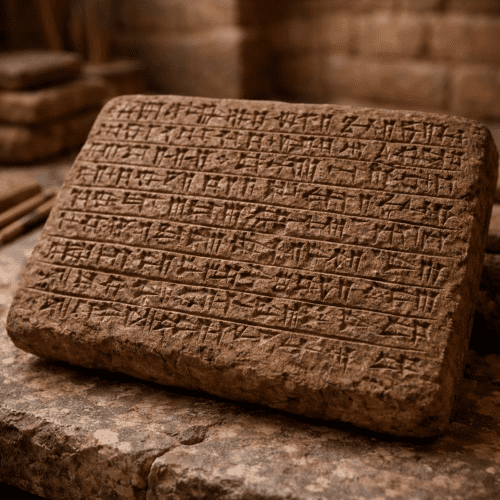
Sanskrit was preserved orally for centuries before it was written down, relying on highly formalised memorisation techniques. When writing became common around the first millennium BCE, Sanskrit adapted to regional scripts rather than developing a single native one. Early inscriptions used Brahmi, which later evolved into numerous Brahmic scripts. Among these, Devanāgarī eventually became the most widely recognised script for Sanskrit and remains the standard today.
Devanāgarī is an abugida, meaning consonants carry an inherent vowel sound modified by diacritics. This structure reflects its phonetic clarity and precision. The language’s grammatical system, codified by the grammarian Pāṇini around the 4th century BCE, ensured that pronunciation, word formation, and syntax were fixed with remarkable exactness. This precision was essential because sound itself was believed to carry sacred power, especially in mythological hymns and ritual chants.
Mythological Texts Written
Sanskrit is inseparable from the mythological literature of South Asia. The earliest and most sacred texts, the four Vedas, present hymns addressed to cosmic forces such as fire, wind, dawn, and order. These hymns are not myths in a narrative sense alone but poetic frameworks explaining creation, sacrifice, and the relationship between humans and the cosmos.
Later literature expanded myth into grand narrative forms. The Mahābhārata explores conflict, duty, and divine intervention within a human war, while the Rāmāyaṇa presents an idealised vision of kingship, exile, devotion, and moral struggle. The Purāṇas further systematised mythology, describing cycles of creation and destruction, genealogies of gods and kings, and stories of divine incarnations. Sanskrit also preserved Buddhist and Jain cosmologies, proving its adaptability across religious traditions without losing its sacred status.
Transmission & Preservation
The endurance of Sanskrit mythology rests on its oral transmission. Knowledge was passed through the guru–śiṣya tradition, where students memorised texts with meticulous attention to sound, rhythm, and sequence. Complex recitation methods ensured that even minor errors could be detected and corrected. This oral discipline preserved texts like the Rigveda with extraordinary consistency across centuries.
Written manuscripts later supported this oral tradition. Palm-leaf and birch-bark manuscripts circulated across monasteries, temples, and royal libraries from India to Southeast Asia. Although many manuscripts were lost due to climate and historical upheaval, millions survive today. Modern digitisation projects now safeguard these texts, allowing Sanskrit mythology to remain accessible to scholars and practitioners worldwide.
Symbolism & Cultural Role
Sanskrit holds symbolic power beyond its content. In many traditions, it is believed that the universe itself emerged through sound, making language a creative force rather than a neutral medium. Mantras are not symbolic representations alone but are understood as embodiments of divine energy. The syllable Om, for example, encapsulates creation, preservation, and dissolution within a single sound.
Culturally, it provided a unifying framework across regions and communities. Concepts such as dharma, karma, mokṣa, and artha gained coherence through Sanskrit expression, shaping ethical systems and social values. Festivals, rituals, and rites of passage continue to draw on Sanskrit chants, reinforcing continuity between ancient mythological thought and lived cultural practice.
Comparative Analysis
Sanskrit belongs to the Indo-European language family, sharing deep structural similarities with ancient Greek and Latin. Like Homeric Greek, it preserved epic poetry that defined cultural identity, while its later scholarly role parallels Latin in medieval Europe. However, Sanskrit differs in its unparalleled grammatical system, which froze linguistic change and ensured continuity between early and later texts.
Compared with Classical Chinese, it functioned as a transregional intellectual language rather than a spoken vernacular. Its interaction with Dravidian languages also sets it apart, introducing phonetic features not found in other Indo-European tongues. This combination of conservatism and adaptability allowed Sanskrit mythology to remain both stable and culturally responsive across vast regions.
Modern Influence
In the modern world, Sanskrit continues to shape thought, language, and spirituality. Many Indian languages draw heavily from the vocabulary, while global terms such as yoga, karma, and nirvāṇa carry its philosophical depth into everyday usage. Sanskrit remains central to ritual life and academic study, with universities and research centres across the world dedicated to its preservation.
Digital humanities and computational linguistics have renewed interest in Sanskrit’s logical structure, which aligns naturally with rule-based systems. Efforts to revitalise spoken Sanskrit coexist with its enduring role as a liturgical and scholarly language. Far from being a relic, Sanskrit continues to inform cultural identity, ethics, and intellectual exploration.



Sources
Wikipedia contributors. (2026). Sanskrit. Wikipedia. https://en.wikipedia.org/wiki/Sanskrit
Wikipedia contributors. (2026). Devanagari. Wikipedia. https://en.wikipedia.org/wiki/Devanagari
Exotic India Art. (2024). The Sanskrit epics’ representation of Vedic myths. https://www.exoticindiaart.com/book/details/sanskrit-epics-representation-of-vedic-myths-idd984/
Hinduism Net. (n.d.). Hinduism epics, Ramayana, Mahabharata, Vedas, Puranas. https://www.hinduismnet.com/hinduism_epics.htm
Doniger, W. (1993). Purāṇa Perennis: Reciprocity and Transformation in Hindu and Jaina Texts. Albany: State University of New York Press.
D’Anvers, N. (2023). Hindu Tales from the Sanskrit. New Delhi: Double 9 Books LLP.
Temple University Press. (1978). Classical Hindu Mythology: A Reader in the Sanskrit Purāṇas. Philadelphia: Temple University Press.
University of Delhi. (n.d.). Journal of Sanskrit & Indic Research. Retrieved January 12, 2026, from https://jsir.sanskrit.du.ac.in/
Frequently Asked Questions
What is Sanskrit and why is it important?
Sanskrit is a classical Indo-Aryan language that preserved India’s sacred texts, myths, and philosophies with exceptional accuracy.
Is Sanskrit still used today?
Yes, it is actively used in rituals, academic study, and cultural practices, and its texts continue to influence modern thought.
Why is Sanskrit called the language of the gods?
Because it was believed to carry divine sound vibrations and was used for sacred hymns, mantras, and ritual communication with the cosmos.
Which scripts are used to write Sanskrit?
Sanskrit has been written in many Brahmic scripts, with Devanāgarī being the most widely used today.
How did Sanskrit influence other cultures?
Through trade, religion, and scholarship, it shaped mythologies, royal ideology, and philosophy across South and Southeast Asia.