

Matsieng : The Primordial Ancestor of Tswana Tradition
Listen
At a glance
| Description | |
|---|---|
| Origin | Tswana Mythology |
| Classification | Spirits |
| Family Members | N/A |
| Region | Botswana |
| Associated With | Creation, Rain rituals |
Matsieng
Introduction
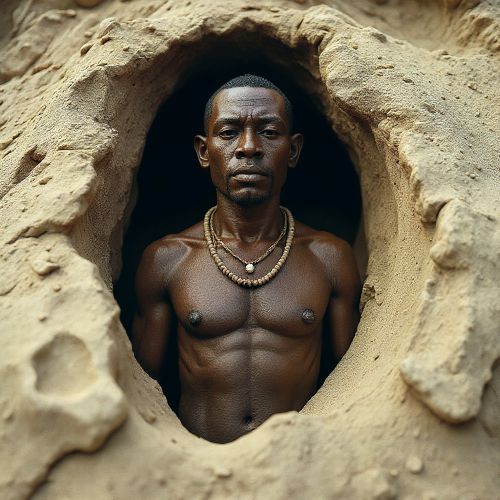
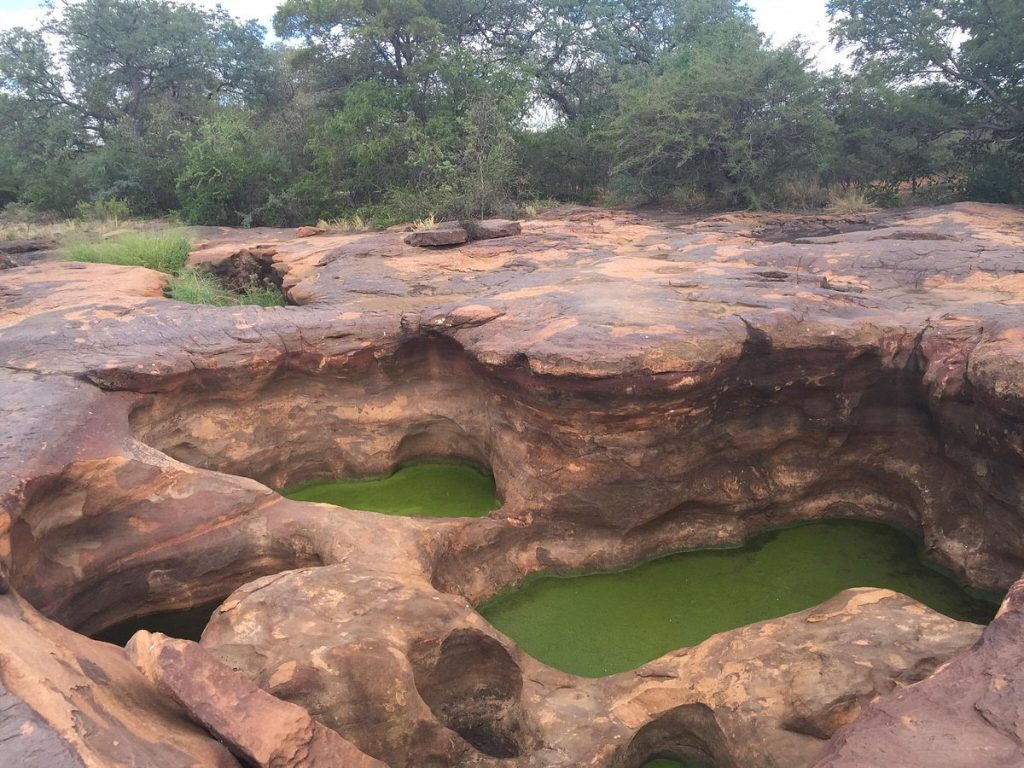
Matsieng occupies a foundational place in Tswana cosmology as a primordial being associated with the very beginning of human and animal life. In Tswana oral tradition, he is remembered as the figure who emerged first from beneath the earth, guiding people, livestock, and wild creatures into the world as it exists today. This moment of emergence is believed to have occurred at a sacred location now known as the Matsieng Footprints site in southeastern Botswana, near modern-day Gaborone. Natural rock depressions and ancient engravings at the site are interpreted within tradition as the literal footprints of Matsieng and those who followed him into daylight.
The story of Matsieng functions as both a creation narrative and a cultural charter. Rather than describing creation as an act imposed from the heavens, Tswana tradition frames existence as an emergence from the land itself. Humanity, animals, and territory are thus bound together from the first moment of life. Matsieng is not simply a creator figure but a guide, a leader who opens the passage between worlds. His story provides the Tswana people with a shared origin that connects ancestry, landscape, and identity into a single sacred narrative that continues to hold cultural authority today.
Physical Traits
Matsieng is most vividly remembered for his unusual physical form. Across many oral accounts, he is described as a giant with only one leg, a feature that immediately distinguishes him from ordinary humans and places him within the liminal space between the human and the supernatural. His size is consistently portrayed as immense, capable of striding across the land in ways that ordinary beings cannot. The massive footprints attributed to him, carved or weathered into sandstone, reinforce this image and serve as physical anchors for belief.
The symbolism of Matsieng’s single leg has been interpreted in several ways within scholarly and cultural discourse. It may represent incompleteness, reflecting a being who belongs neither fully to the underworld nor entirely to the human realm. Others interpret it as a marker of transition, emphasizing that Matsieng exists between states of existence. Even in traditions that describe him as having two legs, his form remains exaggerated and monumental, underscoring his role as a being of origins rather than a historical person. His body is less important as anatomy and more as metaphor, expressing the instability, power, and mystery of beginnings.
Family
Unlike many mythological figures whose importance is reinforced through elaborate family trees, Matsieng stands largely alone in Tswana tradition. He is not remembered through spouses, children, or dynasties in the conventional sense. Instead, his role as an ancestor is collective and symbolic. He is understood as the forebear of peoples rather than the father of individuals. Humans, animals, and clans that emerged with him are considered his descendants in a cultural rather than biological sense.
Some traditions describe Matsieng as acting under the authority of Lowe, a higher creative force or sacred place associated with the opening in the earth from which life emerged. In these versions, Matsieng functions as an intermediary, carrying out the act of emergence rather than originating it himself. This relationship suggests a layered cosmology in which creation involves cooperation between different levels of divine or ancestral power. Matsieng’s family, therefore, is the world itself. His legacy lives not through named heirs but through the continued existence of the people and animals he led into being.
Other names
Matsieng is most commonly known by that name across Tswana oral traditions, and unlike many mythic figures, he does not possess a wide range of formal aliases. This consistency reflects his archetypal status as the first being rather than a localized hero. However, descriptive titles are sometimes used in storytelling to emphasize particular aspects of his role. He may be referred to as Matsieng wa Lowe to highlight his connection to the sacred opening or creative force associated with Lowe.
In other narratives, he is simply described through titles such as “the one-legged ancestor” or “the great giant,” emphasizing physical and symbolic attributes rather than personal identity. These variations are less about renaming Matsieng and more about framing him differently depending on the storyteller’s focus. The absence of competing names reinforces his singular position in Tswana cosmology as a unique figure whose identity is inseparable from his function.
Powers and Abilities
Matsieng’s abilities are rooted in acts of transformation rather than displays of supernatural spectacle. His greatest power lies in his role as a leader of emergence. By opening or guiding passage from the underworld to the surface, he enables the transition from potential existence to lived reality. Humans and animals follow him, establishing the natural order of the world. This act alone places him among the most significant figures in Tswana belief.
Beyond emergence, Matsieng is often credited with mastery over animals and the natural environment. He is portrayed as a great hunter and organizer, capable of domesticating animals and teaching survival in a newly revealed world. His footprints are believed to retain spiritual potency, and rainwater collected from the rock depressions associated with him is traditionally used in rituals connected to fertility and rainmaking. In some versions of the myth, Matsieng eventually withdraws back into the earth, disappointed with human behavior. This retreat symbolizes the distancing of the sacred from everyday life, explaining why divine presence is felt rather than seen in the modern world.
Modern Day Influence
Matsieng continues to shape cultural identity in Botswana through both tradition and heritage preservation. The Matsieng Footprints site is protected as a national monument and remains a place of ritual significance for local communities. While archaeologists interpret the engravings and depressions as Late Stone Age rock art created by ancestral San peoples between approximately 3,000 and 10,000 years ago, Tswana oral tradition maintains its sacred association with Matsieng. These perspectives coexist, enriching rather than negating one another.
In contemporary Botswana, Matsieng’s story is taught as part of cultural education and referenced in discussions of ancestry, land rights, and heritage. Artists, writers, and musicians continue to draw inspiration from the myth, reimagining Matsieng as a symbol of emergence, resilience, and belonging. His story resonates in modern contexts as a reminder that identity is rooted in place and that humanity’s relationship with the land is both ancient and sacred. Matsieng remains not just a figure of the past, but a living presence in cultural memory.
Related Images
Source
Morupisi, D. (1995). Myths, legends and beliefs among Batswana. Kutlwano, 33(11), 4-5.
Schapera, I. (1995). The Tswana (2nd ed.). Kegan Paul International. (Classic ethnographic source on Tswana lore including Matsieng origins.)
Wikipedia contributors. (2024). Matsieng Footprints. Wikipedia. https://en.wikipedia.org/wiki/Matsieng_Footprints
Face2Face Africa. (n.d.). Inside Botswana’s Matsieng cultural site where locals say the first human was created. https://face2faceafrica.com/article/inside-botswanas-matsieng-cultural-site-where-locals-say-the-first-human-was-created
Atlas Obscura. (2016). Matsieng Footprints in Kgatleng. https://www.atlasobscura.com/places/matsieng-footprints
Sunday Standard. (n.d.). History of Bangwaketse – Children of Matsieng (Part I).
https://www.sundaystandard.info/history-of-bangwaketse-oco-children-of-matsieng-part-i/
Mmegi Online. (2016). The Orphan And The Ants Part 1 The Sons Of Matsieng. https://www.mmegi.bw/ampArticle/80086
Botswana Tourism. (n.d.). Matsieng Footprints. https://www.botswanatourism.co.bw/explore/matsieng-footprints
Frequently Asked Questions
Who is Matsieng in Tswana tradition?
Matsieng is a primordial ancestral figure believed to have led humans and animals from beneath the earth into the world.
Where are the Matsieng Footprints located?
The Matsieng Footprints site is located near Gaborone, Botswana, and is preserved as a national heritage monument.
Why is Matsieng described as one-legged?
The single leg symbolizes Matsieng’s liminal nature, existing between the underworld and the human realm.
Is Matsieng considered a god?
Matsieng is best understood as a primordial ancestor or culture hero rather than a supreme god.
Are the Matsieng Footprints archaeological or mythological?
Archaeologically, they are ancient rock engravings, while culturally they are revered as sacred imprints of Matsieng.
