


Qat : The Creator God of the Banks Islands
Listen
At a glance
| Description | |
|---|---|
| Origin | Banks Island Mythology |
| Classification | Gods |
| Family Members | Ro-Lei (Wife) |
| Region | Vanuatu |
| Associated With | Creation, Humanity, Night, Death, |
Qat
Introduction
Qat stands at the heart of the oral traditions of the Banks Islands, a remote archipelago in northern Vanuatu within the Melanesian cultural world. He is remembered not through temples or formal worship, but through stories passed down across generations, making him both a creator deity and a culture hero rooted in lived memory. Qat’s narratives explain how land emerged from the sea, how humanity came into being, and why death became part of the human condition. Unlike distant cosmic gods, Qat behaves with curiosity, humor, and intelligence, reflecting a worldview where the divine remains closely tied to everyday life. His stories function as cosmology, moral teaching, and entertainment, reinforcing identity in island communities shaped by ocean, land, and ancestral knowledge.
Physical Traits
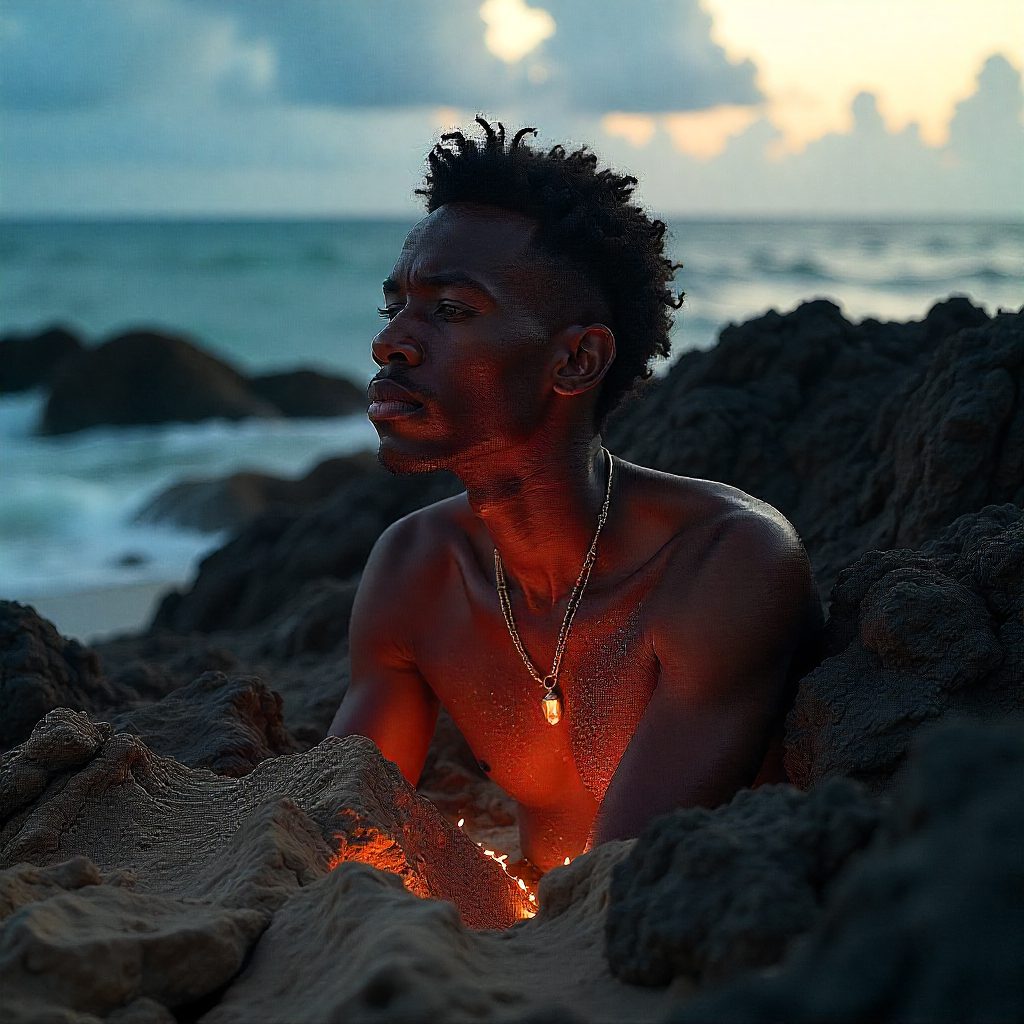
Descriptions of Qat’s appearance are intentionally fluid, a reflection of Melanesian storytelling traditions that prioritize action over form. Rather than possessing a fixed or imposing physical body, Qat is understood as a vui, a powerful spirit capable of assuming human-like presence when needed. His most defining physical moment occurs at his birth, when he emerges fully formed from a stone known as Qatgoro, already able to speak and act with supernatural awareness. This origin emphasizes his connection to the land itself rather than to flesh or lineage. When Qat interacts with humans, he does so in an approachable, almost familiar manner, reinforcing his role as a culture shaper rather than an unreachable god.
Family
Family relationships play a crucial narrative role in Qat’s stories, particularly in highlighting contrast and conflict. He is said to have eleven brothers, most notably Tangaro Gilagilala and Tangaro Loloqong, whose repeated failures serve to emphasize Qat’s intelligence and foresight. Through these sibling rivalries, the stories illustrate how wisdom and patience triumph over impulsiveness. Qat’s wife, Ro-Lei, is a sky maiden who descends to earth. By hiding her wings, Qat ensures her presence in the human world, a recurring Oceanic motif symbolizing the union of celestial and earthly realms. These familial dynamics frame Qat not only as a creator but also as a figure navigating relationships, responsibility, and consequence.
Other names
Qat appears under several linguistic variations across Vanuatu, including Qet, Kpwet, Iqet, and Ikpwet. These variations emerge from the region’s rich linguistic diversity and the oral transmission of stories rather than from doctrinal differences. In broader Melanesian contexts, Qat is often associated with or compared to Tagaro, another creator figure found across neighboring islands. This overlap suggests a shared mythic structure that adapted locally over time. Rather than weakening Qat’s identity, these name variations demonstrate how his character evolved organically across communities while preserving a consistent creative role.
Powers and Abilities
Qat’s abilities extend beyond raw creation into the shaping of culture and cosmic order. He is credited with fishing the islands out of the sea, transforming oceanic chaos into inhabitable land. Humanity itself originates through Qat’s craftsmanship, as he carved figures from trees and animated them through rhythm, movement, and sound. His introduction of night brought rest and balance to the world, while his decision to introduce death defined the limits of human existence. Qat also established essential social structures, including marriage customs and prohibitions against incest, embedding moral order into society. His relationship with Marawa, the spider spirit, reflects ongoing tension between creation and decay, reinforcing the idea that balance arises through opposition rather than absolute control.
Modern Day Influence
Although Qat is no longer worshipped as a living deity, his influence remains deeply embedded in the cultural fabric of Vanuatu. His stories continue to be shared through oral performance, education, and cultural preservation initiatives, particularly in the Banks Islands. Anthropologists and linguists have documented Qat’s narratives as key examples of Melanesian cosmology and worldview. In modern interpretation, Qat symbolizes continuity, reminding island communities of their ancestral relationship with land, sea, and social responsibility. His stories also appear in comparative studies alongside figures like Maui and Tagaro, placing Qat within a wider Pacific narrative tradition. Through storytelling, scholarship, and cultural pride, Qat remains a living presence rather than a forgotten god.
Related Images
Source
Codrington, R. H. (1891). The Melanesians: Studies in their anthropology and folk-lore. Clarendon Press.
Deacon, A. B. (1934). Malekula: A vanishing people in the New Hebrides. Routledge & Sons.
Guiart, J. (1953). Mythologie et société mélanésiennes. Musée de l’Homme.
Layard, J. (1942). Stone men of Malekula. Chatto & Windus.
Robertson, G. (1901). The native races of the British Solomon Islands protectorate. Unpublished manuscript, Alexander Turnbull Library.
Wikipedia. (2025). Qat (deity). https://en.wikipedia.org/wiki/Qat_(deity)[3]
Pantheon.org. (n.d.). Qat | Facts, Information, and Mythology. https://pantheon.org/articles/q/qat.html
Godchecker. (n.d.). QAT – Melanesian Mythology. https://www.godchecker.com/melanesian-mythology/QAT/
Frequently Asked Questions
Who is Qat in Pacific belief systems?
Qat is a creator spirit and culture hero from the Banks Islands of Vanuatu, known for shaping land, humanity, and social order through oral tradition.
Is Qat worshipped as a god?
Qat was not worshipped through rituals but remembered through storytelling, making him a cultural ancestor rather than a temple deity.
What did Qat create?
Qat created islands, humans, night, and social customs, including marriage laws and moral boundaries.
Who are Qat’s brothers?
Qat has eleven brothers, often portrayed as less capable, whose failures highlight Qat’s wisdom and creative skill.
Why is Qat important today?
Qat remains important as a symbol of cultural identity, ancestral memory, and Melanesian worldview preserved through oral heritage.
