

Shemwindo : The Chief Whose Fear Shaped the Mwindo Epic
Listen
At a glance
| Description | |
|---|---|
| Origin | Nyanga Mythology |
| Classification | Mortals |
| Family Members | Mwindo (Son) |
| Region | Democratic Republic of Congo |
| Associated With | Royalty |
Shemwindo
Introduction
Shemwindo stands as one of the central forces shaping the Mwindo Epic, the defining oral tradition of the Nyanga people from the Democratic Republic of Congo. As the ruler of Tubondo and the father of the miraculous hero Mwindo, Shemwindo represents the powerful but deeply flawed leader whose fear of losing authority pushes him toward destructive choices. His refusal to allow the birth of a son, driven by a prophecy foretelling his downfall, sets in motion the entire narrative. This act positions him not merely as an antagonist but as a symbolic expression of leadership corrupted by insecurity and an inability to accept the natural cycle of succession.
Through multiple generations of storytellers and recordings by scholars such as Daniel Biebuyck and Kahombo Mateene, Shemwindo’s character remains vital to understanding Nyanga perspectives on justice, hierarchy, morality, and the consequences of abusing power.
Physical Traits
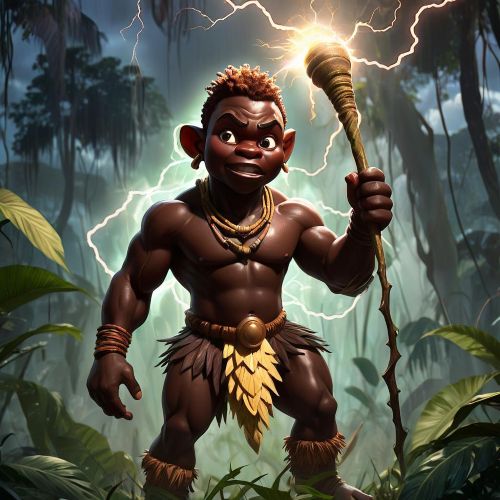
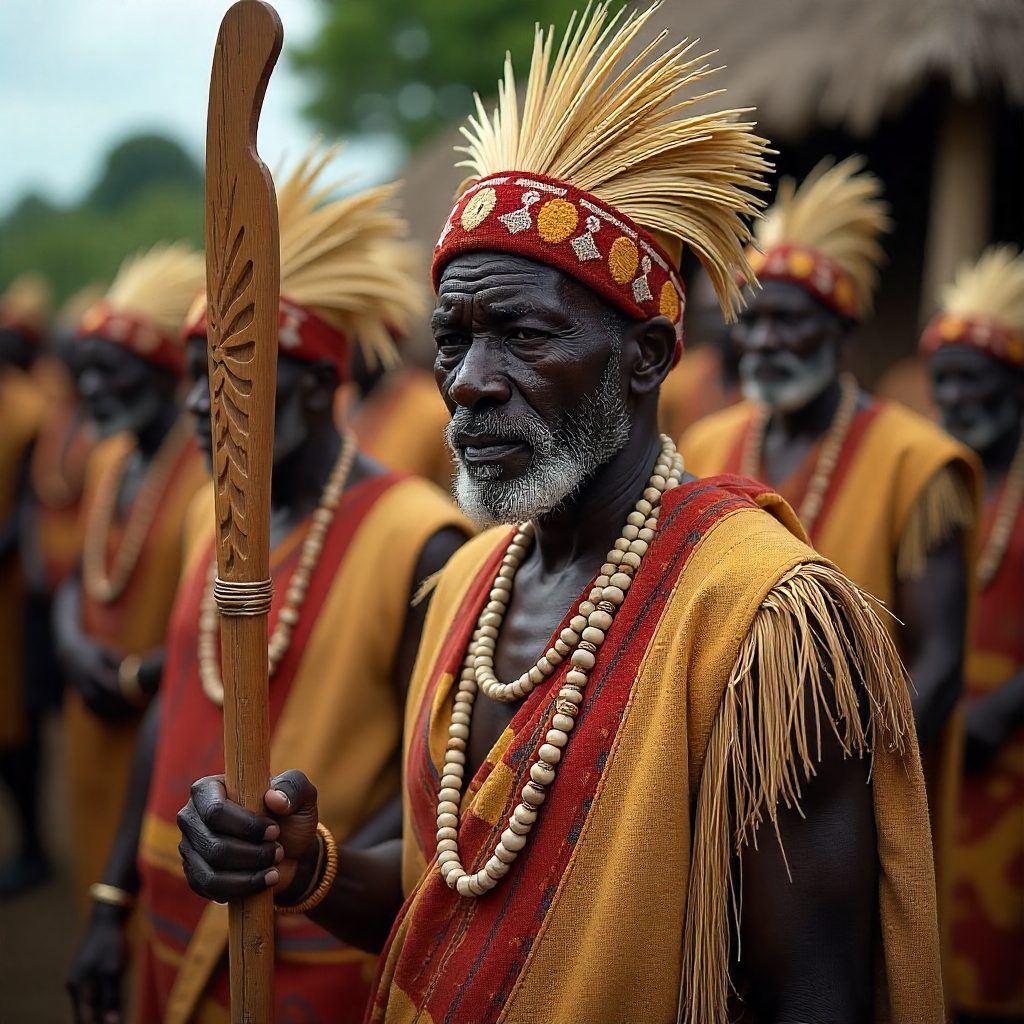
The Mwindo Epic offers little in the way of specific physical description for Shemwindo, a deliberate narrative choice that shifts attention to his role and authority rather than his appearance. Instead, the oral tradition emphasizes the regalia and posture expected of a Nyanga chief. He is imagined through performance as a figure draped in symbols of rank—ornamental staffs, woven garments, and objects representing kinship leadership.
Although not portrayed as possessing supernatural features, his strength is implied through the severity of his actions. He orders violent attempts on Mwindo’s life—burying, stabbing, and drowning—suggesting a chief who is capable, forceful, and accustomed to unquestioned obedience. In bardic retellings, Shemwindo is often acted out with exaggerated gestures of dominance, reinforcing his authoritarian nature and grounding him firmly within the visual vocabulary of Nyanga leadership.
Family
Shemwindo’s family plays a crucial role in the shaping of the epic’s conflict. As a chief with seven wives—an important number in Nyanga cosmology—his household represents both wealth and prestige. His decree that only female children may be born reflects the central tension of the narrative: his terror at the prophecy predicting that a male child would overthrow him.
From the moment Mwindo is born to Nyamwindo, his seventh wife, Shemwindo’s fear intensifies into repeated attempts at infanticide. Yet Mwindo’s supernatural resilience defies every attempt, illustrating the inevitable triumph of divine destiny over human resistance.
Other key family connections deepen the narrative’s emotional landscape. Iyangura, Mwindo’s aunt, shelters him and becomes instrumental in his survival and later journey. Her marriage to Mukiti, the serpent deity of the river, intertwines family relationships with mythic forces, creating a dynamic where Shemwindo’s choices echo across both human and supernatural realms. Ultimately, the family structure surrounding Shemwindo highlights themes of loyalty, betrayal, lineage, and the unbreakable bond between generations despite conflict.
Other names
Most primary and secondary sources preserve the name Shemwindo with remarkable consistency. Variations that do appear, such as “Shemwindu” or the phonetic rendering “Shay-MWEE-n-doh,” stem from differences in transcription and the natural fluidity of oral storytelling traditions.
Unlike many mythological figures who accumulate titles or epithets, Shemwindo’s identity is firmly tethered to his role as chief of Tubondo and father of Mwindo. The stability of his name across Nyanga performances suggests an intentional anchoring of the character: he is not a mythic being with shifting masks, but a human ruler who embodies a particular kind of historical and moral authority within the community’s worldview.
Powers and Abilities
Shemwindo’s abilities derive not from supernatural might but from the combined power of kingship, ritual knowledge, and social authority. His attempts to kill Mwindo—casting him into the river within a sacred drum, ordering his burial, or attacking him with weapons—indicate access to ritual objects and ceremonial practices used in times of crisis.
However, these actions also reveal his limitations. Mwindo survives every assault, demonstrating that Shemwindo’s authority belongs to the human sphere and cannot overcome divine intention. This contrast establishes the thematic heart of the epic: power rooted in fear cannot triumph over power rooted in destiny and justice.
Later episodes in the epic show Shemwindo fleeing into distant realms seeking protection or hiding among powerful beings. His ability to negotiate with spirits or foreign rulers suggests political skill but also desperation. His eventual capture and submission represent not only personal defeat but the symbolic end of a corrupted era of leadership.
Modern Day Influence
The story of Shemwindo has traveled far beyond its Nyanga origins, shaping global conversations about leadership, moral authority, and reconciliation. Modern literature, theatre, and educational reinterpretations of the Mwindo Epic often reposition Shemwindo as a cautionary example—a ruler transformed by fear into an agent of destruction, only to find redemption through humility.
In African studies and comparative mythology, scholars draw parallels between Shemwindo and figures such as King Laius of Thebes or even Shakespeare’s King Lear, identifying recurring themes of prophecy, paternal conflict, and tragic downfall. Contemporary African writers and educators use Shemwindo’s character to explore governance, succession, and the dangers of authoritarianism, especially within discussions of postcolonial leadership.
Today, digital retellings, performances, and classroom resources continue to present Shemwindo as a figure whose moral failings offer enduring lessons on power, responsibility, and the need for leaders to balance authority with wisdom.
Related Images


Source
Biebuyck, D. P., & Mateene, K. (1969). The Mwindo Epic: From the Banyanga of the Congo. University of California Press.
Columbia University. (n.d.). Mwindo Epic. World Epics Project. https://edblogs.columbia.edu/worldepics/project/mwindo-epic/
Encyclopedia.com. (n.d.). Mwindo. https://www.encyclopedia.com/history/encyclopedias-almanacs-transcripts-and-maps/mwindo
Finnegan, R. (2012). Oral Literature in Africa. Open Book Publishers.
Okpewho, I. (1999). African Oral Literature: Backgrounds, Character, and Continuity. Indiana University Press.
Scheub, H. (1998). Story: An Introduction to the Narrative Tradition. University of Wisconsin Press.
Vansina, J. (1985). Oral Tradition as History. University of Wisconsin Press.
Wikipedia. (n.d.). Mwindo Epic. https://en.wikipedia.org/wiki/Mwindo_epic
Frequently Asked Questions
Who is Shemwindo in the Mwindo Epic?
Shemwindo is the chief of Tubondo and the primary antagonist in the Mwindo Epic, known for trying to prevent his son Mwindo from fulfilling a prophecy of overthrowing him.
Why does Shemwindo try to kill Mwindo?
A prophecy predicts that a male child will dethrone him, leading Shemwindo to order that only daughters be born and later attempting to kill Mwindo repeatedly.
Does Shemwindo have supernatural powers?
Shemwindo does not possess magical abilities like Mwindo, but he uses ritual objects and authority-based power, reflecting his status as a human chief.
How does Shemwindo’s story end?
He is eventually defeated, captured, and forced to repent, after which Mwindo chooses reconciliation over revenge, restoring harmony to the community.
What does Shemwindo represent in Nyanga mythology?
He symbolizes flawed leadership—specifically the dangers of fear-driven rule, abuse of authority, and resistance to the natural cycle of succession.