

Dindi : The Supreme Creator of the Huli People
Listen
At a glance
| Description | |
|---|---|
| Origin | Huli Mythology |
| Classification | Gods |
| Family Members | N/A |
| Region | Papua New Guinea |
| Associated With | Supreme, Creation |
Dindi
Introduction
Dindi occupies a central place in the cosmology of the Huli people of Papua New Guinea, particularly those living in the mist-covered highlands of Hela Province. As the supreme creator, Dindi embodies the origin of the world, humanity, and the unseen forces that sustain life. His presence is woven through Huli oral traditions, where creation myths function not only as sacred stories but also as frameworks for understanding land, ancestry, and communal identity. Although Dindi is revered as the source of all existence, he is rarely depicted as a deity who interferes directly in human affairs. Instead, he represents a cosmic framework—an ordering principle that underpins the harmony between people, spirits, and the natural world. Through this lens, Dindi remains vital to Huli spirituality, even as modern influences shift cultural practices.
Physical Traits
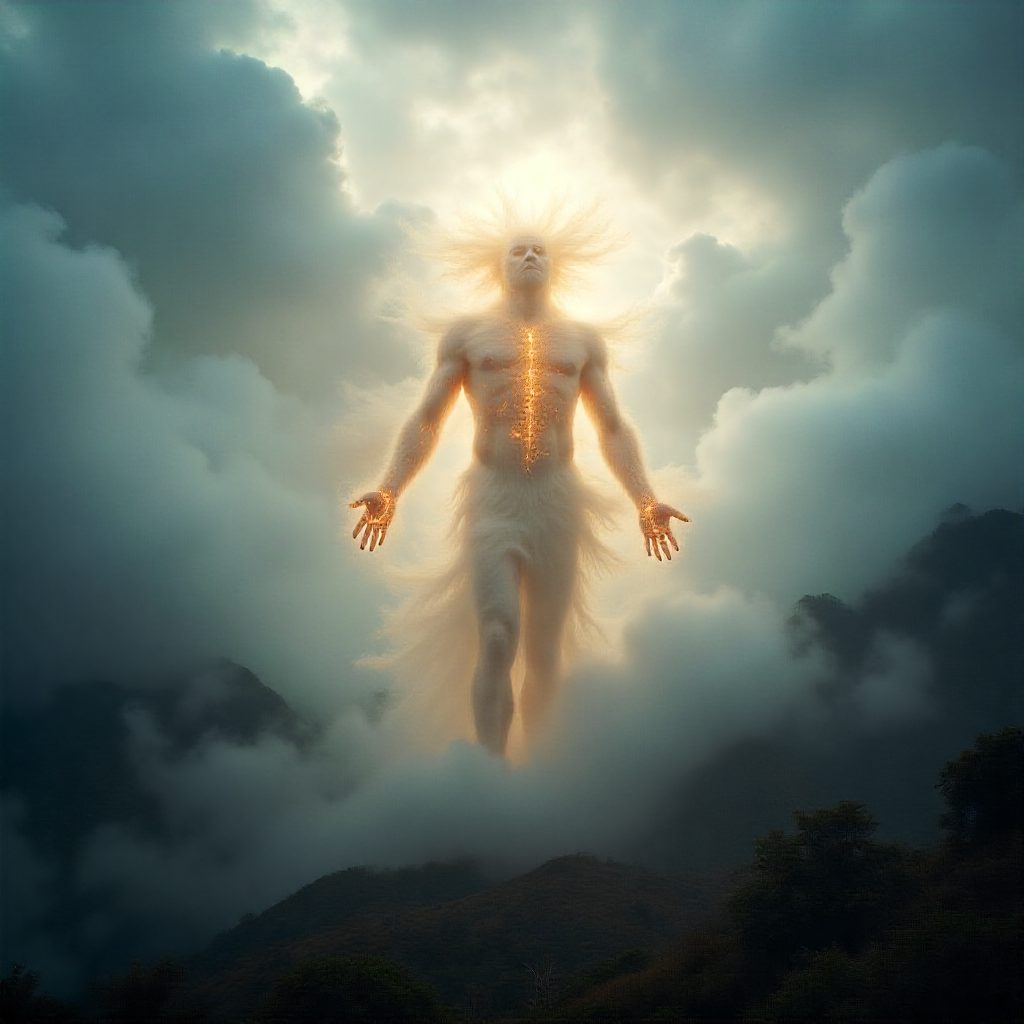
Descriptions of Dindi do not adhere to human physical characteristics, reflecting the Huli emphasis on spiritual abstraction over figurative representation. He is typically envisioned as an expansive, celestial force rather than a defined being, embodying the sky’s vastness and the earth’s underlying strength. Elders often describe his presence through natural events such as rumbling earth, heavy storms, or movements in the heavens, using these phenomena to express his immense creative power. This lack of corporeal imagery is consistent with Huli ritual culture, where spiritual entities are invoked through chant, story, and land-based symbolism rather than through idols or physical depictions. Dindi’s form therefore remains intentionally mysterious, reinforcing his status as a cosmic rather than humanlike deity.
Family
Within Huli mythology, Dindi’s significance is intertwined with Kware, his divine consort. While Dindi is the architect of the world itself, Kware plays a pivotal role in shaping human lineage. She is credited with creating the first Huli man and woman, grounding the people’s ancestry in a divine maternal source. Their partnership reflects the Huli understanding of balance between heavenly order and earthly vitality. Together, they represent the unity of sky and soil, authority and growth. Other spiritual figures surrounding them form a dynamic pantheon, but Dindi and Kware stand at the origin point of creation. Their relationship also mirrors Huli cultural values in which family, land, and ancestral continuity are tightly interwoven.
Other names
The name “Dindi” remains the primary and consistent term used across Huli communities to identify the supreme creator. Due to the oral nature of Huli storytelling, variations sometimes appear in ritual language, though these rarely function as proper alternate names. One notable expression—dindi dumbirumbi, meaning “the earth shaking”—is used to refer to earthquakes and is associated with Dindi’s immense power. While not an alternative title, the phrase demonstrates how his presence is linguistically embedded in descriptions of natural force. Ritual specialists may also invoke Dindi alongside ancestral beings such as dama (spirits connected to land and lineage), which affirms his overarching authority in the spiritual hierarchy.
Powers and Abilities
Dindi’s powers are rooted in creation and cosmic governance. He is credited with forming the earth, shaping its contours, and establishing the order that allows life to flourish. His influence is not expressed through direct interaction but through the structure of existence itself. Natural events—particularly earthquakes, lightning, and intense storms—are sometimes seen as echoes of his primordial energy, reminding the people of the powerful force that shaped their world. Dindi also symbolizes the ultimate source of spiritual equilibrium, ensuring that relationships between humans, land, and ancestral spirits remain intact. This approach to divine power aligns with Huli cosmology, where deities often set the cosmic framework and human rituals maintain the balance within it. Dindi’s abilities thus operate on a foundational level, influencing life through underlying order rather than through episodic actions.
Modern Day Influence
Although contemporary Huli society has undergone significant cultural change due to modernization, Christianity, and shifting economic realities, Dindi’s legacy continues to shape identity and ritual practice. Traditional leaders still reference Dindi in discussions of origin and land ownership, grounding their authority in ancient cosmology. Ceremonial practices, including storytelling and ritual recitations, preserve his mythological role for younger generations, ensuring cultural continuity. Many Huli still interpret dramatic natural occurrences—especially earthquakes, which are common in Papua New Guinea—through a cosmological lens linked to Dindi’s elemental presence.
In academic contexts, anthropologists studying highland societies frequently highlight Dindi as a crucial figure for understanding spiritual relationships between people and landscape. Documentaries and cultural exhibitions that portray Huli traditions often reference Dindi’s worldview, reinforcing his symbolic importance beyond the community itself. Even as lifestyles evolve, Dindi remains a marker of cultural resilience, connecting the modern Huli people with their ancestral cosmology and reinforcing their deep ties to land, heritage, and spiritual order.
Related Images


Source
Goldman, L. R. (1998). Huli gender ideology and the division of labour (Doctoral dissertation, University of Cambridge).
Huli Culture. (2017). Bradley University Anthropology Wiki. https://sites.google.com/fsmail.bradley.edu/buanthro/huli-culture
PNG LNG Project. (2008). Social impact assessment appendix 26. https://pnglng.com/media/PNG-LNG-Media/Files/Environment/EIS/eis_appendix26.pdf
Soul-o-Travels. (2024). Tribe profile: The Huli wigmen of Papua New Guinea. https://soul-o-travels.com/2024/01/18/tribe-profile-the-huli-wigmen-papua-new-guinea/
Tamu, N. (2012). Huli: The last of the stone age. Niugini Images.
Wood, M. (1982). Huli culture and society. Papua New Guinea National Research Institute.
Zelenietz, M. (1979). The Huli of Papua New Guinea: A study in cultural change. McMaster University Anthropology Publications.
Ballard, C. (1994). The death of a great land: Ritual, history and subsistence revolution in Papua New Guinea. Canberra: ANU Press.
Frankel, S. (1986). The Huli response to illness. Cambridge: Cambridge University Press.
Strathern, A. (1979). Melanesian religions: An anthropological overview. London: Routledge.
Goldman, L. (1998). Child’s play: Myth, mimesis and make-believe among the Huli. Oxford: Berg Publishers.
Wiessner, P., & Tumu, A. (1998). Historical vines: Enga networks of exchange, ritual, and warfare in Papua New Guinea. Smithsonian Institution Press.
Frequently Asked Questions
Who is Dindi in Huli mythology?
Dindi is the supreme creator deity in the mythology of the Huli people of Papua New Guinea, credited with forming the world and establishing cosmic order.
Does Dindi have a physical form?
No. Huli tradition describes Dindi in abstract, cosmic terms rather than humanlike features, emphasizing his role as a transcendent creator.
Who is Kware in relation to Dindi?
Kware is Dindi’s divine consort and the creator of the first Huli humans, representing fertility and the continuity of lineage.
What powers is Dindi believed to possess?
Dindi holds the power of creation, cosmic governance, and elemental influence, particularly over phenomena like earthquakes and storms.
Is Dindi still worshipped today?
While Christianity has influenced modern Huli society, Dindi remains culturally significant in rituals, storytelling, and interpretations of natural events.
