

Hikule’o : Goddess of the Tongan Underworld
Listen
At a glance
| Description | |
|---|---|
| Origin | Tongan Mythology |
| Classification | Gods |
| Family Members | Limu and Kele (Parents) |
| Region | Tonga |
| Associated With | Underworld |
Hikule’o
Introduction
Hikule’o, also known in several traditions as Havea Hikule’o, stands as one of the most influential deities in Tongan mythology. She rules over Pulotu, the underworld realm where ancestral spirits dwell and continue their existence beyond the mortal world. Her presence in Tongan cosmology highlights the deep spiritual relationship between the people of Tonga, their land, and their roots, connecting the creation of islands, the forces of nature, and the continuity of lineage.
In many oral traditions, Hikule’o is the guardian of life’s hidden cycles—presiding over death not as a force of destruction but as a custodian of ancestral wisdom. Her stories often intertwine with the origins of Tonga’s volcanic landscapes, as she is credited with forming several islands by casting powerful stones from the sky. This intertwining of geological transformation with divine narrative reflects Tonga’s understanding of nature as a living, spiritual force shaped by gods who govern specific cosmic realms.
Physical Traits
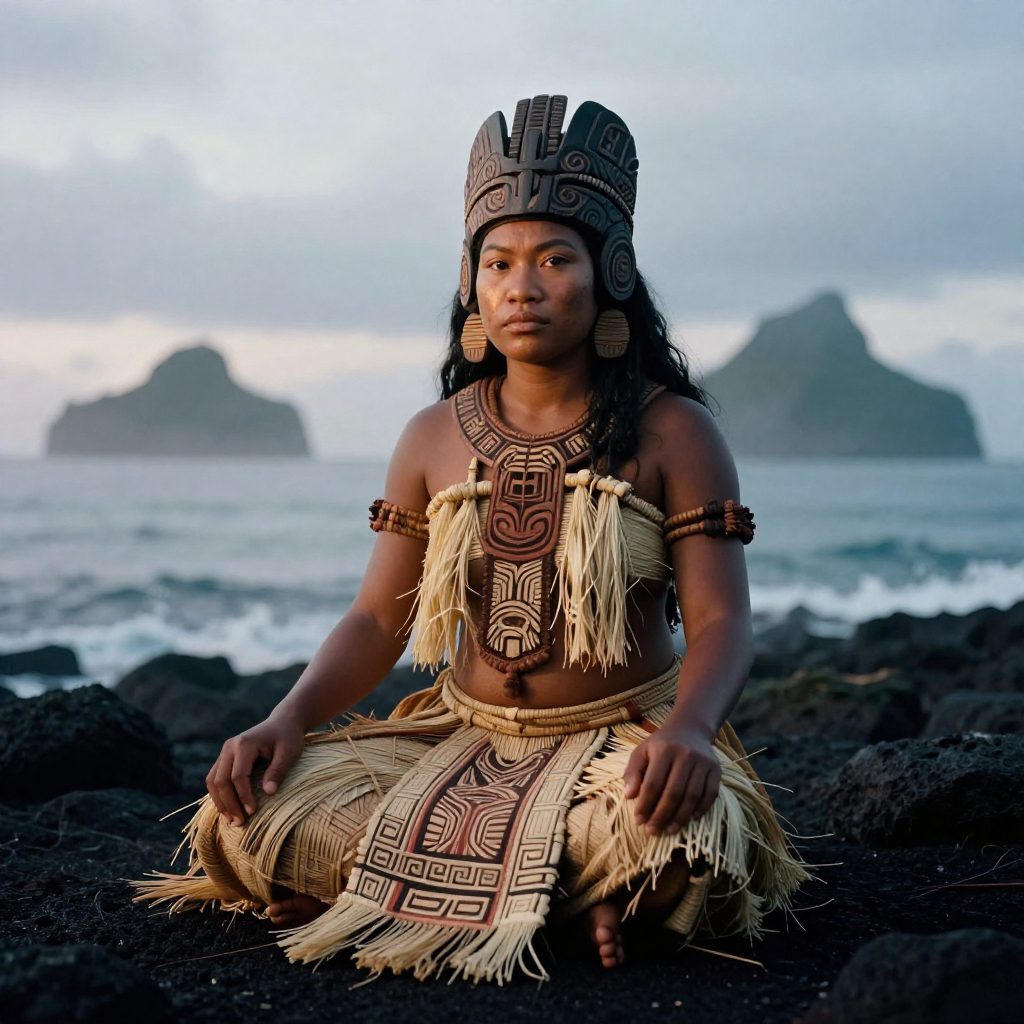
Hikule’o’s appearance is rarely described in human-like detail, as Polynesian deities are often associated more with natural power than with anthropomorphic features. However, surviving pre-Christian figurines and carvings offer important insight into how she was perceived. These wooden sculptures portray her as a squatting female figure with pronounced, powerful features, symbolizing fertility, authority, and grounding energy.
This representation emphasizes her role not through ornamentation but through posture and form. The squatting stance, common in ancient Tongan carvings, signifies rooted power and connection to the earth—fitting for a goddess who oversees volcanic creation and the ancestral realm. Her depictions were often kept bound or ritually secured, a symbolic acknowledgement of her immense strength, which early Tongans believed required restraint to maintain balance among divine forces.
Family
Hikule’o’s lineage is deeply interwoven with the foundational genealogies of Tongan cosmology. She is widely described as a child of Limu and Kele, elemental beings representing organic sea growth and sediment. Together, they gave rise to the divine ancestors from whom many Tongan gods originate.
Her closest siblings are Tangaloa, the god of the sky, and Maui, the cultural hero known for shaping islands and fishing land from the sea. Upon the death of their father Taufulifonua, the siblings divided the universe: Tangaloa received the heavens, Maui governed the earth, and Hikule’o was entrusted with Pulotu. This triadic structure reflects the Polynesian worldview, where cosmic harmony is achieved through separation of realms, each ruled by a guardian whose power sustains cosmic balance.
Other names
Hikule’o appears under different names throughout Tongan oral literature, reflecting regional traditions and ritual functions. Havea Hikule’o is one of the most common variants, emphasizing her association with the noble lineage of the Havea clan. Certain traditions refer to her as Havea Lolofonua, linking her to domains beneath the earth and reinforcing her authority over the spiritual realm.
These variations do not alter her divine identity but instead highlight the flexibility of oral storytelling, where names shift to reflect context, lineage, or ritual significance. All forms, however, maintain her status as the sovereign of Pulotu.
Powers and Abilities
Hikule’o’s abilities encompass some of the most powerful forces in Tongan cosmology. As ruler of Pulotu, she governs the spirits of the dead and ensures that ancestral continuity remains intact. The underworld in Tongan belief is not a place of punishment but a sacred home of departed family members, making her role deeply tied to cultural reverence for genealogy.
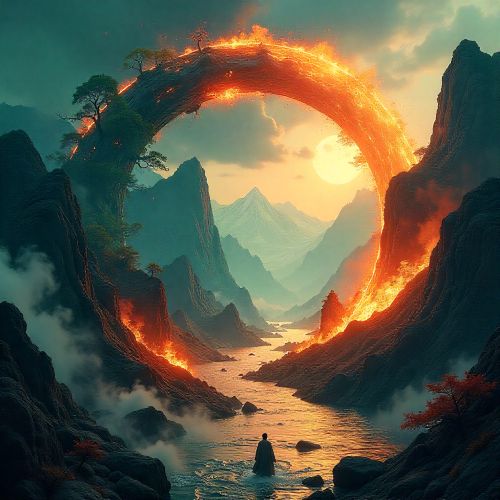
One of her most renowned powers is the creation of volcanic islands. Legends state that she cast stones from the heavens to form islands such as Kao, Tofua, and the Hunga Tonga–Hunga Haʻapai complex. This connection between myth and geology reflects the region’s explosive volcanic history and provides a spiritual explanation for the ever-shifting Pacific landscape.
She is also associated with seismic and volcanic activity, fertility, and the restoration of life force. In certain traditions, she holds the rare ability to reanimate the dead or recall spirits temporarily, emphasizing her supreme authority over life cycles. Her power is often described as immense yet deliberately contained, reinforcing her role in maintaining equilibrium across the realms governed by her siblings.
Modern Day Influence
With the arrival of Christianity in Tonga during the 19th century, Hikule’o’s worship was actively suppressed, and many of her wooden images were destroyed by missionaries. However, her presence has not disappeared; instead, she has transformed into a figure of cultural memory and revival.
In recent decades, scholars, cultural historians, and Pacific artists have increasingly revisited Hikule’o’s mythology to reclaim erased indigenous narratives. Her stories now appear in academic research, local history projects, and cultural festivals, where she symbolizes resilience and ancestral pride.
Following events like the 2022 Hunga Tonga volcanic eruption, many Tongans referenced the ancient myth of Hikule’o casting stones, demonstrating how her presence still shapes cultural interpretation of natural events. Contemporary artists and writers incorporate her into visual art, poetry, and storytelling, while scholars highlight her significance in understanding Tongan identity, gender roles, and pre-Christian spirituality.
Today, Hikule’o stands not as a worshipped deity but as a powerful emblem of heritage—a reminder of the deep relationship between Tongans, their land, and their ancestors.
Related Images


Source
Craig, R. D. (1989). Dictionary of Polynesian mythology. Greenwood Press.
Ka’ili, T. O. (2024, September 23). Tonga’s ancient gods and the 21st century. Pacific Media Network. https://pmn.co.nz/read/language-and-culture/tonga-s-ancient-gods-and-the-21st-century
Pacific Pn. (2023, April 2). International Women’s Day reflection: The goddess Hikule’o. https://www.pacificpn.com/blog/international-womens-day-reflection-the-goddess-hikuleo
Taumoefau, F. (2017). Ko e tala-tukufakaholo ‘o Tonga: An alter-native holistic historiography of Tonga history. Academia.edu. https://www.academia.edu/72628434
The Coconet. (2012, July 31). Tales of Taonga – Hikule’o goddess figurines. https://www.thecoconet.tv/coco-docos/im:13217/tales-of-taonga-hikuleo-goddess-figurines/
Wikipedia. (2023, August 17). Hikuleʻo. https://en.wikipedia.org/wiki/Hikule%CA%BBo
Wikipedia. (2011, June 27). Tongan religion. https://en.wikipedia.org/wiki/Tongan_religion
Collocott, E. E. V. (1921). Tongan Myths and Legends. Journal of the Polynesian Society, 30(119), 145–162.
Kaeppler, A. L. (1999). Art, Ritual, and Society in Oceania. Ashgate Publishing.
Rutherford, N. (1977). Friendly Islands: A History of Tonga. Oxford University Press.
Campbell, I. C. (1992). Island Kingdom: Tonga Ancient and Modern. Canterbury University Press.
Māhina, ‘O. (2004). Tongan Traditional Society and Culture. In Polynesian Cultural Studies (pp. 45–67). University of the South Pacific Press
Frequently Asked Questions
Who is Hikule’o in Tongan mythology?
Hikule’o is the goddess of Pulotu, the Tongan underworld, and is associated with volcanic creation, ancestral spirits, and the cycle of life and death.
What powers is Hikule’o known for?
She rules the ancestral realm, creates volcanic islands, controls seismic forces, and maintains cosmic balance alongside her brothers Tangaloa and Maui.
Is Pulotu considered a place of punishment?
No. Pulotu is viewed as a sacred ancestral homeland where spirits reside peacefully under Hikule’o’s guardianship.
Why were Hikule’o’s figurines destroyed?
During 19th-century Christian missionary influence in Tonga, many traditional carvings were destroyed to suppress indigenous spiritual practices.
How does Hikule’o influence modern Tongan culture?
She appears in cultural revitalization movements, academic studies, art, and public narratives linking mythology to natural events like volcanic eruptions.
