


Pattini : The Sri Lankan Goddess of Justice and Protection
Listen
At a glance
| Description | |
|---|---|
| Origin | Sri Lankan Mythology |
| Classification | Gods |
| Family Members | Palanga (Husband) |
| Region | Sri Lanka |
| Associated With | Protection, Fertility, Justice |
Pattini
Introduction
Pattini is one of Sri Lanka’s most widely venerated guardian deities, honored by Sinhalese Buddhists and Sri Lankan Tamil Hindus alike. Rooted in the South Indian character Kannaki from the Tamil epic Cilappatikaram, she evolved over centuries into a uniquely Sri Lankan goddess of purity, justice, fertility, and protection. Her worship gained prominence around the 2nd century CE, traditionally linked to King Gajabahu I, who is believed to have brought the cult of Kannaki to the island. Although her origins lie in a Tamil literary tradition, Pattini became seamlessly woven into the cultural, spiritual, and ritual practices of Sri Lanka, shaping village ceremonies, healing rites, and annual festivals.
Pattini’s enduring appeal stems from her layered identity. She represents the power of moral integrity, the fierce loyalty of a devoted wife, the compassion of a protective mother, and the authority of a deity who punishes injustice. At a time when epidemics and crop failures shaped everyday life, her image as a guardian of health and fertility made her indispensable to communities. This mixture of mythic origin and local adaptation transformed Pattini into one of the most culturally unifying figures in the region.
Physical Traits
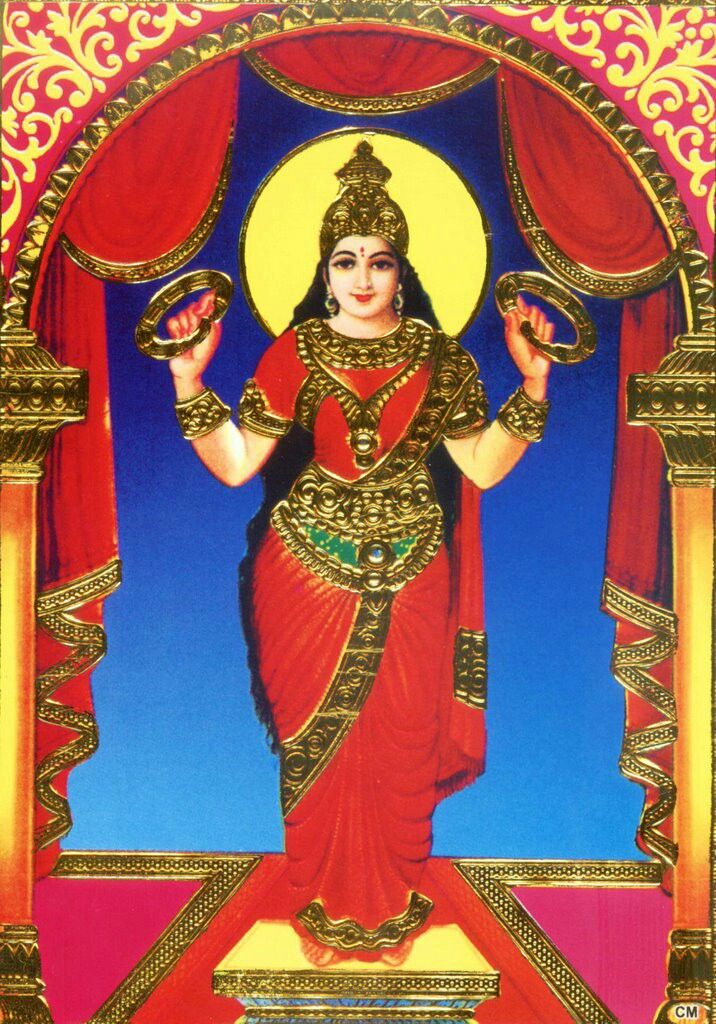
Descriptions of Pattini focus less on divine grandeur and more on symbols that reflect her purity and moral strength. She is commonly visualized as a radiant woman dressed in white or red—white signifying purity and red signifying righteous power. Her most iconic attribute is the anklet, the object that proves her husband’s innocence in Cilappatikaram. This anklet, filled with rubies rather than pearls, becomes the defining emblem of truth and justice in her narrative.
Artistic depictions often give Pattini a serene, motherly expression, highlighting her protective role. In some Sri Lankan traditions, she appears holding sprigs of neem—plants associated with cleansing and healing. She may also be represented riding a goat, symbolizing both humility and spiritual resilience. While her form remains human, subtle divine features—like a glowing face or elongated proportions—distinguish her from mortal figures. These representations reinforce her dual nature as a woman of extraordinary virtue who transcended mortality.
Family
The core of Pattini’s story is inseparable from her relationship with her husband, known as Kovalan in Tamil literature and Palanga or Kāvāla in certain Sri Lankan narratives. His wrongful execution for allegedly stealing the queen’s anklet marks the turning point in Pattini’s transformation. After proving his innocence, her grief and righteous fury lead to supernatural acts that ultimately elevate her to divine status.
Though married, Pattini is revered in Sri Lanka as a virgin goddess, a concept that underscores her spiritual purity rather than biological status. This symbolic virginity reinforces her identity as a deity untouched by worldly corruption, capable of purifying entire communities. Over time, her cult absorbed the roles of several local mother goddesses, such as Kiri Amma, enhancing her reputation as a nurturer of children and protector of families.
Her family narrative, therefore, is less about lineage and more about moral force. It is her loyalty, purity, and unwavering devotion that define her divine character.
Other names
Pattini is known by various names throughout Sri Lanka and South India, each emphasizing different aspects of her identity. Among Sinhalese Buddhists, she is called Pattini Deviyo, a guardian of villages and protector against disease. Among Tamil Hindus, she is Kannaki Amman, preserving her literary origins and highlighting her role as the chaste heroine of Cilappatikaram.
She is also referred to as Silambu Kannaki, a title that centers the anklet at the heart of her legend, and in some regions, she is simply known as Amman, an honorific given to revered mother goddesses. These names reflect her widespread influence and the adaptability of her cult across different ethnic and religious traditions.
Powers and Abilities
Pattini’s powers arise from her purity, devotion, and moral authority. Communities seek her blessings for protection against diseases such as smallpox, measles, and chickenpox—ailments historically associated with divine displeasure. Firewalking and neem-based rituals in her honor emphasize purification and collective resilience.
As a goddess of fertility, Pattini is believed to ensure healthy childbirths, abundant harvests, and the well-being of livestock. Her role in agriculture is especially important in rural Sri Lanka, where rituals invoking her blessings are performed before planting seasons and major harvests.
Justice remains a central pillar of her divine persona. Pattini’s wrath destroyed the city of Madurai in Cilappatikaram, and in Sri Lankan belief, she punishes kings, rulers, or spirits who cause harm unjustly. This dual nature—as a compassionate healer and stern judge—gives her worship a moral dimension. Her devotees respect her not only as a protector but also as a guardian of ethical conduct.
Modern Day Influence
Today, Pattini continues to play a major role in Sri Lankan cultural identity. Annual festivals at Pattini Kovils feature firewalking, drumming rituals, and symbolic reenactments of her story. Communities perform Gammaduwa, a traditional healing ceremony dedicated to her, to protect villages from misfortune. These rituals blend Buddhist and Hindu elements, making Pattini one of the most powerful shared symbols of cultural unity on the island.
Her influence extends beyond religious practice into literature, dance, and visual arts. Modern retellings of her story highlight themes of feminine strength, righteous anger, and devotion—values that resonate with contemporary audiences. During health crises, Pattini is still invoked for protection, showing how her ancient role as a healer remains relevant. Pattini’s ability to bridge cultures, faiths, and centuries of tradition solidifies her place as a central figure in Sri Lanka’s spiritual landscape.
Related Images



Source
Allen, D. (2018, November 24). Mythological Girls: Pattini / Kannaki. Girl Museum. https://www.girlmuseum.org/mythological-girls-pattini-kannaki/
Demapitiya, S. (n.d.). Discovery of Gods Unseen. [Book].
Ilango Adigal. (2nd century CE). Cilappatikaram. [Epic poem].
Obeyesekere, G. (n.d.). The Ritual Drama of Goddess Pattini. Karava of Sri Lanka. http://karava.org/religious/the_pattini_cult
Pattini – Wikipedia. (2006, April 27). https://en.wikipedia.org/wiki/Pattini
Pattini – Kannaki Devotion in Sri Lanka. (2014, April 10). HerSpace Sri Lanka. https://herspacesrilanka.wordpress.com/2014/04/10/pattini-kannaki-devotion-in-sri-lanka/
Pattini the Goddess of Motherly Protection. (2018, June 25). Backpacker Pilgrim. https://backpackerpilgrim.wordpress.com/2018/06/26/the-seven-lives-of-pattini-the-mother-goddess-of-sinhalese/
Pattini Cult: Beliefs on a Female Deity Venerated by Sri Lankans. (n.d.). https://archive.cmb.ac.lk/server/api/core/bitstreams/78b9ad18-2d69-4d64-bb91-a3c5e036c5fd/content
Frequently Asked Questions
Who is Pattini in Sri Lankan tradition?
Pattini is a revered guardian goddess associated with purity, justice, fertility, and protection, worshipped by both Sinhalese Buddhists and Tamil Hindus.
What is the origin of Pattini?
She originates from Kannaki, the heroine of the Tamil epic Cilappatikaram, whose story was absorbed into Sri Lankan belief systems around the 2nd century CE.
What symbols are associated with Pattini?
Her anklet symbolizes justice, while neem leaves, white attire, and a goat convey healing, purity, and resilience.
Why is Pattini connected to healing?
Historically, she was invoked to protect communities from diseases such as smallpox and continues to be associated with purification and health rituals.
How is Pattini worshipped today?
She is honored through annual festivals, firewalking ceremonies, healing rituals, and village celebrations across Sri Lanka.
