Listen
At a glance
| Description | |
|---|---|
| Origin | Dogon Mythology |
| Classification | Spirits |
| Family Members | Nommo (Sibling) |
| Region | Mali |
| Associated With | Chaos, Imbalance, Language |
Ogo
Introduction
Among the Dogon people of Mali, cosmology is not an abstract philosophy but a lived framework that shapes language, ritual, architecture, and moral thought. At the heart of this system stands Ogo, sometimes called Yurugu, a primordial figure whose very existence explains why the world is imperfect. Unlike Amma, the supreme creator, or the Nommo, the twin water beings who embody balance and harmony, Ogo represents what happens when creation moves too fast, alone, and without alignment.
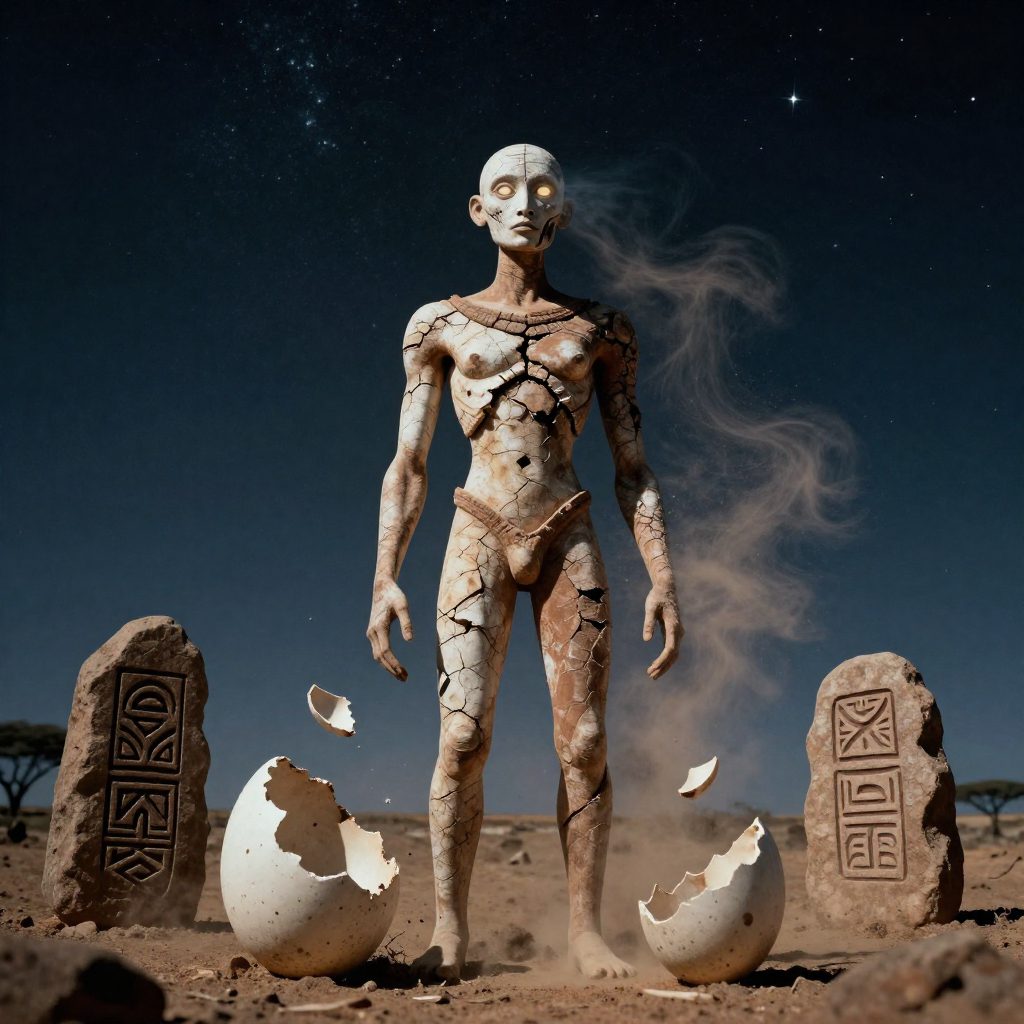
According to Dogon tradition, the universe began within Amma’s cosmic egg, a vessel of potential and rhythm. Ogo emerged prematurely from this egg, driven by impatience and a desire for autonomy. In stealing part of the egg’s substance to create his own world, Ogo disrupted the divine order before it was complete. His rebellion did not result in true creation but in sterility, barrenness, and imbalance. For the Dogon, Ogo is not evil in a simplistic sense; he is the embodiment of incompleteness, a reminder that separation from harmony leads to fragmentation. His myth functions as a cosmic explanation for chaos, human error, and the constant need for ritual restoration.
Physical Traits
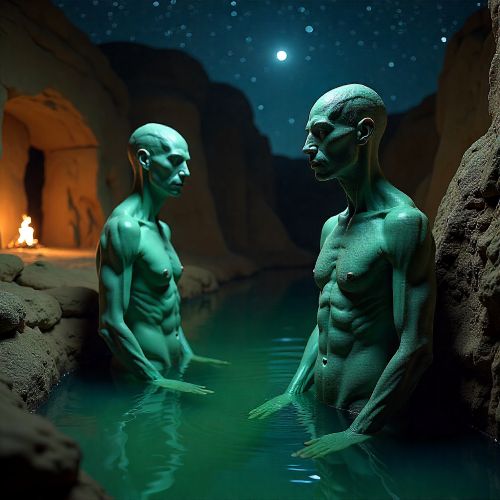
Ogo’s physical form reflects his metaphysical condition. He is consistently described as incomplete, malformed, or asymmetrical, lacking the dual balance that defines successful creation in Dogon cosmology. In mythic imagery, Ogo is associated with dryness, heat, and isolation, in stark contrast to the Nommo, who are aquatic, luminous, and regenerative. His premature birth left him without the complementary twin that grants wholeness.
Over time, Ogo becomes identified with the pale fox, an animal that wanders alone at night across the arid bushlands. The fox’s erratic movement, solitary nature, and avoidance of water mirror Ogo’s separation from cosmic order. This association is not merely symbolic. In Dogon ritual life, the pale fox is considered a living trace of Ogo’s presence, its physical tracks acting as visible signs of invisible disorder. Ogo’s body, whether imagined as primordial being or animal form, is thus a map of imbalance made flesh.
Family
Ogo’s origins place him firmly within Amma’s creative lineage, yet his story is defined by rupture rather than belonging. Amma produced the Nommo as twin beings, each pair embodying balance, speech, and life-giving order. Ogo, however, emerged alone. In some traditions, he is linked to a missing or inaccessible twin, while in others his isolation itself is the defining flaw.
This lack of relational balance places Ogo in permanent opposition to the Nommo. While they descend to Earth to teach humanity agriculture, language, and moral law, Ogo wanders the margins, unable to integrate. His estrangement is not resolved through reconciliation. Instead, Amma restores cosmic order by sacrificing a Nommo, whose dispersed body seeds life across the Earth. Ogo remains excluded from this renewal, becoming a cosmic outsider whose role is to test, disrupt, and expose fragility.
Other names
The name Yurugu is often used interchangeably with Ogo, though it carries a specific emphasis on incompleteness and deviation. While “Ogo” refers to the primordial rebel, “Yurugu” highlights his later manifestation as the pale fox, the embodied consequence of his defiance. This dual naming reflects a broader Dogon approach to myth, where beings exist across symbolic layers rather than as fixed identities.
Beyond Dogon society, Yurugu has entered African philosophical discourse as a metaphor for imbalance in human systems. Writers and scholars have used the name to describe cultural alienation, social fragmentation, and the destructive effects of forced separation from ancestral rhythms. In this way, Ogo’s name continues to evolve while retaining its core meaning as a symbol of unfinished becoming.
Powers and Abilities
Ogo’s powers are paradoxical. He cannot create life in the true sense, yet his actions shape the conditions under which life struggles, adapts, and seeks meaning. His initial theft of the cosmic substance introduces disorder into the universe, making imperfection a permanent feature of existence. This disruption is not random but structural, explaining why the world requires continual ritual correction.
One of Ogo’s most enduring influences is his relationship to language. Dogon belief holds that human speech emerged in response to chaos. Because Ogo fractured the original unity of creation, humans were forced to name, distinguish, and communicate in order to survive. In this sense, Ogo is indirectly responsible for the birth of language, even though he himself lacks the sacred speech of the Nommo.
Ogo’s presence is also central to Dogon divination. The pale fox leaves tracks overnight in ritual sand drawings, and priests interpret these markings as messages from the unseen world. Through this process, Ogo becomes an unwilling intermediary, revealing truths precisely because he stands outside harmony. His wandering nature embodies both danger and insight, showing that knowledge can emerge from disorder, though never without cost.
Modern Day Influence
Ogo remains deeply embedded in Dogon ritual life, particularly in divination practices that continue to guide social and spiritual decisions. Beyond Mali, his myth gained international attention through the work of anthropologists such as Marcel Griaule, whose recordings of Dogon cosmology sparked both fascination and scholarly debate. While some interpretations have been challenged, the central role of Ogo as a figure of imbalance remains undisputed.
In contemporary thought, Ogo is often compared to global trickster figures like Loki, Coyote, or Anansi, though his role is more cosmic than comedic. Philosophers and cultural critics have used Yurugu as a lens to discuss colonial disruption, ecological imbalance, and the dangers of progress without wisdom. In modern mythological discourse, Ogo stands as a reminder that chaos is not an external enemy but a consequence of disconnection from shared order. His relevance endures because the tension he represents has never disappeared.
Related Images
Source
Griaule, M. (1948). Dieu d’eau: Entretiens avec Ogotommêli. Éditions du Chêne.
Griaule, M., & Dieterlen, G. (1954). Le renard pâle: Légendes et mythes cosmogoniques des Dogon. Institut d’Ethnologie.
Scranton, L. (2006). The science of the Dogon: Decoding the African mystery tradition. Inner Traditions.
Temple, R. K. G. (1976). The Sirius mystery. St. Martin’s Press.
Calame-Griaule, G. (1965). Le mot et les mythes: La langue des Dogon. Maspero.
Godchecker. (2018). OGO – the Dogon God of Chaos. https://www.godchecker.com/african-mythology/OGO/
Britannica. (2025). Nommo. https://www.britannica.com/topic/Nommo
Frequently Asked Questions
Who is Ogo in Dogon belief?
Ogo is a primordial being in Dogon cosmology who represents chaos, incompleteness, and rebellion against divine order.
Why is Ogo associated with a fox?
Ogo manifests as the pale fox, symbolizing solitude, sterility, and imbalance, and serving as a medium for divination.
Is Ogo considered evil?
Ogo is not purely evil but represents disorder and the consequences of acting outside cosmic harmony.
What role does Ogo play in divination?
The tracks of the pale fox are interpreted by Dogon priests to reveal hidden truths and spiritual messages.
How is Ogo different from the Nommo?
While the Nommo embody balance, life, and sacred speech, Ogo embodies isolation, disruption, and incomplete creation.