Listen
At a glance
| Description | |
|---|---|
| Origin | Malaita Mythology |
| Classification | Spirits |
| Family Members | N/A |
| Region | Solomon Islands |
| Associated With | Ancestor, Protection |
La’aka
Introduction
La’aka occupies a powerful place in the mythology of the Kwaio people of Malaita, Solomon Islands, where ancestral spirits are not distant figures of the past but active forces shaping daily life. Remembered as both a founding ancestress and a warrior of exceptional strength, La’aka embodies the Kwaio understanding of ancestry as living authority. Her presence reflects a worldview in which lineage, land, morality, and spiritual power are inseparable. Far from being a symbolic figure alone, La’aka is treated as an adalo—an ancestral spirit whose mana continues to influence fertility, protection, and social order.
Kwaio mythology emphasizes continuity rather than spectacle. La’aka’s importance lies not in elaborate mythic adventures but in her role as a stabilizing force who established taboos, rituals, and kinship obligations that still define Kwaio identity. Through oral tradition, ritual practice, and historical movements of resistance, La’aka emerges as a figure through whom the Kwaio articulate survival, autonomy, and ancestral legitimacy in the face of colonial and modern pressures.
Physical Traits
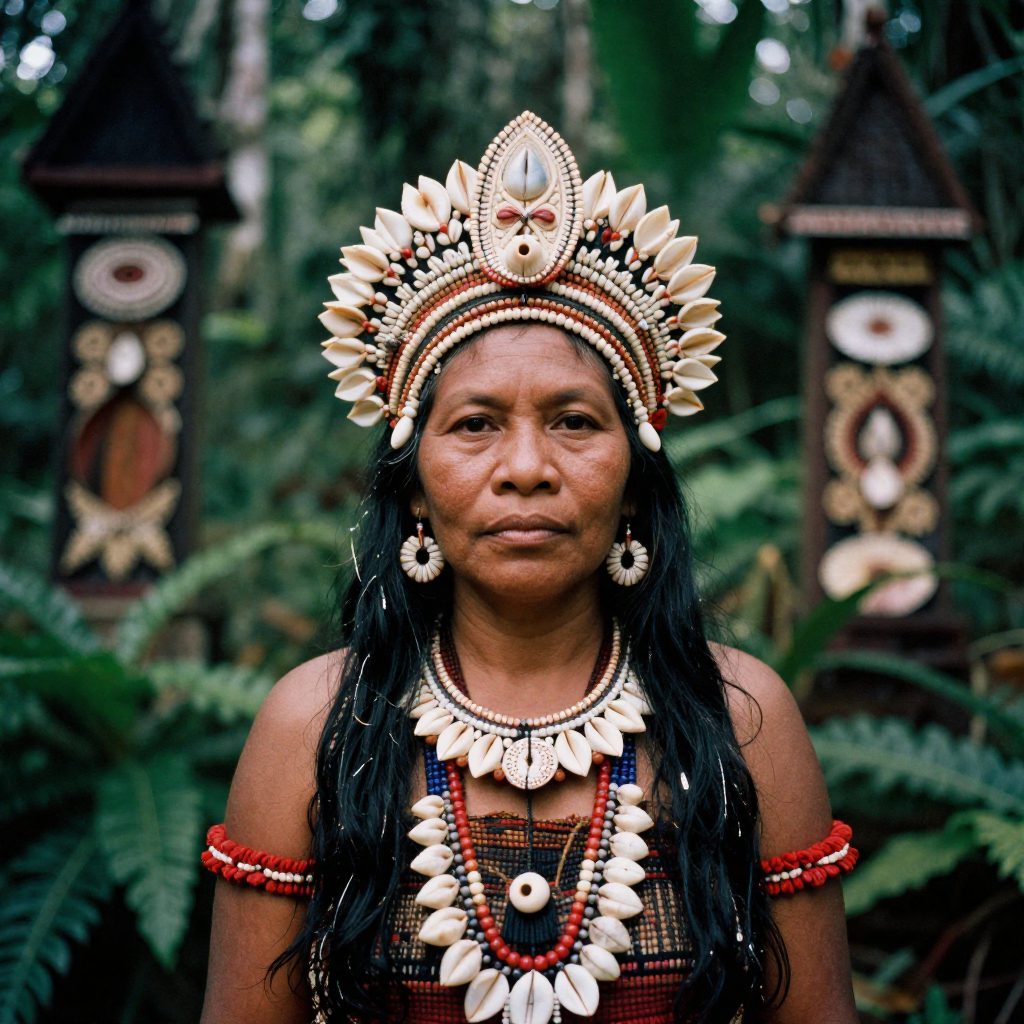
La’aka is not described through fixed physical imagery, reflecting Kwaio beliefs that ancestral spirits are encountered through experience rather than visual form. Her presence is understood through dreams, ritual sensations, omens, and the consequences of obedience or transgression. Rather than a body, La’aka manifests as authority—felt in moments of protection, illness, success, or failure.
When narratives allude indirectly to her form, they emphasize strength and dignity rather than beauty or ornamentation. She is imagined as possessing the endurance and power associated with ancestral women who labored, defended their communities, and sustained lineage continuity. This symbolic physicality reinforces her dual role as nurturer and warrior, suggesting that her strength was not exceptional despite her femininity, but because of it.
Family
La’aka belongs to the deepest genealogical layers of Kwaio society, positioned approximately twelve to twenty generations in the past. She is remembered as a foundational ancestress whose descendants continue to propitiate her through ritual observance. In Kwaio cosmology, family extends beyond blood into the spiritual realm, where ancestors remain bound to their living kin through obligation and reciprocity.
Specific details of La’aka’s immediate relatives are preserved within clan-based oral histories rather than public myth cycles. Her familial importance lies in her role as a conduit of mana passed through generations. Shrines associated with her lineage anchor land rights, purity rules, and moral conduct, reinforcing the belief that ancestry is an active contract rather than a historical record.
Other names
La’aka is consistently known by this name within Kwaio tradition and ethnographic documentation. Unlike many deities whose identities fragment across regions, La’aka retains a singular designation, emphasizing her specificity to Kwaio ancestral memory. Minor variations in pronunciation may occur across dialects, but these do not alter her identity.
Rather than possessing alternative names, La’aka is contextualized through her classification as an adalo, a category that defines her spiritual function rather than renaming her. This reinforces the Kwaio tendency to preserve ancestral figures as distinct personalities rather than abstract mythic archetypes.
Powers and Abilities
La’aka’s power is rooted in mana, the spiritual force that enables ancestors to intervene in human affairs. She is invoked for protection against illness, misfortune, and social disorder, particularly when taboos related to purity or land are threatened. Her authority extends to fertility, ensuring the productivity of both people and crops when properly honored.
As a warrior ancestress, La’aka is remembered for strength comparable to male strongmen ancestors, challenging rigid gender distinctions in spiritual authority. Her power is not only protective but corrective, manifesting as sickness or hardship when moral or ritual boundaries are violated. Through dreams and divination, she communicates approval or warning, reinforcing her role as moral arbiter.
One of the most striking demonstrations of her perceived power occurred in 1939, when a Kwaio priest named Noto’i claimed to receive prophetic messages from La’aka. She reportedly foretold the arrival of American forces who would challenge British colonial authority. Though initially dismissed, these visions later gained significance during World War II, reinforcing belief in her ability to perceive events beyond local and temporal boundaries.
Modern Day Influence
La’aka continues to shape Kwaio life in both visible and subtle ways. Among communities that maintain kastom practices, she remains a central ancestral presence invoked through ritual, sacrifice, and adherence to taboo. Her legacy reinforces resistance to cultural erasure, particularly in regions that resisted early Christian conversion.
Historically, La’aka’s prophecies contributed to anti-colonial consciousness that later intersected with movements such as Maasina Ruru. Though political expressions evolved, the spiritual authority attributed to her persisted, validating indigenous interpretations of global events. Today, scholars and cultural practitioners document her mythology as part of broader efforts to preserve Malaitan intangible heritage.
In contemporary discourse, La’aka stands as a symbol of indigenous resilience, reminding both local and global audiences that Oceanian mythology is not frozen in the past but actively engaged with history, identity, and survival.
Related Images


Source
Keesing, R. M. (1982). Kwaio religion: The living gods of Mount Keneacci. Columbia University Press.
Keesing, R. M. (1989). Creating the past: Custom, identity, and ideology in a lowland New Guinea people. Custom and identity in the contemporary Pacific.
Keesing, R. M., & Corris, P. (1980). Lightning meets the West Wind: The Malaita Massacre. Oxford University Press.
Ivens, W. G. (1911). Grammar of the language of Sa’a, Malaita, Solomon Islands. Journal of the Royal Anthropological Institute. https://www.jstor.org/stable/40443771
Wikipedia contributors. (2025). La’aka. Wikipedia. https://en.wikipedia.org/wiki/La%27aka
Wikipedia contributors. (2025). Kwaio people. Wikipedia. https://en.wikipedia.org/wiki/Kwaio_people
Wikipedia contributors. (2025). Malaita. Wikipedia. https://en.wikipedia.org/wiki/Malaita
Satomi, R. (2012). Kastom and shifting identity among the Lau in North Malaita. Japanese Society for Oceanic Studies. https://www.jstage.jst.go.jp/article/jsos/28/0/28_1/_pdf
Frequently Asked Questions
Who is La’aka in Malaita mythology?
La’aka is a revered ancestral spirit of the Kwaio people, remembered as a founding ancestress and powerful guardian whose mana continues to influence community life.
Is La’aka considered a goddess?
La’aka is not a goddess but an adalo, an ancestral spirit whose authority comes from lineage, ritual power, and ongoing spiritual presence.
What powers does La’aka possess?
She grants protection, fertility, and moral order while also punishing taboo violations through illness or misfortune.
What is La’aka’s connection to colonial history?
In 1939, La’aka was said to deliver prophecies predicting foreign intervention, later interpreted as validating indigenous resistance to colonial rule.
Is La’aka still worshipped today?
Among kastom-practicing Kwaio communities, La’aka remains honored through rituals, shrines, and ancestral observance.