


Jolakotturin : The Monster Cat
Listen
At a glance
| Description | |
|---|---|
| Origin | Icelandic Mythology |
| Classification | Animals |
| Family Members | N/A |
| Region | Iceland |
| Associated With | Christmas, Terror |
Jolakotturin
Introduction
Jólakötturinn, often called the Yule Cat, is one of Iceland’s most intriguing and fearsome Christmas legends. Unlike the cozy image of a house cat curled beside a fire, this enormous feline prowls the frozen Icelandic countryside during the Yule season, devouring or punishing those who fail to receive new clothes before Christmas Eve. Rooted in centuries of folklore, the story of Jólakötturinn reflects Iceland’s harsh winters, the value placed on hard work, and the importance of community effort in pre-industrial life. The myth’s enduring appeal lies in its eerie blend of morality and seasonal menace, where the cat’s sharp claws serve as a reminder that diligence and generosity were essential for survival during the long northern nights.
The legend gained wide recognition through the poet Jóhannes úr Kötlum’s 1932 poem Jólakötturinn, which vividly captured the terror of this monstrous cat. While earlier oral versions emphasized its role as a cautionary tale to encourage industriousness in the wool harvest season, later adaptations transformed it into a beloved yet intimidating symbol of Icelandic Christmas culture.
Physical Traits
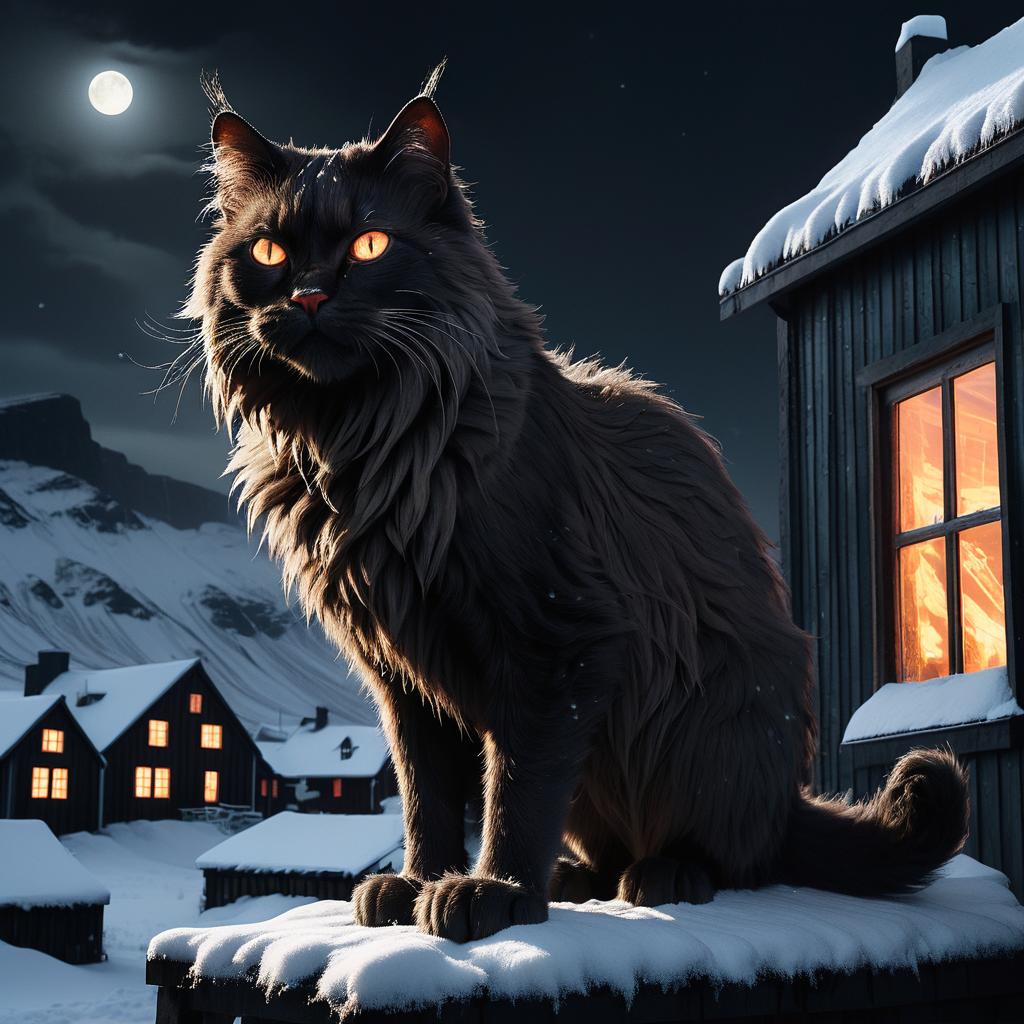
Jólakötturinn is described as a creature of night and snow—huge, black, and terrifyingly majestic. Its fur is thick and shadowy, helping it blend into the winter darkness, while its glowing eyes pierce through the blizzards like two burning embers. Legends say it can grow as large as a house, towering over rooftops as it peers through windows to inspect who has received new garments. Its claws are razor-sharp, its teeth capable of tearing through wood and flesh, and its long tail moves like a whip in the icy wind.
Some tales suggest that Jólakötturinn’s size and appearance can shift according to circumstance: in distant shadows, it might appear merely as a large domestic cat, but as it draws closer, it grows into a monstrous predator that embodies the harshness of winter itself. The creature’s stealth is legendary—it makes no sound on the snow, leaving behind only giant paw prints that villagers dread to see near their homes.
Family
Though Jólakötturinn is a formidable figure on its own, it is often linked to Iceland’s most infamous mythological family. The cat is said to belong to Grýla, a monstrous ogress who lives in the mountains and comes down during Christmas to capture naughty children in her sack. She is the mother of the Yule Lads—thirteen mischievous figures who visit Icelandic homes during the thirteen nights before Christmas.
In many modern retellings, Jólakötturinn acts as Grýla’s pet and enforcer, mirroring her appetite for punishing laziness and bad behavior. While Grýla feasts on misbehaving children, the Yule Cat preys on those who fail to receive new clothes, symbolizing negligence or idleness. Some versions even claim that the smallest of the Yule Lads, Stúfur, is the only one capable of taming or riding the ferocious cat. Together, these characters form a darkly comic yet moralistic pantheon that balances Iceland’s Christmas celebrations with a reminder of consequence and effort.
Other names
In Icelandic, the creature’s name—Jólakötturinn or Jólaköttur—literally translates to “Yule Cat.” The word Jól refers to the Yule season, an ancient midwinter festival later associated with Christmas, and kötturinn means “the cat.” In English sources, it is most commonly called the “Yule Cat,” though the “Christmas Cat” occasionally appears in translations or popular retellings.
While the Yule Cat is unique to Iceland, scholars have noted similarities between its legend and European tales of midwinter beasts that reward good behavior and punish laziness—such as Krampus in Central Europe or the Perchten of Alpine folklore. However, Jólakötturinn’s association with clothing, work, and the wool industry makes it distinctly Icelandic, a reflection of the country’s deep connection to textiles and self-sufficiency.
Powers and Abilities
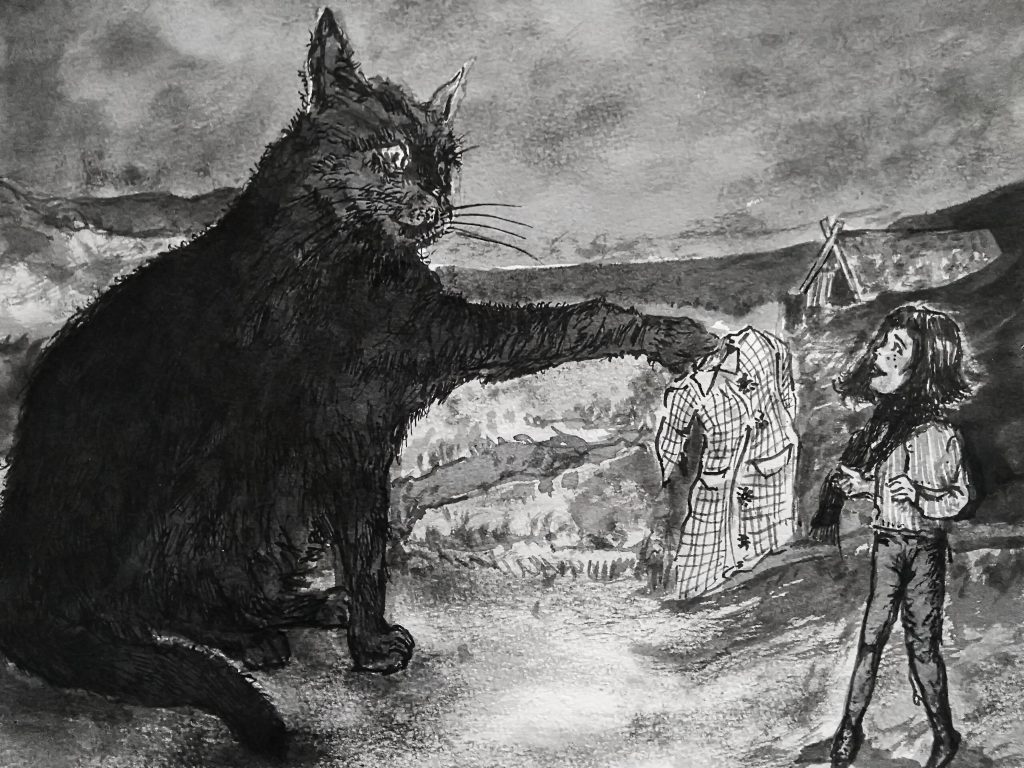
Jólakötturinn’s powers are less about magical spells and more about its supernatural strength, enormous size, and moral discernment. It possesses an uncanny ability to detect who has received new clothes before Christmas Eve—a test of both effort and generosity. Those who worked hard in the autumn wool harvest were rewarded with warm garments, while those who were lazy or left unrewarded became targets for the Yule Cat’s wrath.
Older accounts claim the cat devours these unfortunate souls whole, while later and gentler versions suggest it merely steals their Christmas food. In either form, the cat’s judgment serves a social function: to ensure everyone contributes to winter preparations and that no one is left without new clothing. In this sense, Jólakötturinn represents the moral order of the season—punishing sloth while reinforcing community responsibility.
The cat’s supernatural abilities are further enhanced by its keen senses and silent movement. It can traverse vast snowy landscapes in moments, appearing suddenly and vanishing without a trace. In some interpretations, it symbolizes nature’s watchful eye—an embodiment of winter’s relentless scrutiny, where laziness could mean death in the cold north.
Modern Day Influence
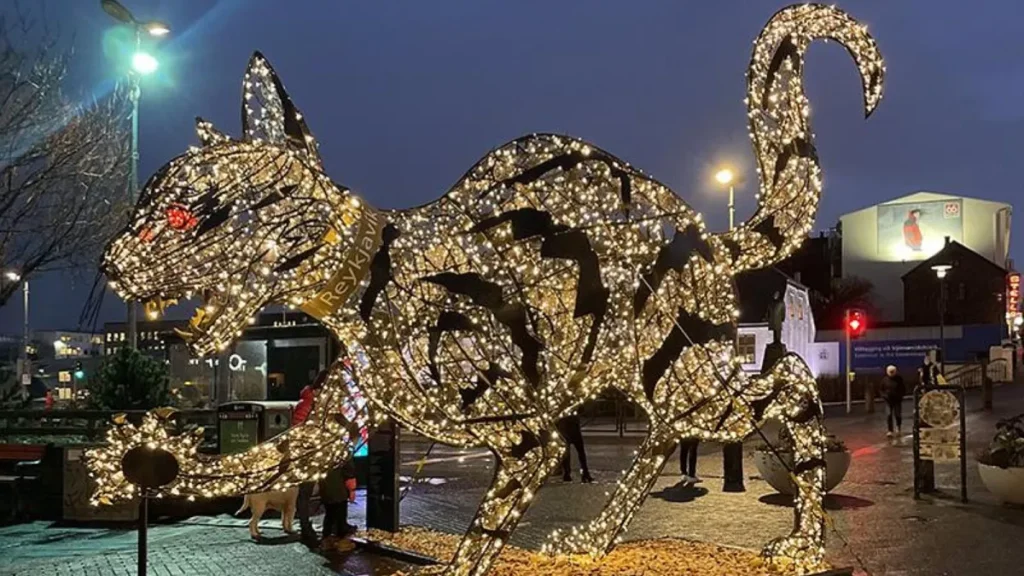
Despite its frightening origins, Jólakötturinn has become a beloved icon in modern Iceland. Since Jóhannes úr Kötlum’s 1932 poem reintroduced the tale to a new generation, the Yule Cat has appeared in countless songs, books, and holiday decorations. One of the most striking tributes to the creature is the enormous illuminated sculpture displayed in Reykjavík’s city center each Christmas—a five-meter-tall iron structure that draws tourists and locals alike.
In Icelandic homes, the Yule Cat’s story is often told to children not to frighten them, but to encourage generosity and a sense of participation. Families ensure everyone receives at least one new piece of clothing for Christmas, keeping the tradition alive in a symbolic form. Musicians, including Iceland’s own Björk, have adapted the tale into songs, while authors and filmmakers continue to reinterpret it as part of Iceland’s broader mythology of winter spirits.
In global culture, Jólakötturinn has begun to gain recognition alongside other winter legends like Krampus and Frau Perchta. It appears in documentaries, holiday articles, and folklore anthologies, often highlighting Iceland’s unique blend of dark humor and moral storytelling. The creature’s image—half terrifying, half endearing—has also become a popular motif in Christmas markets and souvenirs, representing Iceland’s ability to balance folklore, creativity, and cultural pride.
While few today truly fear being devoured for lacking new clothes, the story of Jólakötturinn continues to carry moral weight. It speaks to themes of diligence, compassion, and the importance of providing for others—a message that remains relevant even in modern, comfortable societies. The Yule Cat may no longer prowl the Icelandic countryside, but its shadow lingers in every warm sweater given at Christmas, every shared story by the fire, and every reminder that kindness and hard work still ward off the cold.
Related Images


Source
Wikipedia. (2023, November 29). Yule cat. https://en.wikipedia.org/wiki/Yule_cat
HistoryExtra. (2024, December 18). What Is Iceland’s Yule Cat? History & Origins Of The … https://www.historyextra.com/period/general-history/yule-cat-iceland-christmas-jolakotturinn/
Folklore.usc.edu. (2017, March 11). The Jólakötturinn. https://folklore.usc.edu/the-jolakotturinn/
Neal, R. (n.d.). Blood on the Snow. http://www.rickneal.ca/public/Blood%20on%20the%20Snow.pdf
Jóhannes úr Kötlum. (1932). Jólin koma (Poetry collection).
Ingibjörg Þorbergs. (ca. 1970). Songs based on Jóhannes úr Kötlum’s poems.
Reykjavík Grapevine. (2008). Article on the Yule Cat.
Reddit. (n.d.). TIL about Jólakötturinn. https://www.reddit.com/r/todayilearned/comments/dtln9a/til_about_j%C3%B3lak%C3%B6tturinn_the_icelandic_yule_cat/
Frequently Asked Questions
What is lorem Ipsum?
I am text block. Click edit button to change this text. Lorem ipsum dolor sit amet, consectetur adipiscing elit. Ut elit tellus, luctus nec ullamcorper mattis, pulvinar dapibus leo.
What is lorem Ipsum?
I am text block. Click edit button to change this text. Lorem ipsum dolor sit amet, consectetur adipiscing elit. Ut elit tellus, luctus nec ullamcorper mattis, pulvinar dapibus leo.
What is lorem Ipsum?
I am text block. Click edit button to change this text. Lorem ipsum dolor sit amet, consectetur adipiscing elit. Ut elit tellus, luctus nec ullamcorper mattis, pulvinar dapibus leo.
What is lorem Ipsum?
I am text block. Click edit button to change this text. Lorem ipsum dolor sit amet, consectetur adipiscing elit. Ut elit tellus, luctus nec ullamcorper mattis, pulvinar dapibus leo.
What is lorem Ipsum?
I am text block. Click edit button to change this text. Lorem ipsum dolor sit amet, consectetur adipiscing elit. Ut elit tellus, luctus nec ullamcorper mattis, pulvinar dapibus leo.
