


Jayadratha : The Unscrupulous Warrior
Listen
At a glance
| Description | |
|---|---|
| Origin | Indian Mythology |
| Classification | Mortals |
| Family Members | Vriddhakshatra (Father), Dushala (Wife), Duryodhana, Dushasana and Kauravas (Brothers in Law) |
| Region | India |
| Associated With | Cheating, Dishonour, Humiliation |
Jayadratha
Introduction
Jayadratha (Sanskrit: जयद्रथ) stands as one of the most fascinating yet controversial characters in the Mahabharata. Known as the king of the Sindhu kingdom, his story weaves together ambition, betrayal, divine intervention, and an inescapable destiny. His most infamous act—blocking the Pandavas from rescuing Abhimanyu in the Chakravyuha formation—etched his name into the darker side of the epic. Yet, Jayadratha’s presence goes beyond that single episode. From his marriage to Dushala, the sister of the Kauravas, to the divine boon that shielded him from ordinary death, his life is a study of political strategy, human frailty, and cosmic justice. Over centuries, Jayadratha’s tale has been retold in poetry, art, and performance, where he often emerges as a tragic figure caught between power and fate.
Physical Traits
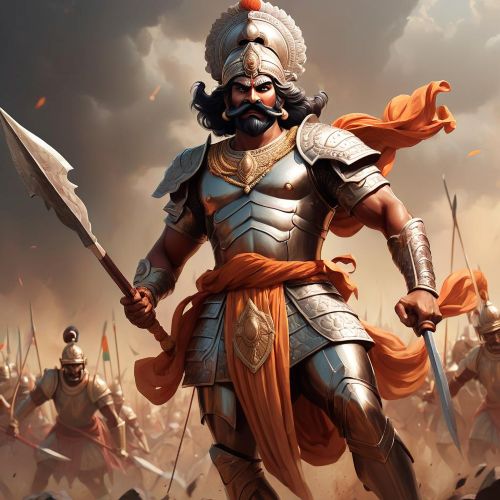
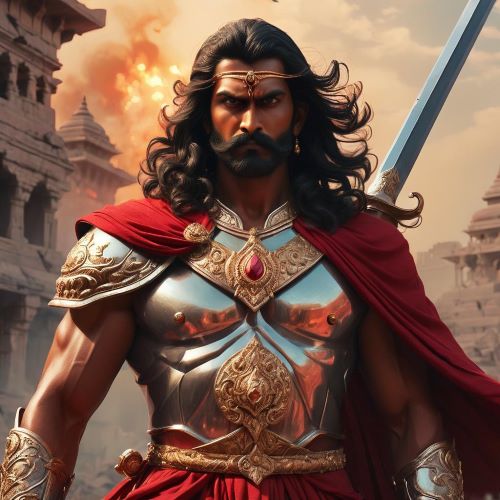
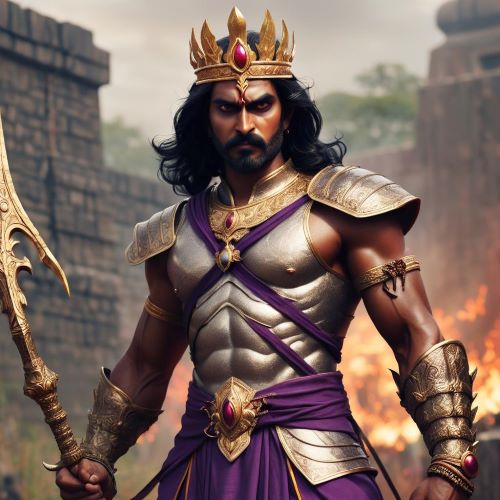
Descriptions of Jayadratha’s physical appearance are scattered in the Mahabharata, offering glimpses of his royal stature. As a warrior king, he was portrayed as tall and commanding, often seen with a mighty bow in hand. His eyes are described as large and striking, enhancing his regal aura on the battlefield. After his failed attempt to abduct Draupadi, however, he was humiliated when Bhima shaved his head, leaving only five tufts of hair—a disfigurement that became a permanent mark of dishonor. Despite this, Jayadratha’s presence on the battlefield remained formidable, his physique strong enough to withstand assaults from the greatest warriors of the time. Clad in armor and adorned with garlands, he was a symbol of martial pride, even as his scarred appearance reminded others of his earlier disgrace.
Family
Jayadratha’s family ties added significant weight to his position in the Mahabharata. He was the son of Vriddhakshatra, who had performed severe penance to gain a divine boon ensuring that Jayadratha could not be slain easily. His marriage to Dushala, the beloved sister of the Kauravas, tied him directly to the central conflict of the epic, making him not just an ally but family to the Kauravas. The union strengthened his political influence, extending his reach beyond Sindhu to the Kuru dynasty. Jayadratha also fathered a son named Suratha, who carried forward his lineage after his tragic death. His other marriages to princesses from Gandhara and Kamboja suggest that Jayadratha used alliances to expand his sway across northwestern India, embodying the archetype of a ruler who fused politics with kinship.
Other names
In the Mahabharata, Jayadratha is not confined to a single identity but is remembered by many names. He is often referred to as Saindhava, denoting his sovereignty over Sindhu, and Sauvīraja, acknowledging his rule over Sauvīra. At times, he is called Saindhavaka, a term used in poetic stylizations of his story. In some traditions, he was initially named Vasusena before adopting the name Jayadratha, meaning “he who possesses mighty chariots.” These names are not just linguistic variations but reflect the layered identity of a king whose reputation stretched across kingdoms and cultures. Through these epithets, Jayadratha’s legacy was woven into regional lore, ensuring that his memory was tied to both geography and destiny.
Powers and Abilities
Jayadratha’s strengths were not limited to human skill; they were fortified by divine protection. His father’s penance earned him a powerful boon: if anyone caused Jayadratha’s head to fall to the ground, their own head would shatter into a thousand pieces. This supernatural safeguard made him nearly invincible, ensuring that his slayer would have to resort to extraordinary means. As a warrior, Jayadratha was a capable strategist, commanding ten kingdoms with Sindhu as his crown jewel. His martial skills were evident when he successfully resisted the advances of Bhima, Yudhishthira, Nakula, and Sahadeva on the battlefield. His most infamous act came on the thirteenth day of the Kurukshetra war when he blocked the Pandavas from rescuing Abhimanyu, sealing the young warrior’s fate inside the Chakravyuha. It was this act that enraged Arjuna, who swore a vow to kill Jayadratha before sunset the next day—a vow fulfilled through Krishna’s divine guidance when Jayadratha’s head was sent flying into his father’s lap, thereby bypassing the deadly boon.
Modern Day Influence
The story of Jayadratha continues to resonate in modern culture, where he is often portrayed as a symbol of betrayal, ambition, and tragic downfall. In literature, his role has been reinterpreted in nationalist writings, particularly during the late colonial period when poets like Maithilisharan Gupta drew parallels between Abhimanyu’s sacrifice and freedom struggles, casting Jayadratha as a metaphorical obstacle to liberation. On screen, Jayadratha has been immortalized in popular adaptations of the Mahabharata, most famously in B.R. Chopra’s television epic, where actor Deep Dhillon’s performance gave him enduring recognition. In art, painters like Raja Ravi Varma depicted the episode of Draupadi’s attempted abduction, fixing Jayadratha’s image as a man driven by misguided desire.
In contemporary discourse, Jayadratha is sometimes invoked as an archetype of misplaced ambition, where political calculations lead to disastrous consequences. His story has inspired discussions in management studies and leadership training, often framed as the “Jayadratha Syndrome,” referring to those who overestimate their power without accounting for fate and larger forces at play. In digital storytelling, Jayadratha appears in video games, web series, and AI-driven narratives exploring Mahabharata characters, keeping his name alive for new generations. Ultimately, Jayadratha endures as a reminder that power without humility invites destruction, and that even kings cannot escape destiny.
Related Images


Source
Wikipedia contributors. (2025). Jayadratha. Wikipedia. Retrieved August 29, 2025, from https://en.wikipedia.org/wiki/Jayadratha
Hinduism Facts. (2025, April 11). Jayadratha – The Story of the King of Sindhu Kingdom. Retrieved August 29, 2025, from https://hinduismfacts.org/jayadratha/
Mahakaal. (2021, April 27). The Complete Story Of Jayadratha – The King Of Sindhu Kingdom. Hindu FAQs. Retrieved August 29, 2025, from https://www.hindufaqs.com/the-complete-story-of-jayadratha-%E0%A4%9C%E0%A4%AF%E0%A4%A6%E0%A5%8D%E0%A4%B0%E0%A4%A5-the-king-of-sindhu-kingdom/
Govinda Bhat K. (2024). Mahabharat: Jayadratha Vadha Parva – Gomangala. https://gomangala.com/index.php/2024/06/13/mahabharat-jayadratha-vadha-parva/
Jayadratha – Vyasa Mahabharata. (n.d.). https://www.vyasaonline.com/encyclopedia/jayadratha/
Jayadratha – Giri USA. (n.d.). https://giriusa.com/products/jayadratha?srsltid=AfmBOop34jgaFFYxyx-77qnu1XoSDCkU1BtyIbVaMr0lpz3BqKXXVW29
Frequently Asked Questions
What is lorem Ipsum?
I am text block. Click edit button to change this text. Lorem ipsum dolor sit amet, consectetur adipiscing elit. Ut elit tellus, luctus nec ullamcorper mattis, pulvinar dapibus leo.
What is lorem Ipsum?
I am text block. Click edit button to change this text. Lorem ipsum dolor sit amet, consectetur adipiscing elit. Ut elit tellus, luctus nec ullamcorper mattis, pulvinar dapibus leo.
What is lorem Ipsum?
I am text block. Click edit button to change this text. Lorem ipsum dolor sit amet, consectetur adipiscing elit. Ut elit tellus, luctus nec ullamcorper mattis, pulvinar dapibus leo.
What is lorem Ipsum?
I am text block. Click edit button to change this text. Lorem ipsum dolor sit amet, consectetur adipiscing elit. Ut elit tellus, luctus nec ullamcorper mattis, pulvinar dapibus leo.
What is lorem Ipsum?
I am text block. Click edit button to change this text. Lorem ipsum dolor sit amet, consectetur adipiscing elit. Ut elit tellus, luctus nec ullamcorper mattis, pulvinar dapibus leo.

Roma Ondricka
Wow superb blog layout How long have you been blogging for you make blogging look easy The overall look of your site is magnificent as well as the content
Woodrow Nicolas
Hey there You have done a fantastic job I will certainly digg it and personally recommend to my friends Im confident theyll be benefited from this site
Chelsie Howe
Your blog is a true hidden gem on the internet. Your thoughtful analysis and in-depth commentary set you apart from the crowd. Keep up the excellent work!