Listen
At a glance
| Description | |
|---|---|
| Origin | Scottish Mythology |
| Classification | Spirits |
| Family Members | N/A |
| Region | Scotland |
| Associated With | Seduction, Blood-drinking, Illusion |
Baobhan Sith
Introduction
The Baobhan Sith is one of the most unsettling supernatural figures to emerge from Scottish Highland folklore. Pronounced baa-van shee, the name is commonly translated as “fairy woman,” though this gentle meaning hides a far darker reality. These beings belong to the shadowed edges of Celtic fairy belief, where beauty and danger exist in perfect balance. Unlike benevolent fair folk, the Baobhan Sith is a nocturnal predator, often compared to vampires or succubi due to its reliance on seduction and blood-drinking.
Traditional tales place the Baobhan Sith deep within forests, glens, and remote hunting lodges, where isolation makes humans vulnerable. Stories frequently involve hunters or travelers seeking shelter at night, only to encounter enchanting women who dance, sing, or offer companionship before revealing their lethal nature. These narratives reflect long-standing cultural anxieties surrounding temptation, wilderness, and the peril of straying from communal safety. Rooted in oral tradition, the Baobhan Sith occupies a liminal space between fairy lore and early vampiric mythology, making it one of Scotland’s most enduring supernatural legends.
Physical Traits
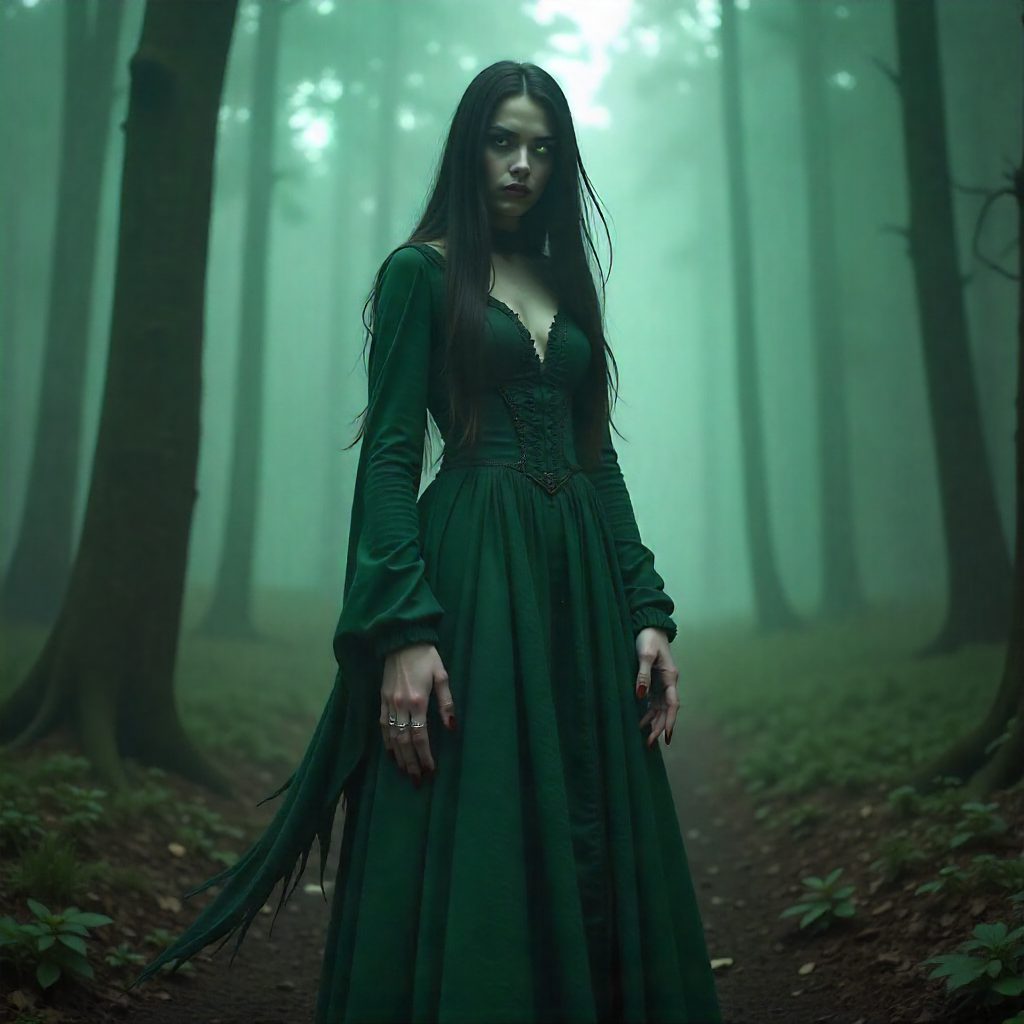
The Baobhan Sith is almost always described as breathtakingly beautiful, appearing as a young woman with pale skin, long flowing hair, and an otherworldly elegance that immediately draws attention. Their clothing is traditionally green, a colour strongly associated with fairy beings in Celtic belief, symbolising their connection to the Otherworld. This beauty is not incidental but essential to their survival, as it functions as the primary lure for unsuspecting victims.
Despite their flawless appearance, folklore often includes subtle physical markers that betray their true nature. The most famous of these is their feet, which are said to resemble the hooves of a deer. These hooves are typically concealed beneath long dresses or only revealed to those observant enough to notice. Unlike later vampire traditions, the Baobhan Sith does not possess fangs. Instead, it uses elongated, razor-sharp nails to tear into flesh and drink blood directly. This physicality reinforces their identity as a fairy predator rather than an undead corpse.
Family
The Baobhan Sith does not possess a defined familial structure within Scottish folklore. Unlike ancestral spirits or household fairies, they are not linked to bloodlines, clans, or inherited roles. They are most often portrayed as solitary hunters or, in some stories, appearing in small, loosely connected groups without kinship ties.
Rather than family in the human sense, the Baobhan Sith is associated with the broader fairy world known as the Sìth. They are frequently aligned with darker fairy traditions, sometimes connected to the Unseelie Court, which encompasses hostile or dangerous fairy beings. Some later interpretations suggest they may be cursed human women transformed through magic or supernatural punishment, but these versions are inconsistent and not part of the earliest recorded traditions. Overall, their lack of lineage reinforces their role as isolated predators rather than social beings.
Other names
The name Baobhan Sith originates from Scottish Gaelic, where baobh can imply a hag, witch, or dangerous woman, and sìth refers to fairy folk. Variations in spelling, including baobh-shìth and baobhan-sìdh, exist due to the oral nature of the tradition and regional dialects across the Highlands.
They are sometimes loosely referred to as fairy witches or fairy women, though such labels can blur important distinctions. While often compared to banshees, the two are fundamentally different. The banshee is a herald of death, not a cause of it, whereas the Baobhan Sith actively hunts and kills. In modern retellings, they are occasionally described as Highland succubi or fairy vampires, terms that reflect interpretation rather than traditional naming.
Powers and Abilities
The defining power of the Baobhan Sith is its supernatural ability to enchant and seduce. Victims are often compelled to dance or engage socially until exhaustion leaves them defenceless. This charm is not merely physical but psychological, overwhelming human will through glamour and illusion.
Once a victim is vulnerable, the Baobhan Sith drains their blood using its claws. Blood is believed to sustain and rejuvenate them, reinforcing their vampiric qualities. Many tales suggest they can appear suddenly or vanish into mist, hinting at limited shapeshifting or illusionary movement. Their activities are strictly nocturnal, and dawn marks the end of their hunt.
Traditional folklore consistently states that iron serves as a powerful deterrent. Iron weapons, horseshoes, or iron-shod horses are often the only means of protection or escape. Christian prayers or invoking divine protection also appear in later stories, reflecting the blending of pagan and Christian belief systems in Scotland.
Modern Day Influence
The Baobhan Sith continues to exert a strong influence on modern fantasy and horror storytelling. It appears in novels, role-playing games, podcasts, and digital media as a vampiric fae figure that bridges Celtic folklore and global supernatural archetypes. Contemporary depictions often emphasise its elegance and lethality, portraying it as both alluring and monstrous.
In modern cultural analysis, the Baobhan Sith is frequently reinterpreted through feminist and psychological lenses, representing fears surrounding desire, autonomy, and the dangers of misjudging appearances. Its deep association with wild landscapes also allows it to function as a symbol of nature’s indifference to human vulnerability. The continued popularity of the Baobhan Sith demonstrates how ancient folklore adapts seamlessly into modern storytelling without losing its original menace.
Related Images
Source
Mackenzie, D. A. (1935). Scottish folk-lore and folk life: Studies in race, custom and tradition. Blackie & Son Limited.
Chadbourn, M. (2001-2003). The age of Misrule trilogy. Tor Books.
Harper, C. (2023). Desire and blood: The complete Baobhan Sith trilogy. Independently published.
Spooky Scotland. (2023, July 27). Baobhan Sith. https://spookyscotland.net/baobhan-sith/
Connect Paranormal. (2024, January 6). Scotland’s Baobhan Sith: The vampire of the Highlands. https://connectparanormal.net/2024/01/06/scotlands-baobhan-sith-the-vampire-of-the-highlands/
Wikipedia contributors. (2025). Baobh-shìth. Wikipedia. https://en.wikipedia.org/wiki/Baobhan-sìth
Briggs, K. M. (1976). An encyclopedia of fairies: Hobgoblins, brownies, bogies, and other supernatural creatures. Pantheon Books.
Monaghan, P. (2004). The encyclopedia of Celtic mythology and folklore. Facts on File.
Fraser, C. (2025, April 26). Baobhan Sith – Unveiling Scotland’s Haunting Legends of the Night. Scotland’s Enchanting Kingdom. https://www.scotlands-enchanting-kingdom.com/baobhan-sith/
Frequently Asked Questions
Is the Baobhan Sith a vampire?
The Baobhan Sith is not an undead vampire but a fairy being that drinks blood, making it a unique precursor to later vampiric legends.
How do you protect yourself from a Baobhan Sith?
Scottish folklore states that iron weapons, iron horseshoes, and divine prayers can repel or protect against a Baobhan Sith.
What does Baobhan Sith mean?
The name comes from Scottish Gaelic and roughly translates to “dangerous fairy woman” or “fairy witch.”
Are Baobhan Sith related to banshees?
No, banshees are messengers of death, while Baobhan Sith actively hunt and kill their victims.
Where are Baobhan Sith said to live?
They are traditionally associated with remote Highland forests, glens, and isolated hunting shelters.