

Aspidochelone : The Island Turtle
Listen
At a glance
| Description | |
|---|---|
| Origin | Greek Mythology |
| Classification | Animals |
| Family Members | N/A |
| Region | Greece |
| Associated With | Illusion, Island |
Aspidochelone
Introduction
The Aspidochelone is one of the most fascinating creatures of medieval and classical lore, blending natural observation with mythic imagination. First recorded in the Physiologus, a Greek didactic text from the 2nd century AD, the creature was described as a sea monster so vast it could be mistaken for an island. Its name comes from the Greek words aspis—meaning either “shield” or “asp” (snake)—and chelone, meaning “turtle.” The name can thus be translated as “shield turtle” or “asp turtle,” reflecting its ambiguous identity as both protective and dangerous.
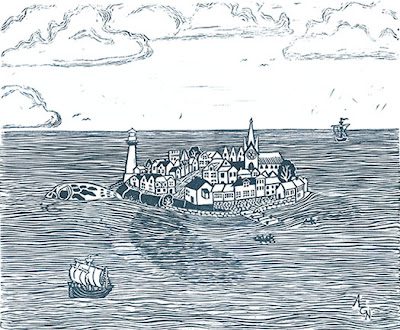
The story of the Aspidochelone quickly spread across Europe and the Middle East, entering medieval bestiaries where it became an allegory for spiritual deception. The core tale describes sailors landing on what appears to be solid ground, only to realize too late that they have set foot on the back of a living beast. Once they build fires or anchor their ships, the creature plunges into the depths, dooming them to watery graves. This motif—an island that turns out to be a monster—has appeared in Irish, Norse, and Arabic traditions, cementing the Aspidochelone as a universal symbol of the sea’s treacherous illusions.
Physical Traits
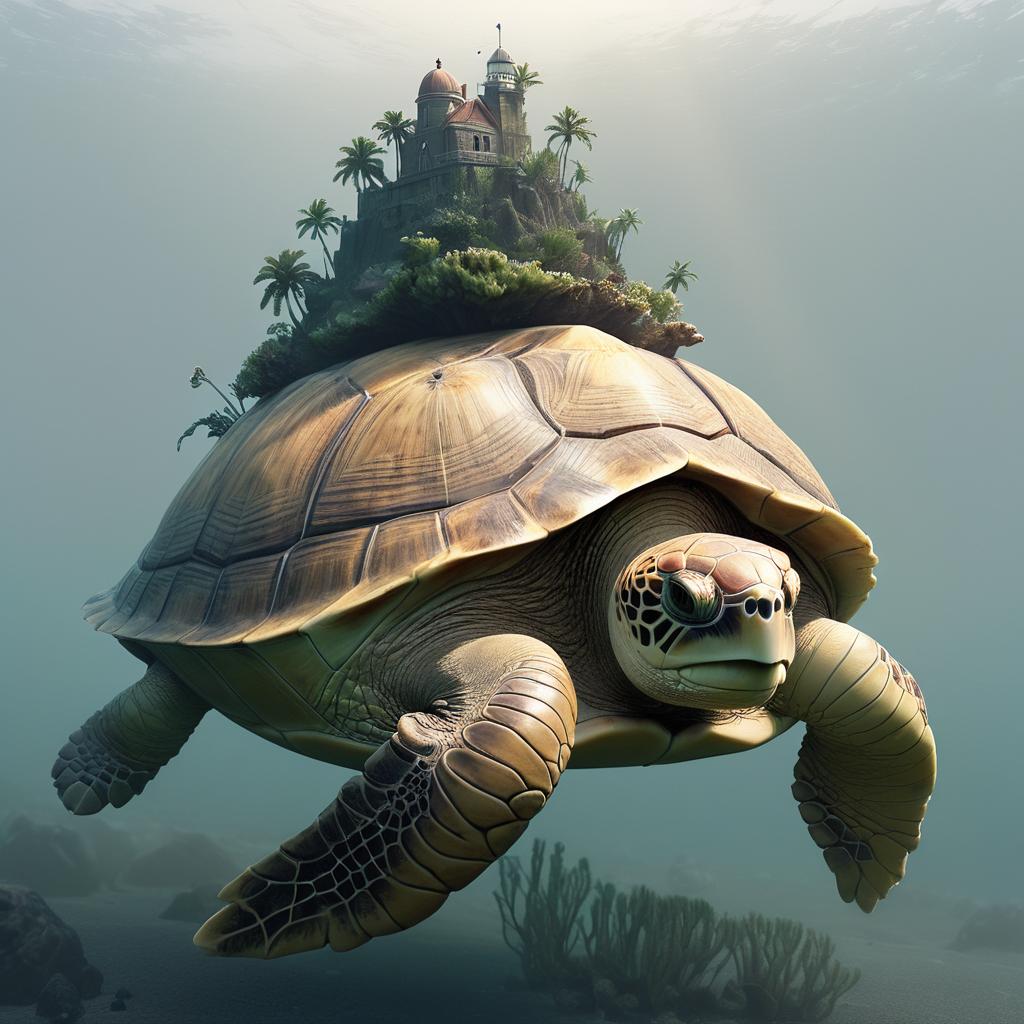
The defining characteristic of the Aspidochelone is its deceptive resemblance to an island. Ancient and medieval sources describe its shell or back as rocky, mottled, and covered with vegetation. Over time, debris, soil, and even trees were said to take root on its surface, making the illusion even more convincing. Some accounts add spines or ridges along its body, features that would make it look like a rugged, mountainous landscape from afar.
Its sheer size is emphasized in every retelling. While no fixed measurements exist, descriptions compare it to mountains or entire landmasses. Its enormity meant it could carry not just sailors but whole ecosystems on its back. In certain bestiaries, it is also said to exhale a fragrant smell that lured fish into its mouth, combining camouflage with predatory cunning.
Unlike other monstrous sea beings like the Leviathan or Kraken, the Aspidochelone does not rely on direct aggression. Its greatest weapon is stillness, letting its prey come to it, only to ensnare them in a catastrophic act of submersion.
Family
The Aspidochelone does not belong to a mythological family tree in the same way that Greek gods or Norse giants do. Instead, it is part of a broader tradition of deceptive island-creatures. One of the closest parallels is the Jasconius, a giant fish described in the Voyage of Saint Brendan, where monks mistakenly celebrate Mass on its back. In the Middle East, the Zaratan appears in The Thousand and One Nights, with sailors meeting similar fates. Scandinavian tales mention enormous sea beasts that capsize ships in comparable ways.
Pliny the Elder’s Natural History also records gigantic marine creatures, such as the pristis, where sailors misinterpret their immense bulk as floating land. These overlapping stories suggest that the Aspidochelone is not a standalone myth but part of a larger network of maritime cautionary tales, reflecting sailors’ real fears of the unknown ocean and its hidden dangers.
Other names
The Aspidochelone is known by many names, each reflecting linguistic shifts and cultural reinterpretations. In Greek, Aspidokhelone was the original form, which over time morphed into variations such as Aspidocalon, Aspidodelone, and Aspidochelys in Latinized texts. In medieval English manuscripts, scribes rendered it as Aspidochelon or Aspidechelone.
In some Christian bestiaries, it is called the Devil Whale, a direct symbol of Satan’s deceit. Guillaume de Clerc in the 13th century referred to it as Cetus, while Bartholomaeus Anglicus used the term Bellua, both emphasizing its monstrous identity rather than its turtle-like qualities. In Anglo-Saxon literature, the name Fastitocalon emerges, notably in the Old English poem The Whale, where the creature serves as a warning against false security. These variations highlight how the same myth was adapted to different cultural and theological contexts, each emphasizing either its natural wonder or its allegorical danger.
Powers and Abilities
The Aspidochelone’s most infamous ability is its power of deception. By appearing as an island, it creates a false sense of safety that draws sailors into peril. Its camouflage is both visual and ecological: its back looks like rocky terrain, sometimes even supporting grass or trees, while its immense size makes the illusion convincing enough to fool entire crews.
Beyond its disguise, some texts grant the creature additional powers. The Physiologus mentions its ability to release a sweet aroma, attracting fish into its open mouth. This predatory trickery reinforces its role as a passive but deadly hunter. In Christian allegory, this becomes symbolic of temptation, where sinners are lured in by apparent sweetness before destruction.
Some modern interpretations, especially in fantasy literature and gaming, expand on its attributes. These versions imagine the Aspidochelone as possessing extraordinary longevity, psychic empathy with the ecosystems on its back, or even control over weather and tides. While these embellishments are not part of the medieval record, they demonstrate how flexible and imaginative the myth has become in recent retellings.
Modern Day Influence
Though not as famous as Leviathan or Kraken, the Aspidochelone has left a significant imprint on culture and continues to inspire creative works. In medieval Europe, woodcuts and manuscripts often depicted the creature with ships anchored on its back or sailors cooking over fires, moments before disaster struck. These images carried both entertainment and moral lessons, warning against misplaced trust.
In literature, J.R.R. Tolkien revived the creature in The Adventures of Tom Bombadil, where he includes a poem about the Fastitocalon, preserving the medieval tradition in his Middle-earth mythology. Michael Ende references a similar creature in The Neverending Story, while its likeness has appeared in modern video games such as The Legend of Zelda: Majora’s Mask. In the anime Naruto, the giant turtle-island motif is also used, showing its influence in Japanese pop culture.
The motif has also inspired storytelling in animation. In Avatar: The Last Airbender, the Lion Turtle serves as both an island and a wise ancient being, echoing the Aspidochelone’s dual nature as landform and creature. Even in contemporary theological studies, the Aspidochelone is revisited as a symbol of false refuge, deception, and the dangers of misplaced faith.
Its adaptability across cultures and genres demonstrates the timelessness of its themes. Whether in medieval sermons or modern entertainment, the Aspidochelone continues to embody the human fear of appearances that conceal danger, particularly in the vast and mysterious ocean.
Related Images






Source
Wikipedia contributors. (2025). Aspidochelone. Wikipedia. Retrieved from https://en.wikipedia.org/wiki/Aspidochelone
Mythical Encyclopedia. (2025). Aspidochelone (Mythical Creature). Retrieved from https://mythicalencyclopedia.com/aspidochelone/
Mythical Creatures Info. (2025). Aspidochelone – Deceptive island-turtle. Retrieved from https://mythicalcreatures.info/characters/aspidochelone/
Frequently Asked Questions
What is lorem Ipsum?
I am text block. Click edit button to change this text. Lorem ipsum dolor sit amet, consectetur adipiscing elit. Ut elit tellus, luctus nec ullamcorper mattis, pulvinar dapibus leo.
What is lorem Ipsum?
I am text block. Click edit button to change this text. Lorem ipsum dolor sit amet, consectetur adipiscing elit. Ut elit tellus, luctus nec ullamcorper mattis, pulvinar dapibus leo.
What is lorem Ipsum?
I am text block. Click edit button to change this text. Lorem ipsum dolor sit amet, consectetur adipiscing elit. Ut elit tellus, luctus nec ullamcorper mattis, pulvinar dapibus leo.
What is lorem Ipsum?
I am text block. Click edit button to change this text. Lorem ipsum dolor sit amet, consectetur adipiscing elit. Ut elit tellus, luctus nec ullamcorper mattis, pulvinar dapibus leo.
What is lorem Ipsum?
I am text block. Click edit button to change this text. Lorem ipsum dolor sit amet, consectetur adipiscing elit. Ut elit tellus, luctus nec ullamcorper mattis, pulvinar dapibus leo.