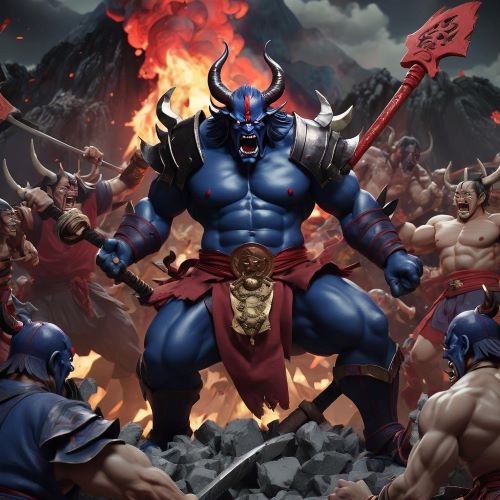


Jizō : The Japanese Guardian of Children, Travelers, and Souls
Listen
At a glance
| Description | |
|---|---|
| Origin | Japanese Mythology |
| Classification | Spirits |
| Family Members | N/A |
| Region | Japan |
| Associated With | Children, Travellers, Souls |
Jizo
Introduction
Jizō, commonly known as Jizō Bosatsu, holds a uniquely intimate place within Japanese Buddhism. Unlike distant cosmic Buddhas or majestic bodhisattvas enthroned in temples, Jizō is encountered at ground level—standing quietly along roadsides, at village crossings, near graveyards, and beside mountain paths. His origins trace back to the Indian Mahayana bodhisattva Kṣitigarbha, whose name means “Earth Treasury,” a being who stores compassion as deeply and patiently as the soil itself. When this figure entered Japan around the eighth century, he gradually transformed into one of the most approachable and emotionally resonant protectors in the Buddhist world.
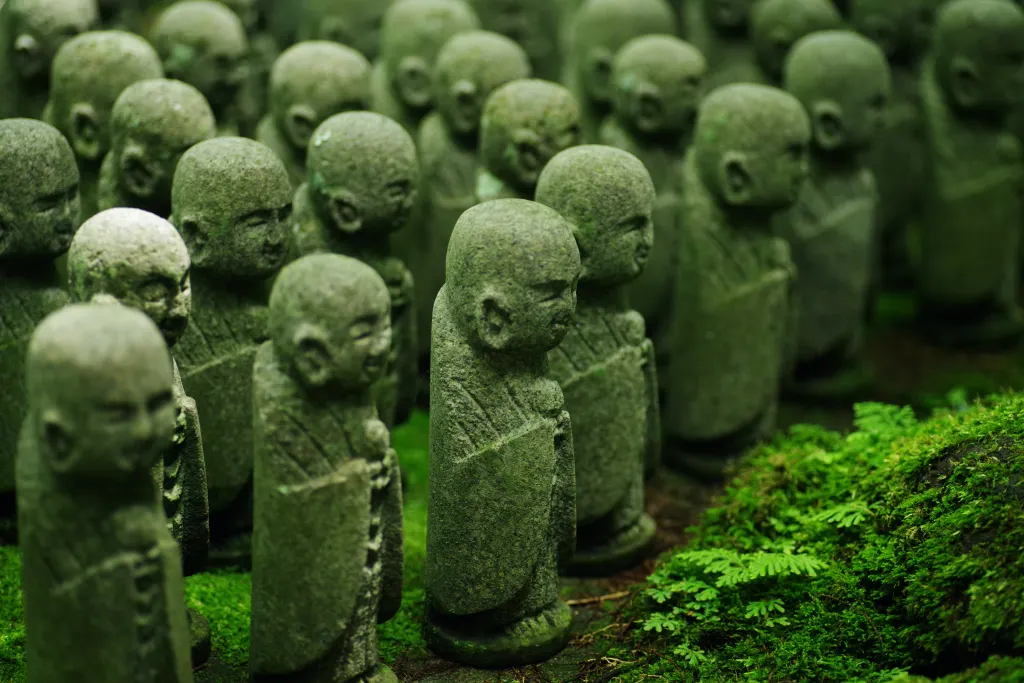
Jizō is revered as the guardian of those who exist in vulnerable states: children, travelers, pregnant women, and souls navigating the uncertain passage between death and rebirth. Over centuries, his role expanded beyond doctrine into folklore, ritual, and daily life. The countless stone statues dressed in red bibs and woolen caps are not mere symbols but acts of devotion—physical expressions of grief, hope, apology, and prayer. Jizō’s popularity endures because he does not judge or command; instead, he waits, listens, and guides, embodying compassion that feels profoundly human.
Physical Traits
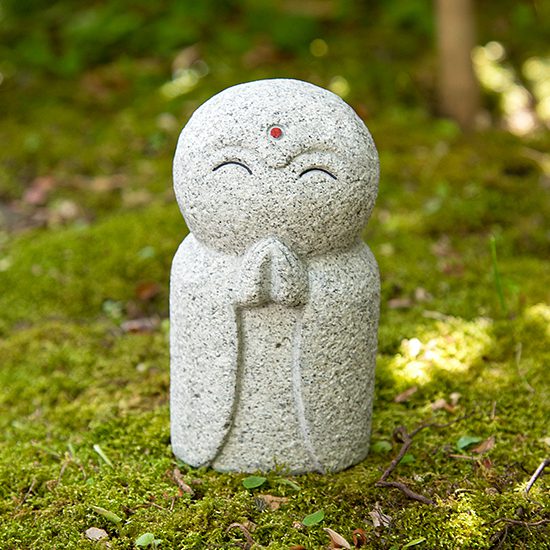
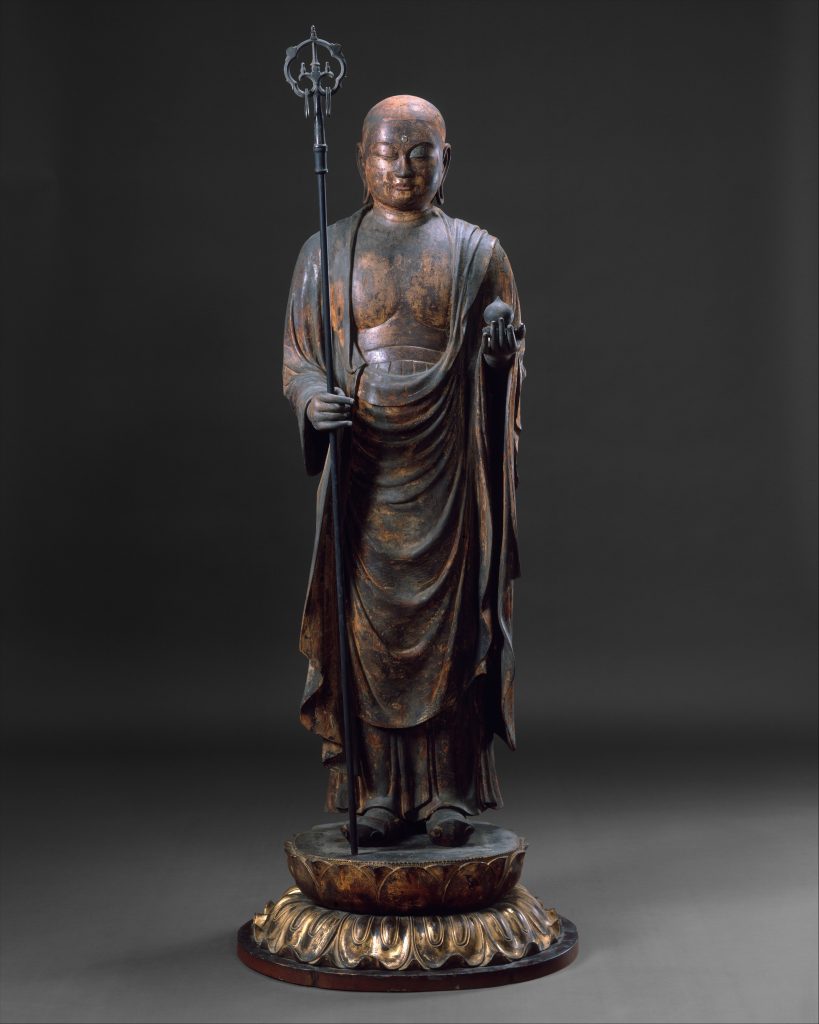
Jizō’s visual form reinforces his accessibility. He is depicted not as a regal celestial being but as a humble Buddhist monk. His shaved head, youthful face, and simple robes communicate renunciation and humility, distancing him from worldly power while drawing him closer to ordinary people. His calm expression often carries a faint smile, suggesting reassurance rather than authority.
Almost every depiction of Jizō includes two ritual objects. The first is the shakujo, a monk’s staff topped with metal rings that jingle softly when moved. These rings symbolize Jizō’s vow to travel through the six realms of existence, alerting suffering beings to his presence. The second is the wish-fulfilling jewel, or mani, representing spiritual illumination that dispels ignorance and despair. Together, these objects define Jizō’s role as both guide and liberator.
The red bibs, hats, and scarves placed on statues are later folk additions rather than canonical features. Red is traditionally believed to ward off illness and malevolent spirits in Japan. Parents who have lost children often clothe Jizō statues as a symbolic act of care, entrusting him with the protection they could not provide in life.
Family
Jizō does not possess a family lineage in the mythological sense. As a bodhisattva, he has renounced worldly attachments in order to serve all beings without distinction. His relationships are therefore spiritual rather than genealogical, defined by shared vows rather than bloodlines.
Within Buddhist cosmology, Jizō often appears alongside other compassionate figures, particularly Kannon, the bodhisattva of mercy. While Kannon responds to cries of suffering in the present world, Jizō is believed to work patiently in darker, liminal spaces—hell realms, graveyards, and transitional states after death. Together, they form complementary expressions of compassion.
In popular belief, Jizō assumes a parental role for lost children. He becomes a surrogate guardian, sheltering souls who died before forming karmic ties through family life. This symbolic parenthood is central to his emotional significance in Japanese culture.
Other names
The name Jizō is the Japanese reading of the Chinese Dizang, itself a translation of the Sanskrit Kṣitigarbha. Across Asia, variations of his name preserve the meaning “Earth Treasury” or “Earth Womb,” emphasizing patience, stability, and boundless compassion. In Korea, he is known as Jijang; in Tibet, as Sa-e Nyingpo.
In Japan, honorific and functional titles reflect localized devotion. Jizō Bosatsu is the formal religious name, while Ojizō-sama is an affectionate term used by laypeople. Specific manifestations emphasize particular roles, such as Mizuko Jizō, associated with deceased infants, or Koyasu Jizō, invoked for safe childbirth. These names do not indicate separate deities but different relational aspects of the same compassionate presence.
Powers and Abilities
Jizō’s power does not manifest through force but through vow. According to Buddhist tradition, he has sworn not to attain Buddhahood until all hell realms are emptied, choosing perpetual service over personal liberation. This makes him a uniquely self-sacrificing figure within Mahayana Buddhism.
He is believed to traverse all six realms of existence, offering guidance to beings trapped by ignorance or karmic suffering. In Japanese folklore, Jizō famously rescues children at the banks of the Sanzu River, where young souls are said to stack stones in penance for dying before their parents. Jizō hides them within his robes, protecting them from demons and easing their passage forward.
For the living, Jizō functions as a guardian of journeys. His roadside statues mark places of safety, watching over travelers, pilgrims, and merchants. He is also invoked to ease grief, shorten suffering in the afterlife, and provide spiritual reassurance during moments of uncertainty. Rather than erasing karma, Jizō is believed to soften its weight through compassion.
Modern Day Influence
Despite modernization and declining formal religious observance, Jizō remains deeply embedded in contemporary Japanese life. His statues continue to appear in cities, rural villages, apartment courtyards, and disaster memorials. After events such as the 2011 Tōhoku earthquake and tsunami, Jizō figures became focal points for mourning and remembrance, symbolizing quiet endurance amid loss.
Rituals like mizuko kuyō, memorial services for miscarried or aborted children, remain emotionally significant, with Jizō serving as a nonjudgmental witness to grief. Annual festivals such as Jizō-bon celebrate children, blending Buddhist prayer with communal joy.
In popular culture, Jizō appears in anime, manga, and literature as a gentle supernatural presence—often silent, watchful, and protective. His image has transcended religion to become a cultural symbol of compassion without condition, reminding modern society of care for the overlooked and the vulnerable.
Related Images




Source
Bays, J. C. (2001). Jizo Bodhisattva: Modern healing & traditional Buddhist practice. Tuttle Publishing.
Glassman, H. (2012). The face of Jizo: Image and cult in medieval Japanese Buddhism. Princeton University Press.
Nagano Experience. (2022, April 2). Jizo: Japan’s beloved guardian bodhisattva. https://naganoexp.com/activities-and-spots/jizo-japans-beloved-guardian-bodhisattva
Onmark Productions. (2012, July 31). Jizo Bodhisattva (Bosatsu), Ksitigarbha, savior from torments of hell. https://www.onmarkproductions.com/html/jizo1.shtml
Parac, I. (n.d.). Bodhisattva Jizo and folk religious influences. Asian Studies, 1(2), 17-32. https://journals.uni-lj.si/as/article/download/4180/5944/0
Wikipedia. (2003, September 4). Kṣitigarbha. https://en.wikipedia.org/wiki/K%E1%B9%A3itigarbha
Centre of Excellence. (2025, July 1). Jizo in Japanese mythology: Myths, symbols & powers. https://www.centreofexcellence.com/jizo-in-japanese-mythology/
Faure, B. (2016). Protectors and Predators: Gods of Medieval Japan. University of Hawai‘i Press.
Glassman, H. (2012). The Face of Jizō: Bodhisattva of Compassion in Japanese Buddhism. University of Hawai‘i Press.
Childs, M. D. (2017). Buddhist Statues and Rituals in Japan. Routledge.
Reader, I. (1991). Religion in Contemporary Japan. University of Hawai‘i Press.
Tanabe, W. J. (2004). Buddhist Guardians and the Afterlife in Japan. Journal of Asian Studies, 63(2), 389–412
Frequently Asked Questions
Who is Jizō in Japanese Buddhism?
Jizō is a bodhisattva revered as the protector of children, travelers, and souls in transition, known for guiding beings through suffering with compassion.
Why are Jizō statues dressed in red bibs and hats?
Red offerings symbolize protection and are placed by devotees, especially grieving parents, as prayers for lost or unborn children.
Is Jizō the same as Kṣitigarbha?
Yes, Jizō is the Japanese form of the Indian bodhisattva Kṣitigarbha, adapted through Chinese and East Asian Buddhist traditions.
What is Jizō’s role in the afterlife?
Jizō guides souls through hell realms and liminal states, easing suffering and helping them progress toward rebirth or enlightenment.
Why is Jizō so popular in Japan today?
His gentle, nonjudgmental compassion resonates across religious and secular life, making him a lasting symbol of protection and hope.